
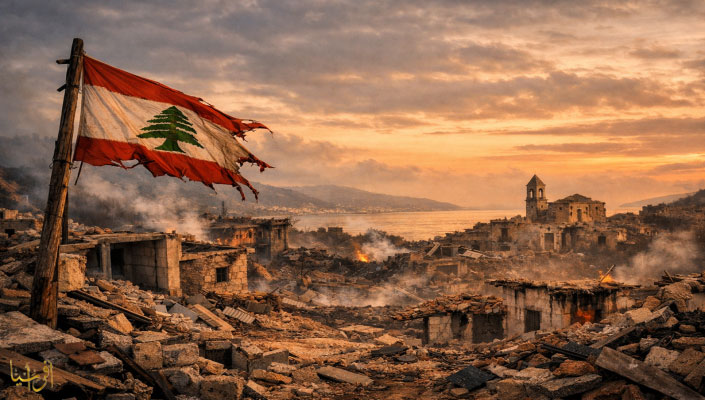
Afrasianet - Laila Nicola - The widespread destruction of villages, the prevention of the return of the population, and the statements calling for their permanent expulsion... All of these are indications and evidence that Israel's intention goes beyond mere control for the purpose of security and reaches the targeting of the human community itself.
Israel's destruction of border villages in southern Lebanon, the razing of their residential neighborhoods, the erasure of their urban features, and the targeting of the social structure that forms the basis of their residents' existence cannot be viewed in isolation from the international legal framework governing armed conflicts.
International humanitarian law is not limited to protecting the lives of civilians during conflicts, but also extends to protecting their property, ensuring their survival in their territory, and preserving the social and cultural ties that make up their collective identity.
Buildings are not viewed as stones, but rather as the physical framework that allows a human group to continue to live and maintain its social, cultural and historical ties. Article 53 of the Fourth Geneva Convention prohibits the destruction of private or public property in territory under military control, except when military necessity absolutely necessitates it.
Article 8 of the Rome Statute of the International Criminal Court also considers that the widespread destruction and seizure of property without military necessity can constitute a war crime that warrants individual criminal responsibility. Article 7 of the same Statute provides that the forcible displacement or widespread or systematic persecution of populations may constitute crimes against humanity.
In southern Lebanon, what Israel is doing is no longer just destroying buildings, facilities, and infrastructure, but has turned into a systematic policy based on removing entire villages from their actual existence, preventing their residents from returning to them, and changing the demographic and geographical reality of an entire region.
Israeli Defense Minister Yisrael Katz says that hundreds of thousands of Shia residents in southern Lebanon will not return to the south, which means that the category of religious groups protected under article 2 of the Convention on the Prevention and Punishment of Genocide will be included.
He also spoke of the destruction of border villages in accordance with similar models to what happened in Rafah and Beit Hanoun in the Gaza Strip. Other Israeli statements were also issued confirming the prevention of the return of the residents and the deliberate intention to completely demolish houses and villages near the border.
International jurisprudence, including the jurisprudence of the International Criminal Court (ICC) and the International Criminal Tribunals for the Former Yugoslavia and Rwanda, attaches particular importance to public statements by officials and has considered in a number of its judgments that public statements by officials may constitute relevant evidence when invoking criminal intent.
Thus, when large-scale destructions are accompanied by explicit declarations of preventing a specific population from returning to their areas or removing their presence there, these statements become part of the evidence on which to understand the true purpose of the policy and to determine its legal nature.
Legally, large-scale forced displacement, prevention of return, destruction of civilian property and removal of the elements of life of a particular group may amount to war crimes and crimes against humanity if they are found to be committed broadly or systematically against the civilian population.
Article 6 of the Rome Statute and the Convention on the Prevention and Punishment of the Crime of Genocide require the existence of a dolus specialis, i.e., the existence of an intention to destroy a national, ethnic, racial or religious group, in whole or in part, as such.
By examining Israel's actions in southern Lebanon, it is possible to observe the interdependence of three basic elements:
· First, the widespread destruction of villages and civilian housing structure.
· Second, public statements about the non-return of the Shia population to their areas and the comprehensive destruction of villages.
· Thirdly, the geographical space that constitutes the center of the historical and social presence of this group in southern Lebanon.
Taken together, Israeli policy can be seen as going beyond the stated security objectives to the physical and social foundations of the existence of a specific population group in a given area.
Hence, the widespread destruction of villages, the prevention of the population from returning, and the political or military statements calling for their permanent expulsion... All of these are indications and evidence that Israel's intention goes beyond mere control for the purpose of security and reaches the targeting of the human community itself.
Therefore, it can be said, from a legal perspective, that the bulldozing, eradication of the southern villages and preventing their residents from returning to them, coupled with official Israeli statements directly addressing the residents concerned with the expulsion, clearly raises the suspicion of war crimes and crimes against humanity, and gives serious legal indications that require an independent and comprehensive investigation into the possible existence of the elements of the crime of genocide, which in turn requires the Lebanese state to withdraw from Article 13 of the Framework Agreement.
________________
Laila Nicola - Professor of International Relations at the Lebanese University.
________________
