
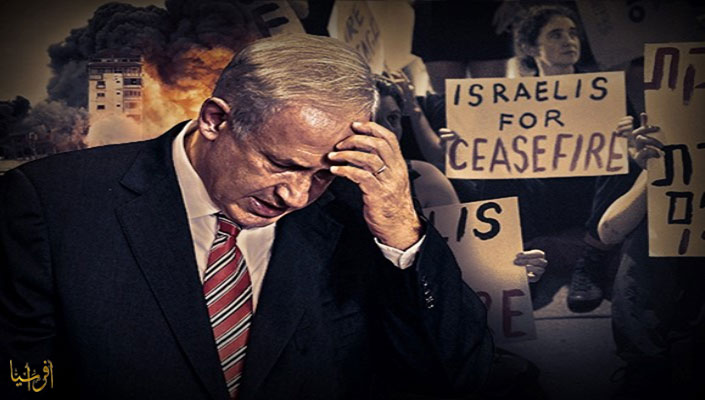
Will the Netanyahu government escape the strategic impasse by fleeing forward and returning to the intensified war? Or will it return to politics, seek compromises and cooperate with more realistic initiatives for the day after the war?
Afrasianet - Wissam Abu Shamala - All levels within Israel agree that the war that broke out about a thousand days ago has not been resolved on all fronts, in Gaza, Lebanon and Iran, and despite the enormous military power that Israel used with the support and full partnership of the United States, it did not achieve victory and did not lead to the subjugation of the resistance, and Israel entered a long and exhausting battle of attrition, which was reflected in its social and political cohesion, and the chances of the government coalition in the upcoming elections declined, as well as the decline of Israel's international standing, and even its relations Its influence and popularity within official American institutions is declining, and trust between Netanyahu and Trump is no longer what it was after the latter assumed the presidency.
After more than a thousand days of war, the Netanyahu government has not made strategic gains, nor has its military superiority and close alliance with the United States translated into political gains or a military decisiveness, which has kept all fronts open, with Israel standing in front of it in a very complex political-security scene. Or will it return to politics, seek compromises and cooperate with more realistic initiatives for the day after the war?
In the Gaza Strip, it does not seem that Israeli goals can be achieved at the negotiating table after they have been aborted on the battlefield, the political horizon on the Gaza dilemma does not seem to be imminent, and in Lebanon, a military confrontation has not been closed, and the door is always open for its renewal, and the Israeli-American war on Iran has not been extinguished by the ceasefire agreement and its political results have not yet become clear.
At the internal Israeli level, the army is exhausted, exhausted, and divided, in everything and everything, from the struggle over the formation of a commission of inquiry into the failure of October 7, to the disagreements over the conscription law as the election approaches, which has translated into a sharp bleeding in the confidence of Israeli society in all its institutions, from the prime minister to the "head of state"The army, the police, the judiciary, and others, which exceeded in its intensity the state and the judiciary before the Al-Aqsa flood battle, and in contrast to all this, the rhetoric of the government coalition and its president, Netanyahu, continues to focus on unprecedented achievements, but they need to be completed.
Hence, Netanyahu is still betting on returning to the war under the pretext of completing the mission, achieving absolute victory, and subjugating the "enemy" after its destruction, which will qualify him to win more seats that he lost due to indecisiveness and the absence of victory on the frontlines. He hinted at the need to convince the United States not to move to the reconstruction phase before returning to a high-intensity war, because without military control over the entire territory of Gaza and over the population, it will not be possible to achieve the first goal of the war, which is to dismantle the resistance and end the work on the ground from which it all began.
If Netanyahu and his colleagues are talking about war without end, under the pretexts of decisiveness and absolute victory, with the aim of winning the next elections, regardless of the internal and external strategic dilemmas that Israel faces due to its closing the door to diplomacy and its rejection of settlement paths, the levels of thinking within a number of Israeli think tanks and various circles have come to see the existing political impasse as a strategic dilemma from which Israel must emerge through the gate of politics and not beat the drums of war.
A number of Israeli researchers and analysts believe that the management of the current Israeli crisis is governed by Netanyahu's short-term tactical policies, which are mainly related to his chances of winning the elections, and he is not interested in building regional tracks in which Israel will enjoy political and economic advantages, especially in terms of expanding the Abraham Accords, provided that the Israeli government agrees to end the war on all fronts, withdraw from the territories it occupied, and start comprehensive regional political tracks, which serve Israel It achieved the most through wars.
At this stage, Netanyahu will not listen to anyone talk to him about ways out of the current crisis, and to shift from a state of military and political stalemate to the stage of dismantling the crisis and creating strategic action paths in the long term.
Netanyahu's options until the Israeli elections next October will not go beyond seeking to escalate the field and military position on various fronts, and he will use all his tools, skills and intelligence at his disposal to persuade US President Donald Trump in his next meeting with him at the White House, to repudiate the agreement with Iran after accusations that it did not abide by it, seek to assassinate him, and push him to resume the intensive war on Iran with the aim of toppling the regime, and giving it the green light to expand the scope of aggression on Lebanon, including Dahiya If Trump adheres to the diplomatic track with Iran along with disciplined military pressure, Netanyahu will intensify his pressure on Trump to give him cover to resume the intensive war on Gaza, under the pretext of Palestinian disarmament and subjugation of the resistance.
________________
