
History was not only a record of the development of civilizations, but also of the development of the means of conflict, until it became clear that technology is not just a product of civilization, but is often the factor that determines its fate.
Afrasianet - Dalal Musa - Technological development is no longer a scientific event that has an impact on laboratories or factories, but has become the hidden force that is reshaping the world order and redefining concepts of power, sovereignty and conflict.
Ever since man discovered fire, every technological advance has opened a new door to life, but at the same time it has opened another door to war.
Thus, history has been not only a record of the development of civilizations, but also of the development of the means of conflict, until it has become clear that technology is not merely a product of civilization, but is often the factor that determines its fate.
Knowledge is the most effective weapon
Humanity has moved from an era in which wars were decided by muscle strength and a large number of fighters, to an era in which knowledge has become the most effective weapon.
The Industrial Revolution changed the balance of power with the production of cannons, gunpowder, and warships, and then the twentieth century saw the emergence of airplanes, tanks, and nuclear weapons, and today the world is entering a more complex phase, where data, algorithms, and cyberspace have become essential elements of the power equation.
Control of territory alone is no longer enough, because control of information can give a country the ability to cripple its adversaries without firing a single shot.
Artificial Intelligence is the Peak of Technological Development
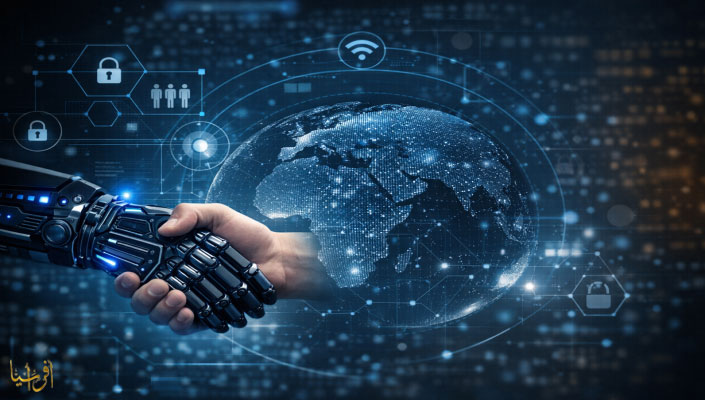
In this context, artificial intelligence is the pinnacle of technological development, because it is no longer just a tool by which humans carry out their orders, but has become a partner in the production of the decision itself, capable of learning, analyzing patterns, predicting probabilities, and processing billions of data in an almost instantaneous time.
This transformation means not only a technological development, but also a transition in the concept of power from the possession of weapons to the possession of the mind that manages the weapon.
In modern warfare, superiority has become measured by the ability of algorithms to anticipate the adversary's movements, penetrate its systems, analyze its weaknesses, direct weapons with extreme precision, and even influence the consciousness of its society through the information industry and the direction of public opinion.
Thus, the battle is fought in the digital space before it begins on Earth, and the "victory" is more dependent on who has the data than the ammunition.
Deep problematic
However, this shift opens the door to a deep philosophical and ethical problem: the more humans rely on artificial intelligence to make fateful decisions, the less space for human responsibility, and the more legitimate it is to ask: can an algorithm turn into an authority beyond the will of its creator?
Will man remain the master of technology, or will he find himself subject to its cold logic that calculates efficiency and losses in the language of numbers, transcending moral and humanitarian considerations?
Changing the nature of the confrontation
The impact of technology is not limited to the development of combat tools, but also extends to changing the nature of war itself. Cyberattacks have become able to disrupt power plants, airports, banks, and telecommunications networks, and disinformation and the dissemination of fake news have become part of military strategies, because controlling people's consciousness may be more effective than controlling their territory.
Hence, the war is no longer just a confrontation between two armies, but has turned into an economic, media, digital, and psychological conflict, in which technology and politics, economics, and culture intersect in a single system.
A striking paradox
However, technological development imposes a striking paradox: the more man is able to control nature, the more he can threaten his existence.
The mind that invented vaccines and medical devices and saved millions of lives is the same mind that invented nuclear weapons, drones, and autonomous combat systems.
Technology reflects the ethics of those who use it
This reveals that technology does not have its own moral system, but rather reflects the morality of those who use it. It is a tool for construction when it is directed at the service of man, and a tool for destruction when it becomes a means of domination and subjugation of peoples.
Hence, the future of wars will not be determined only by the size of military arsenals, but also by the ability of countries to produce knowledge, invest in scientific research, and possess advanced technologies. Universities, research centers, and technology companies will become parallel arenas to the battlefields, because those who produce knowledge have the ability to shape the future and impose the balance of power.
The real question does not seem to be how far technology will evolve, but how far humans will be able to evolve morally in parallel with it.
History shows that knowledge advances faster than wisdom, and that man's ability to innovate often precedes his ability to control the results of his innovations.
The battle is fought first in the digital space
Thus, history has been not only a record of the development of civilizations, but also of the development of the means of conflict, so that it has become clear that technology is not merely a product of civilization, but is often the factor that determines its destiny.
Thus, the battle is fought in the digital space before it begins on Earth, and victory is more about who has the data than the ammunition.
However, this shift opens the door to a deep philosophical and ethical problem: the more humans rely on artificial intelligence to make fateful decisions, the less space human responsibility becomes, and the more legitimate it is to ask: can an algorithm become an authority beyond the will of its creator?
Will man remain the master of technology, or will he find himself subject to its "cold logic" that calculates efficiency and losses in the language of numbers, transcending moral and humanitarian considerations?
The impact of technology is not limited to the development of combat tools, but also extends to changing the nature of war itself.
Cyberattacks have become able to disrupt power plants, airports, banks, and telecommunications networks, and disinformation and the dissemination of fake news have become part of military strategies, because controlling people's consciousness may be more effective than controlling their territory.
Hence, the war is no longer just a confrontation between two armies, but has turned into an economic, media, digital, and psychological conflict, in which technology and politics, economics, and culture intersect in a single system.
________________
