
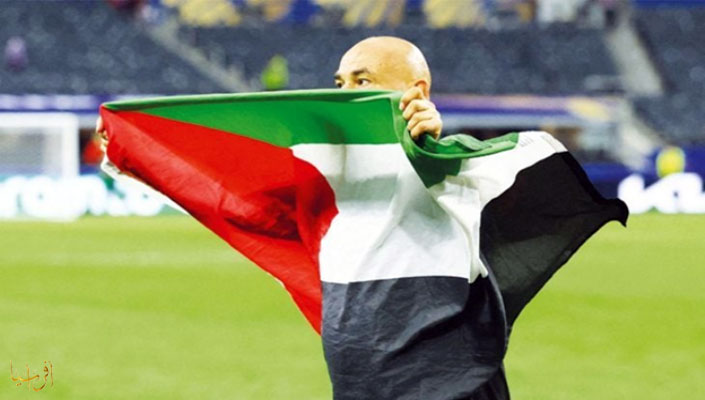
While the fans of the Stands Cup turned into a platform of solidarity with Palestine: The Synod of the Church of England approves a memorandum of solidarity in support of the Palestinians.. and the coordinator of Kairos Palestine: a historic step
Afrasianet - Saeed Abu Mualla and Raed Salha - The General Assembly of the Church of England, by an overwhelming majority, to express its solidarity with Palestinian Christians and the general Palestinian public, and to react to the Kairos Palestine 2 declarations, brought doubly joy and support for the Palestinian cause after years of controversy. Palestinians and Christian leaders say it is "historic" to strengthen solidarity with the Palestinians, after its governing body voted in favor of listening to the voices of Palestinian Christians and interacting with a series of Kairos Palestine 2 announcements.
The General Synod approved an amended memorandum by a vote of 253 to 47, in which members committed to "stand in solidarity" with Palestinian Christians and the rest of the Palestinian people, and encourages dioceses and churches to engage with the Kairos Palestine declarations as part of a broader effort to understand the lived experiences of Palestinian Christians.
The memorandum commits the Church to interfaith dialogue, calls for the adoption of responsible investment policies in light of the July 2024 Advisory Opinion of the International Court of Justice on the illegality of Israel's occupation of the Palestinian territories, and urges the British government to work towards a just and lasting peace. In the Bishops' Council, 25 bishops voted in favor of the proposal, five abstained, and no bishops voted against it. In the Council of Clergy, 115 members voted in favor of the proposal, 20 against it, and 30 abstained.
In the Council of Secularists, 113 members voted in favor of the proposal, 27 against it, while 35 abstained, a result that Palestinian pastor Fadi Diab, who participated in the synod's discussions in Britain, in an exclusive interview with Al-Quds Al-Arabi, sees as a sign of the shift in ecclesiastical positions on the Palestinian issue.
The document discussed by the synod, titled "The Moment of Truth: Faith in the Time of Genocide," was first published in November 2025. It is a theological and political appeal issued by Palestinian Christians, calling on Christians around the world to stand in solidarity with the Palestinians and to exert pressure on governments and global civil society to isolate, boycott, divest and impose sanctions on Israel.
Colonial entity
The document describes Israel as an "exclusionary-colonial settler entity" and calls on churches around the world to clearly distinguish between dialogue with Jews and dialogue with Zionism, which made the decision to adopt the document a joyous result, after a long and painstaking effort by many Palestinian churches.
For his part, the special coordinator of the "Kairos Palestine 2" document, Rifaat Kassis, said in an exclusive interview with Al-Quds Al-Arabi that the decision of the General Assembly of the Church of England "constitutes a very important historical step, not only because The new resolution moves the document from being a Palestinian initiative to a reference that discusses theology and institutionalization within the global churches, opening the door to a broader dialogue on the moral responsibility of the churches in the face of occupation, settlement, apartheid and genocide.
In a press release, the authors of the document described the decision as a courageous step in the march to listen to the voice of Palestinian Christians, who have been bearing the burdens of Israeli occupation, settlement, apartheid, systematic violence and displacement for decades, and are facing increasing challenges that threaten the continuation of their historic presence and authentic Christian presence in the Holy Land.
He added that the resolution also reflects the great efforts made by the "Sabeel Kairos Palestine" initiative and its partners in the United Kingdom, who have worked sincerely and responsibly to build bridges of understanding, and to promote awareness of the reality of the reality that the people of the Holy Land are living, based on the belief that honest dialogue and living testimony are the path to justice and peace.
The resolution emphasizes that true peace cannot be built on ignoring the suffering of peoples or silencing the voices of those who suffer, but on acknowledging the truth.
The Committee pointed out that the decision of the General Assembly came after the visit of the General Assembly The Archbishop of Canterbury, Sarah Mullally, traveled to Palestine a few weeks ago, during which she met with a number of Palestinian religious and political figures, and listened to the reality of Christian churches and communities in the occupied Palestinian territory.
The committee stressed that this decision reflects the growing awareness within the global churches of the reality of the situation in Palestine, and the importance of listening to the voice of the Palestinian churches, and their role in defending justice and human dignity, and consolidating the values of peace based on truth and equity, in line with the principles of international law and Christian values.
The Church of England's vote follows a similar step taken by the Presbyterian Church in the United States, the largest Presbyterian denomination in the country, as its General Assembly last month approved the "Kairos Palestine 2" document, acknowledging that the war The document was prepared by Kairos Palestine, a Palestinian Christian movement that renewed its activity after the genocide war on Gaza, and calls on Christians around the world to stand in solidarity with Palestinian Christians and urges churches to pressure governments "to isolate Israel, hold it accountable, impose sanctions on it, boycott it, and ban arms exports until it abides by international law and ends repression Since its issuance in 2009.
The Kairos Palestine document is a cry of faith and hope launched by Palestinian Christians from the heart of their suffering, and it is an evangelical and moral call to churches around the world to stand on the side of truth and justice, and to work for a just peace that preserves the dignity of all human beings, and has never been a call to hatred or exclusion, but a call to love, justice and reconciliation based on truth In Gaza, it's genocide.
Cup fans turn the stands into a platform of solidarity with Palestine:
In this context, this year's FIFA World Cup has become a prominent arena for expressing solidarity with the Palestinian cause, despite the Palestinian team's non-participation in the competitions, and in light of what observers describe as increasing campaigns of restriction on protests and expressions of solidarity with Palestine in a number of countries.
In an article published by Foreign Policy In Focus on July 14, 2026, American writer David Fine believes that the tournament's support for the Palestinians represents one of the most inspiring scenes in the history of the tournament, especially since it came at a time when the war in the Gaza Strip is still casting a shadow on global public opinion.
Fans, players and coaches from several countries, including Egypt, Scotland, Brazil, South Korea, Morocco, Mexico, Turkey, Norway, Senegal, Bosnia and Herzegovina, Algeria and Spain, and perhaps all 48 participating teams, have publicly expressed their support for the Palestinians, affirming their right to life, freedom and return.
According to the article, the expressions of solidarity were not limited to the fans, but extended to the stadiums themselves, where Palestinian flags were raised in the stands, and were carried by players and coaches during the matches. Chants of "Free Palestine" also resounded inside the stadiums and in the surrounding streets, while thousands of fans attended wearing the Palestinian national team's shirts.
Followers also held banners that read "Expel Israel from FIFA" and "Red card for Israel", referring to FIFA's demand for action against Israel, inspired by the red card, which means the player should be expelled from the match and banned from continuing to play due to a serious violation.
Fine believes the scene is all the more important because it came during a tournament that, like previous tournaments, has not been spared accusations of corruption. In this context, he points out that US President Donald Trump intervened, according to the article, with the president of the International Football Federation in order to cancel the red card penalty that an American player was subjected to so that he could participate with his country's national team, which later lost a match that the writer described as one-sided.
The article also talks about FIFA President Trump's awarding of a symbolic "peace prize" shortly before the United States joined Israel in the war on Iran, a war that the author describes as illegal and historically unpopular.
Fine stresses that raising Palestinian flags or chanting slogans inside stadiums does not alone, change the reality on the ground, but he points out that the days of the tournament itself witnessed the continuation of Israeli military operations in the Gaza Strip, which he says resulted in the death of dozens of Palestinians, in light of the continued US military support for Israel.
An example of this is the martyrdom of Mohamed al-Wahidi, a representative of an Egyptian humanitarian organization operating in Gaza, along with two children and another person, before a match between Argentina and Egypt, on the same day that he was organizing an event to watch the match in Gaza City. Wahidi is one of more than 1,000 Palestinians, including hundreds of women and children, who have reportedly been killed by the Israeli army since the official ceasefire was declared last year.
Palestinian journalist Dina Al-Kurd is quoted as saying that sports tournaments alone cannot end the suffering of Palestinians, explaining that Palestinian families will not regain their homes because people raised a flag in a stadium, but she believes that popular movements are formed over time, through moments of public appearance, the accumulation of pressure, and the insistence on keeping the issue present in the global consciousness and not allowing it to disappear.
The writer stops at the position of the Egyptian national team coach Hossam Hassan, whom he describes as one of the most daring sports figures and continues to express his solidarity with the Palestinians. At a press conference, Hassan said that before he was an Arab, a Muslim, a Christian or anything else, he was a human being, adding that he wanted to send a message through football as the world's greatest soft power to send a message calling for the Palestinian people to be let live, calling on athletes and journalists around the world to Help deliver this message.
Fine concludes by questioning whether this message deserves to be a topic of discussion in match-watching sessions, in cafes, and among family members during the World Cup finals and beyond, arguing that the tournament provided an opportunity to highlight the Palestinian cause in front of a wide global audience.
He will personally express his solidarity by wearing a T-shirt bearing the colors of Palestine, and using the aftermath of the tournament matches to raise funds for humanitarian relief in the Gaza Strip, considering that opening a debate about the ethics of continued U.S. military support for the Israeli government is a first step on a broader path.
Fine concludes his article by quoting the words of Palestinian journalist Dina al-Kurd, who said that she felt a kind of hope when she saw Palestinian flags flying in the stadiums of the World Cup, explaining that this hope is not represented in the expectation of a near or easy solution, but in the sense that the Palestinians are not alone, and that their cause is still present and has not been forgotten.
________________
