
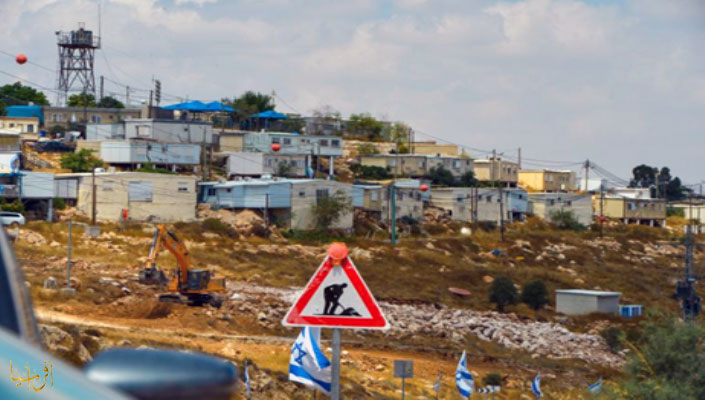
Afrasianet - Bashar Abu Zekri - Despite the escalating calls within the European Union for action against Israeli settlements in the occupied West Bank , the division within the bloc, led by German reservations, has so far prevented these calls from being turned into practical steps, keeping the settlement project away from deterrent measures, at a time when settler attacks against Palestinians continue.
The European Union failed to impose a ban on products from illegally established Israeli settlements after the bloc's foreign ministers failed to muster enough votes to push the European Commission to introduce specific action on the issue during their meeting in Brussels on Monday.
Legal pressures and political division
The European calls followed the 2024 advisory opinion of the International Court of Justice, which called on Israel to end its occupation of the Palestinian territories "as soon as possible" and considered Israel's settlement policies to be in violation of international law.
European countries, including Belgium, the Netherlands and Spain, have called for steps to limit trade with settlements, arguing that their continued dealings are contrary to international law, but these efforts have been met with the reservations of other countries, led by Germany, which oppose the imposition of economic measures or sanctions on Israel.
German Foreign Minister Johann Fadiful said his country would prefer to continue dialogue with the Israeli government, adding that any restrictions or bans on the import of settlement products must be unanimously agreed by member states, a condition that makes it difficult to pass such measures if Germany or other countries object.
Disagreement over sanctions
The EU has been at loggerheads for months over how to deal with Israel's settlement policy; while the bloc's countries agree that settlements are illegal under international law, they have been unable to agree on broad sanctions.
EU foreign policy chief Kaia Callas said the proposal to ban trade with settlements had the most support among member states, but did not get the majority needed to force the European Commission to put measures to a vote.
She added that the 27 countries agreed on the illegality of the settlements, but noted that current European policies have not succeeded in limiting trade with them due to weak enforcement mechanisms and the divergent positions of member states.
The European Commission, headed by Ursula von der Leyen, has resisted pressure to impose new trade restrictions on Israel, presenting only an "options sheet" that included possible measures, such as banning trade with settlements, imposing an import licensing system or targeted tariffs.
During the meeting, only 11 countries called for concrete measures, while eight countries opposed the trade ban, and others did not take a clear position, preventing the resolution from passing.
Disputes within the bloc have revealed a legal divide over the nature of the measure, with some countries seeing it as a commercial measure that can be approved by a qualified majority, while others see it as a political move that needs consensus.
Israel welcomes the failure of sanctions
Israeli Foreign Minister Gideon Sa'ar welcomed the failure to pass any European measures against Israel, saying the attempt to impose new sanctions did not receive enough support within the bloc.
Sa'ar said in a post on the "X" platform that Kaya Callas' attempt to impose sanctions on Israel "failed again," noting that there was no consensus or a qualified majority within the European Foreign Affairs Council.
He added that the referral of the file to the Committee of Permanent Representatives is aimed at keeping the issue under consideration, considering that relations between Israel and Europe must be based on "dialogue and fairness."
Europe lacks will
The European Union's positions have sparked a wave of criticism, as writer and political analyst Wissam Afifa believes that the problem lies not in Europe's inability to take action, but in the lack of political will in some capitals, especially Germany.
Support for banning the trade in settlement products is growing within the bloc, but Berlin refuses to punish the settlement enterprise itself, preferring only to hold some settlers involved in violence accountable.
He adds that settler violence is not an individual behavior, but rather the result of a settlement project supported by the Israeli government, and therefore the exemption of settlements from sanctions leaves the structure that produces such violence unaccountable.
It warns that continued European hesitation undermines the credibility of international law and sends the message that occupation and settlement can continue without political or economic cost.
For his part, international humanitarian law consultant Itai Epstein points out that the preoccupation of some European countries with their internal disputes coincides with Israel's continued expansion of its settlement project.
He explained that the Israeli government has approved the construction of thousands of new settlement units, in addition to allocating billions of shekels for infrastructure projects aimed at consolidating the Israeli presence in the occupied Palestinian territories.
Epstein stressed that international law obliges states not to recognize the legitimacy of the conditions resulting from grave violations and not to provide assistance in their continuation, considering that the ban on goods and services produced in settlements represents the minimum obligations required.
Reviewing the Relationship with Israel
Former Dutch diplomat Simone Filippini argues that European hesitancy is not seen in Israel as diplomacy, but as a signal that annexation and settlement policies will continue.
Dr. Alex Chalaby, a professor of international relations and the history of American foreign policy, also called for continued international pressure, considering that the repetition of political attempts may lead to a change in the attitude towards Israel.
Inside the European Parliament, the Progressive Alliance of Socialists and Democrats said the ongoing war in Gaza and the escalation of settler violence in the West Bank make the "business as usual" policy impossible.
The group called for decisive steps, including the suspension of the Association Agreement with Israel and a ban on trade with settlements, noting that a European review had revealed violations of the human rights clause in the agreement.
Former Swedish Prime Minister and Foreign Minister Carl Bildt also called on the EU to stick to its trade policy and ban trade in goods and services coming from illegal settlements.
Settlement Ban
Belgian human rights researcher Brigitte Hermans says that countries that fear restrictions on Israel confuse punishment with legal action.
It explains that the ban on trade with settlements is not a punishment against Israel, but rather a step to ensure that European trade policy is consistent with international law.
Rights activists believe that the absence of a unified European position gives settlers more room to continue expansion and attacks against Palestinians, while the European Union is content to emphasize the illegality of the settlements without translating this into practical measures.
________________
