

Afrasianet - Ahmad Maulana - When the Chinese Muslim sailor Zheng He sailed in the Indian Ocean in the early 15th century, China was one of the maritime powers of the ancient world. But those voyages were halted after the Ming dynasty adopted isolationism, halting its voyages across the Indian Ocean and even enacting "maritime ban" laws that prevented the Chinese from sailing abroad. For centuries, the Chinese empire was busy securing its vast land borders against the Mongols and tribes from the north, and began to build walls and fortifications Today it forms most of what is known as the Great Wall of China.
China also began to adapt to European naval expansion, which began with the Portuguese incursion into the Macau Peninsula in the mid-16th century (and would not abandon it until 1999). The Chinese Empire weakened further over the following centuries, until the ships of the British Empire appeared on the horizon in the mid-19th century, seized Hong Kong, and forced China to import opium.
"For centuries, the Chinese Empire has been preoccupied with securing its vast land borders, turning its back on the sea."
________________
Then began what is known as the "century of humiliation", which will not end until 1949, according to the Chinese official account, when the People's Republic of China was founded under Mao Zedong, after decolonization, the Communist Party extended its control over the country, and the nationalists went to the island of Taiwan, where they established a state of their own, which is still the most prominent knot in China's strategy and maritime ambitions.
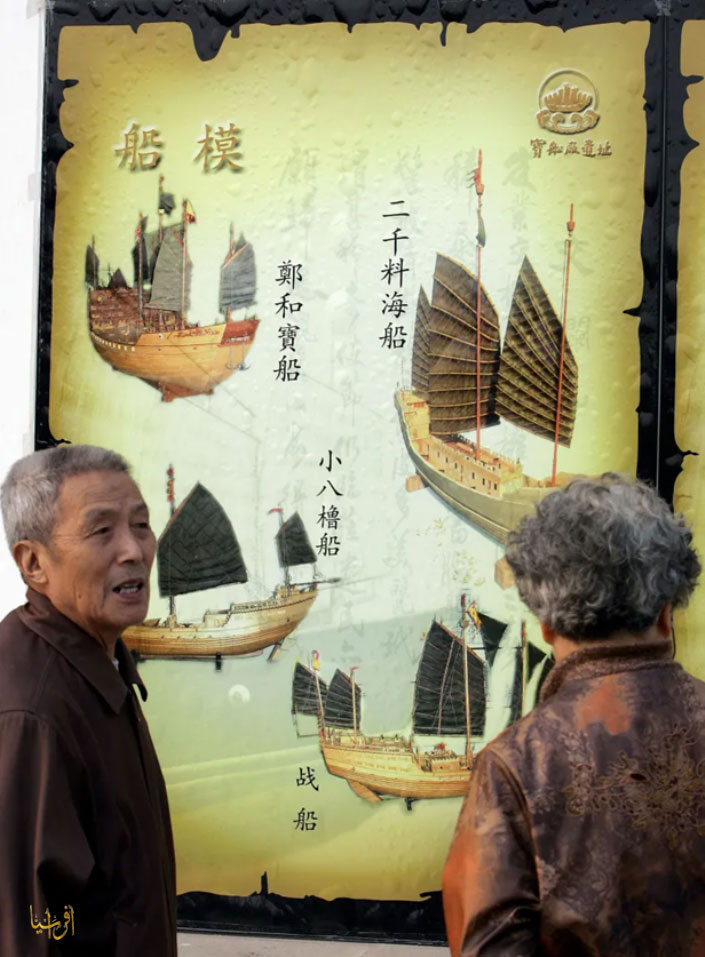
Chinese view drawings of various treasure ships by the famous Chinese navigator Zheng He
The Chinese navy has not fought a naval battle since its 1988 clash with Vietnamese ships over a dispute over Beijing's establishment of observation posts in the Ferry Cross reef, a battle in which the Vietnamese navy was defeated. Despite its practically limited naval role and confined to its geographical perimeter, China's growing naval capabilities since the mid-1990s have been closely watched in the United States.
The U.S. Congressional Research Service annually releases a renewed study on China's fleet modernization and its implications for the U.S. Navy's capabilities, while the U.S. Naval War College established the Institute of Chinese Naval Studies in 2006 to follow up on the evolution of Beijing's naval strategy and military capabilities. In contrast, interest in studying naval power and its role in the country's future is growing within China, raising questions about China's naval strategy and goals.
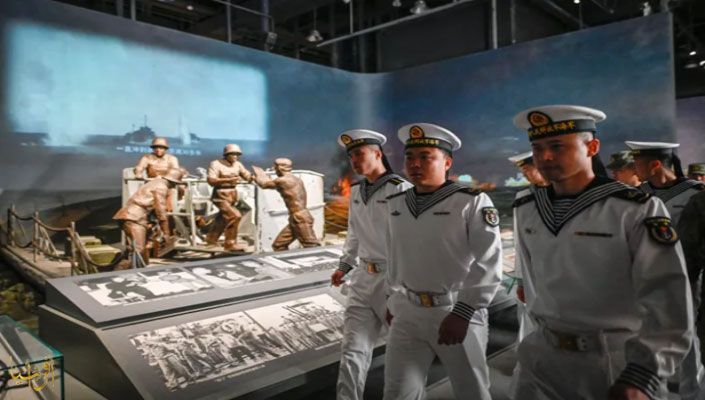
Chinese navy personnel during a tour of the People's Liberation Army Maritime Museum in 2024 (French)
Land or sea power?
The seas are one of the most important sources of wealth and power, as they provide a variety of resources, including oil, gas, fisheries, and minerals, and are the main artery of trade, through which the bulk of goods and raw materials are transported between continents. The oceans have provided European powers with the extension of their influence to Asia, Africa, and the Americas, and the imposition of navigational rules that meet their interests.
Countries vary in the level of their naval power according to the extent of their ability to operate off their coasts. Most countries in the world have coastal naval forces whose activity is limited to protecting territorial waters. There are regional naval powers that can operate in seas far from their coasts, such as Britain, France, and Russia. The highest level is global maritime dominance, which means the ability to deploy in various oceans and secure navigation in major sea lanes, a status that the United States has been in since the end of the Cold War.
For its part, China is located at the crossroads of the Eurasian Pacific, and geographically combines the characteristics of land power and naval power, but Chinese civilization was historically formed around agriculture and major rivers, where fertile lands and local resources provided a great deal of self-sufficiency, and there was no urgent need for maritime expansion or the search for foreign markets and resources, as happened with the European maritime powers.
This environment has produced a political and social mentality that tends to stabilize, conserve, and defend the existing vital sphere. Throughout its history, China has focused on protecting its land borders and confronting threats from the north and west, while the sea has remained secondary among its strategic priorities. The Great Wall of China was the clearest expression of this defensive mentality, and the spread of Confucian thought contributed to the consolidation of the values of stability and order and the avoidance of chaos.
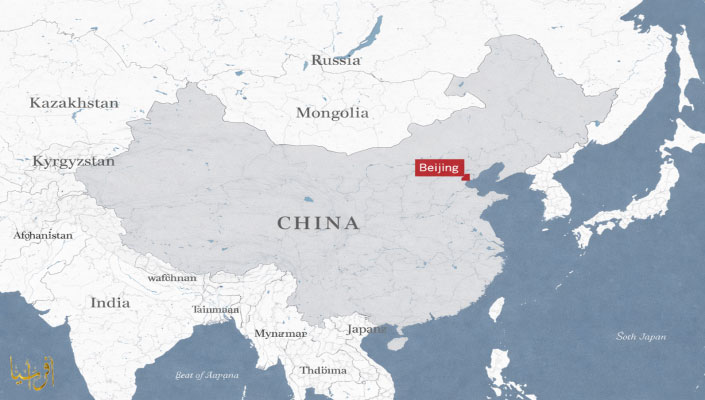
Located at the crossroads of the Eurasian and Pacific Oceans, China geographically combines the characteristics of land power and naval power
Although China experienced periods of maritime prosperity, especially during the Chenghe Voyages, China's maritime activities remained tied to limited commercial objectives, while the country continued to turn its attention to land challenges. As a result, China entered the modern era lacking the traditions, institutions, and maritime expertise that Western powers had accumulated through centuries of navigation and exploration.
"China has entered the modern era lacking the traditions, institutions and maritime expertise that Western powers have accumulated through centuries of navigation and exploration."
________________
Large segments of China's intellectual elite view this legacy as one of the causes of the "century of humiliation." By the 19th century, China found itself confronted with superior naval powers that had imposed their presence on China's coasts, from the Opium Wars with Britain to Japanese expansion in East Asia. Hence China's belated interest in the study of naval strategy, albeit for a long time confined to coastal defense and protection.
Chinese Naval Capabilities
China has about 3 million square kilometers of maritime areas under its jurisdiction, and a coastline that extends for more than 32,000 kilometers, including 14,000 kilometers of island coastline. It is surrounded by 4 main seas, namely the Bohai Sea, the Yellow Sea, the East China Sea, and the South China Sea. Its economic and security interests are also linked to the Western Pacific. However, this maritime area does not give China full freedom of movement, as it faces territorial disputes involving about 1.5 million square kilometers of maritime areas. It also encounters geographical constraints imposed by the "First Island Chain" as it is known in Chinese literature.
This chain, stretching from Japan to Taiwan and the Philippines to Indonesia, is one of China's most significant geopolitical challenges. China's long coastline opens up to a set of semi-closed seas that can be isolated or blocked during crises, prompting Beijing to seek access to the Pacific.
"China's long coastline opens up to a set of semi-enclosed seas that can be isolated or blocked during crises"
________________
Taiwan is thus important in Chinese strategic thinking, as it is located at the heart of the first island chain and its eastern coast is a natural gateway to the Pacific Ocean. Beijing views the Taiwan issue as much as it is about China's maritime future. Hu Bohu, a researcher at Peking University's Ocean Research Institute, emphasizes in his book "China's Naval Power in the Twenty-First Century" that no matter how advanced and powerful China's naval power is, if it fails to decide Taiwan's fate, any maritime ambitions will eventually become illusions.
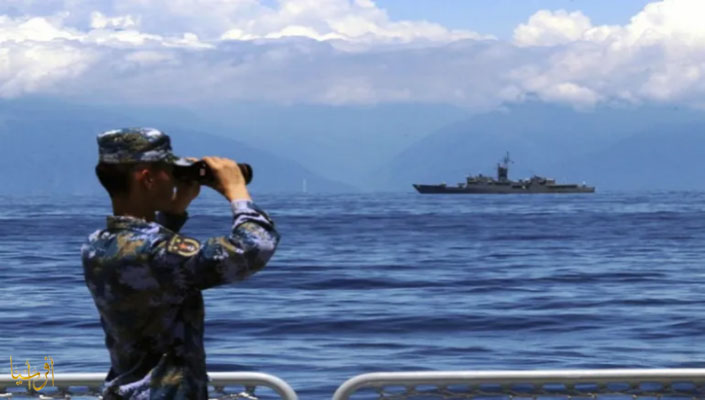
Beijing views the Taiwan issue as an issue related to China's maritime future as it is to China's territorial integrity (Associated Press)
The South China Sea is equally important, with an area of about 3.5 million square kilometers, and is one of the most important trade corridors, accommodating between a third and half of global shipping and maritime traffic, containing large reserves of energy and fisheries, and linking China to the Indian Ocean, the Middle East and Africa. Beijing therefore places sovereignty over disputed islands and coral reefs in the South China Sea, the security of sea lanes, and the protection of natural resources among its strategic priorities.
These considerations are all the more important as the heart of economic activity and geographic concentration is located in China's eastern coastal regions, so Beijing lacks the depth to protect its capabilities and assets. China is the largest trading partner of more than 120 countries, transporting more than 90 percent of its foreign trade by sea, and about 80 percent of China's oil imports pass through sea lanes stretching from the Persian Gulf and Africa to East Asia.
"China is the largest trading partner of more than 120 countries, moving more than 90 percent of its foreign trade and 80 percent of its oil imports by sea."
________________
This reliance has led to the emergence of what is known in Chinese literature as the "Malacca Dilemma", i.e., the fear that the United States in times of crisis will impose a blockade on China and close the Strait of Malacca to Chinese shipping, leading to a complete halt to its foreign trade and oil imports. For China, naval power has become part of the national security and economic development system.
Protecting shipping lanes, securing the flow of energy, and maintaining free access to global markets have all led Beijing to adopt a more ambitious maritime vision. The Belt and Road Initiative, which President Xi Jinping announced in 2013 during his visit to Indonesia, has gained significant importance. The Maritime Silk Road aims to create a network of ports, infrastructure, and economic ties stretching from the South China Sea to the Indian Ocean, the Middle East, Africa, and Europe, including It enhances China's trade security and reduces its dependence on a limited number of sea lanes.
Stages of the development of the Chinese navy
Chinese scholar Edward Sing Yu Chan points out in his book "China's Maritime Security Strategy" that building a major naval force takes much longer than building land and air forces, as the saying goes: "Contracts for land forces, centuries for naval forces." So when the U.S. Navy began to develop its capabilities at the end of the 19th century, it was only in the 1920s that it was able to enter the naval power club, taking advantage of the First World War, which destroyed Germany's capabilities and part of Britain's.
When the People's Republic of China was founded in 1949, the priority of the communist leadership was to establish control over mainland China and secure the continental border. The navy was therefore established as a support force tasked with protecting the coasts and preventing any hostile landings. Their capabilities were limited to patrol boats, torpedoes and small ships capable of operating close to shore, while ground forces captured the largest share of resources and attention.
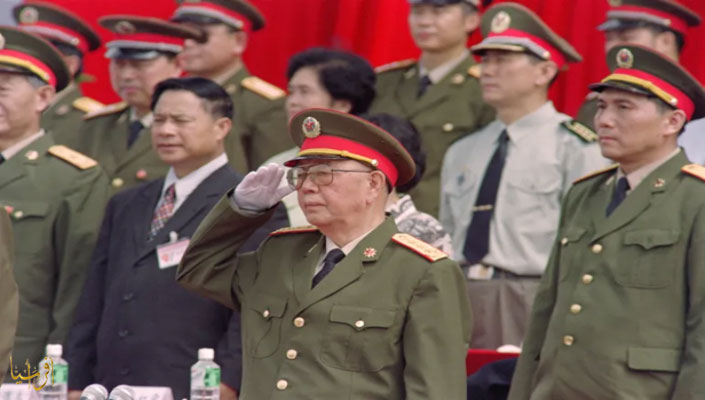
Liu Hua Qing first put forward the strategy of "active defense in the near seas" (French)
This reality did not change much with Deng Xiaoping (1978-1992) coming to power. He considered China's top priority to be economic development and the avoidance of external conflicts, taking advantage of the decline in threats to China after the U.S. withdrawal from Vietnam and the Soviet Union's preoccupation with its internal crises, and China's military spending declined in the 1980s. However, this period saw a pivotal development, represented by the assumption of Admiral Liu Huaqing as commander of the Chinese navy between 1982 and 1988, who was known as the "father of the navy" Modern Chinese".
"Admiral Liu Hua Qing is known as the father of the modern Chinese navy"
________________
Recognizing that the rise of China's economy makes the sea more important to national security, Liu first put forward the "near-sea active defense" strategy, which called for shifting China's defense from the coast to the seas surrounding China within the first island chain to establish a land protection buffer zone within 200 nautical miles of the coast, which includes the Yellow Sea, the East China Sea, the South China Sea, the Taiwan Ocean, and the Okinawa and Spratly island chains.
Liu's main recommendations were the need to build an aircraft carrier by 2000, develop submarines and ships equipped with missiles, and sponsored the establishment of the Naval Equipment Research Center in 1984. Although China's technical and financial capabilities at the time did not allow these ambitions to be realized, Liu's ideas laid the foundation for subsequent maritime modernization. Rather than simply deterring an attack on the coast, Beijing viewed the adjacent seas as a vital area to be defended and controlled.
In 1990, after Jiang Zemin became chairman of the Central Military Commission, he floated the idea of "building a great seawall for the motherland." China had entered the 1990s experiencing massive economic growth, while its naval capabilities remained limited compared to the size of its growing interests. The 1993 incident of the Chinese merchant ship Yin He served as a wake-up call for leadership in Beijing. The U.S. Navy intercepted the vessel in the Indian Ocean under the pretext of transporting chemicals-related materials to Iran, subjected it to inspection, and blocked it for several weeks from continuing her journey before the accusations were found to be untrue. Although the incident ended without a confrontation, it exposed to China its weak ability to protect its merchant ships on the high seas.
"The navy received a third of China's defense budget in the mid-1990s, and also launched programs to modernize submarines, destroyers, and naval missiles."
________________
The next shock came with the 1995 and 1996 Taiwan Strait crisis. After China conducted missile tests near Taiwan, the United States sent the aircraft carriers Nimitz and Independence to the region. Beijing realized that its ability to impose its will on the Taiwan file would remain limited as long as it was unable to deter U.S. naval power. President Zemin, who led the country from 1993 to 2003, stressed that China "should give the construction of the naval fleet a top priority to ensure the maritime security of the country and strengthen the unity of the nation."
Since then, the modernization of the Chinese navy has gained unprecedented momentum. Military spending has soared, the navy acquired a third of China's defense budget in the mid-1990s, and has launched programs to modernize submarines, destroyers, and naval missiles. China purchased four Russian Kilo-class submarines in 1994, began developing new Jin and Shang-class nuclear submarines, and acquired modern destroyers from Russia to make up for the shortfall in its naval capabilities.
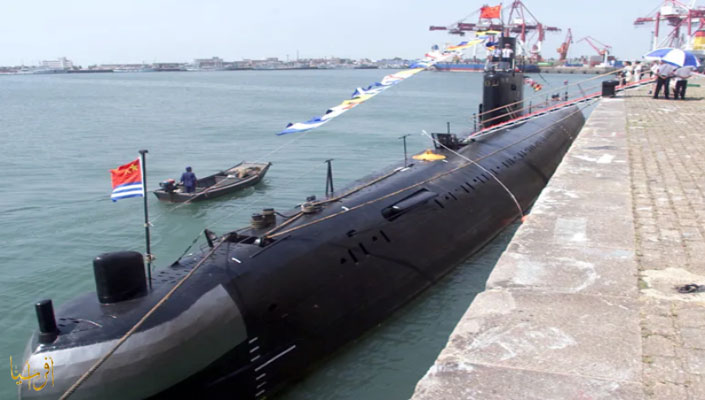
A conventional Russian Kilo-class submarine of the Chinese Navy docks at the headquarters of the North China Sea Fleet in 2000 (French)
This phase saw the start of the aircraft carrier project. In 1998, China purchased the former Soviet ship "Faryag" from Ukraine and converted it into an aircraft carrier with the aim of gaining the technical and know-how needed to build domestic aircraft carriers in the future. By the end of the Ximin era, the Chinese navy had the capability to operate in the Taiwan Strait, the South China Sea, and the East China Sea.
At the beginning of the 21st century, China entered a new phase of its economic rise, as it became the world's industrial workshop and foreign trade became one of its most important engines of growth, and talk began to be made about the need to protect Chinese interests wherever they existed, and theses were crystallized calling for the construction of a "high seas navy" capable of defending trade and energy lines and securing the country's foreign interests.
"By the end of Hu Jintao's reign, the Chinese navy had become a regional power capable of operating on the high seas"
________________
These developments have been accompanied by a boom in warshipbuilding. During Hu Jintao's reign, which spanned from 2003 to 2012, China launched 71 domestically designed ships, and China's maritime industry has seen progress that has allowed Beijing to rely more on domestic production rather than the foreign imports that prevailed in the 1990s. In 2008, Beijing decided to send a naval force to participate in anti-piracy operations off the coast of Somalia in the Gulf of Aden.
This was the first mission of its kind since the founding of the People's Republic of China to carry out a remote maritime operation, allowing for the acquisition of practical experience in logistical support, command and control, and securing commercial shipping lanes in a real operational environment.
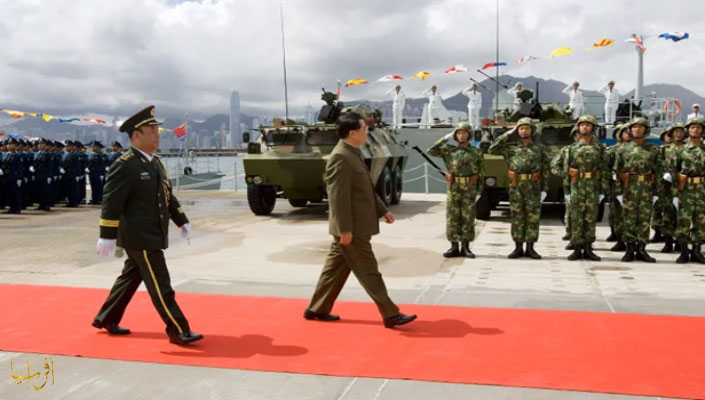
During the reign of Hu Jintao, China inaugurated 71 domestically designed ships (French)
By the end of Hu Jintao's reign, the Chinese navy had become a regional power capable of operating on the high seas, with a presence in the Indian Ocean, and operational expertise beyond the first island chain. It also had an industrial and human base that would allow it to move to a more ambitious phase, a phase that would begin with Xi Jinping's accession to power in 2013, which he considered to be the time to move to the stage of building a "naval superpower" capable of defending Chinese interests and establishing a presence Beijing is part of a plan to transform China's military into a global power by 2049 on the centenary of the victory of the revolution and the proclamation of the People's Republic.
It coincided with escalating competition with the United States, which has launched a policy of "rebalancing towards Asia" and strengthened its military cooperation with Japan, Australia, India and Taiwan, and announced the Quad security dialogue, known as the Quad, with Australia, India and Japan, in a move aimed at curbing China's rise.
During the first decade of Xi's rule, the Chinese navy underwent the largest expansion in its modern history. Dozens of new submarines, destroyers, frigates, and amphibious ships entered service at a rate of 16.5 ships per year, making China the world's largest naval fleet in terms of the number of pieces, with a total of 234 warships compared to 219 U.S. Navy warships, not counting auxiliary and support ships, according to Congressional Research Service data in 2025.
"During the first decade of Xi's rule, the Chinese navy experienced the largest expansion in its modern history"
________________
U.S. intelligence reports have warned that China's shipbuilding capacity is more than 200 times that of its U.S. counterpart. The aircraft carrier Liaoning entered service in 2012, followed by the home-made Shandong carrier and the newer Fujian carrier with an electromagnetic launch system in 2025, while a fourth carrier is currently under construction, allowing Beijing to maintain an effective presence in the western Pacific and northern Indian Ocean regions, and contain hostile forces that may seek to encircle China.
However, having new aircraft carriers does not mean having an effective carrier force. The carrier needs a combat group that includes destroyers, frigates, submarines, supply ships, and early warning aircraft, as well as sophisticated command and control networks, and decades of operational experience and training. The Chinese navy is still lagging behind its U.S. counterpart in this area, with more than eight decades of cumulative experience operating aircraft carriers around the world.
In the South China Sea, Beijing began building artificial islands on a number of coral reefs disputed with its neighbors starting in 2013. Externally, Beijing established its first overseas military base in Djibouti in 2017, linking China's military presence in the Indian Ocean to growing economic interests associated with the Belt and Road Initiative.
U.S.-China Maritime Rivalry
Over the past two decades, the rise of the Chinese navy has become one of the most important files of strategic rivalry between Beijing and Washington. While China sees the development of its naval power as necessary to protect its economic interests and national security, the United States views this development as the most prominent challenge to the maritime system it has led since the end of World War II, and considers China to be building a buffer belt in the western Pacific and northern Indian Oceans outside the first island chain.
The U.S. statements reflect the growing concern about this rise. Admiral Philip Davidson, the former commander of the U.S. Indo-Pacific Command, warned Congress in 2021 that China was accelerating its steps to challenge and possibly surpass U.S. prestige by 2049. He previously noted that in just 30 months, the Chinese navy has carried out more global naval deployments than it has carried out over the previous three decades combined.
"The total tonnage of the Chinese fleet is about 1.85 million tons, less than half of the total tonnage of the U.S. Navy."
________________
Although the Chinese navy is the world's largest navy, a comparison of the Chinese and U.S. navies reveals other facts: China's fleet has a total tonnage of about 1.85 million tons, according to the Congressional Research Service, less than half of the U.S. Navy's total tonnage. The payload here is important because it indicates the extent of sailing given the ability of larger ships to carry more fuel and ammunition. The United States also maintains an edge in aircraft carriers, nuclear submarines, cruisers, and heavy destroyers. U.S. surface ships have more than 9,000 vertical missile launch cells, compared to just about 1,000 in the Chinese Navy.
China, in turn, benefits from a geographical advantage that the United States cannot easily replace. Chinese forces operate close to their ground bases and are supported by the air force and missile force, while U.S. forces are forced to operate far from their territory, relying on a network of bases and allies stretching from Japan and Guam to Australia and the Philippines. Beijing has focused on developing a "denial-access" strategy that relies on anti-ship ballistic missiles, cruise missiles, submarines, naval mines, and cyber warfare to raise the cost of Any U.S. intervention near the Chinese coast.
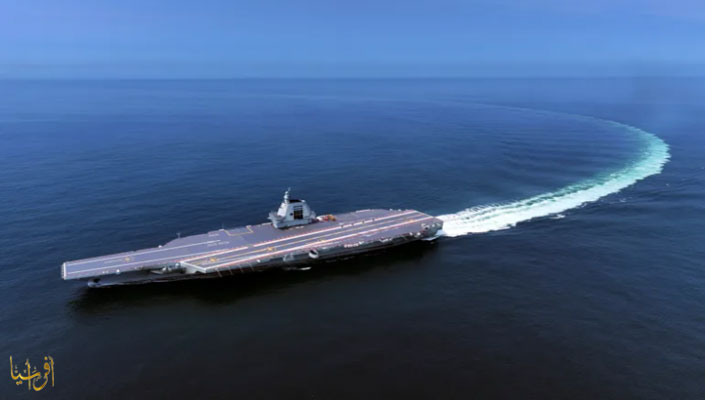
Chinese aircraft carrier Fujian during a sea test (AP)
In the face of these challenges, the United States has dedicated about 60 percent of its fleet to the Indo-Pacific, raised its future fleet size target to 381 warships by 2042, and embarked on developing new operational concepts based on troop deployment and the use of unmanned systems to counter China's growing capabilities.
"It is difficult for the United States to assert its absolute military hegemony near China's coast, and it is difficult for China to challenge American supremacy in the distant oceans."
________________
At its core, the rivalry between the two countries revolves around the balance of power in the Western Pacific, with China having an advantage within the seas near its coasts, while the United States retains a global supremacy based on a network of bases and alliances across continents. It is therefore difficult for the United States to assert its absolute military dominance near China's coasts, and it is difficult for China to challenge American supremacy in the distant oceans.
The Limits of China's Naval Power
Despite the significant progress the Chinese navy has made in the last three decades, it still has a long way to go before reaching the level of global reach that the U.S. Navy enjoys. But China's goal does not seem to be so much about replicating the U.S. model as it is about building a naval force capable of protecting Chinese interests, securing trade and energy lines, and preventing rival powers from exploiting naval superiority to pressure or threaten Beijing.
In this context, China has successfully built an integrated naval, air, and missile force that gives it the ability to impose a high cost on any force operating near its coasts, strengthened its presence in the surrounding seas, and expanded its activity into the Pacific and Indian Oceans.
However, the transition from regional naval power status to global maritime power remains marred by difficulties related to geography and ocean access restrictions, limited overseas base and logistical support networks, limited operational expertise, and the nature of China's adversarial strategic environment, with many regional powers such as Japan, India, Australia, Vietnam, and the Philippines viewing China's growing naval power as a security concern and seeking to build balances that limit Beijing's freedom of movement.
The most important challenge is therefore the extent to which China, having set out to build a naval power, can achieve its goals without descending into a global conflict similar to that fought by major powers in earlier stages of history, which led to their destruction.
________________
