
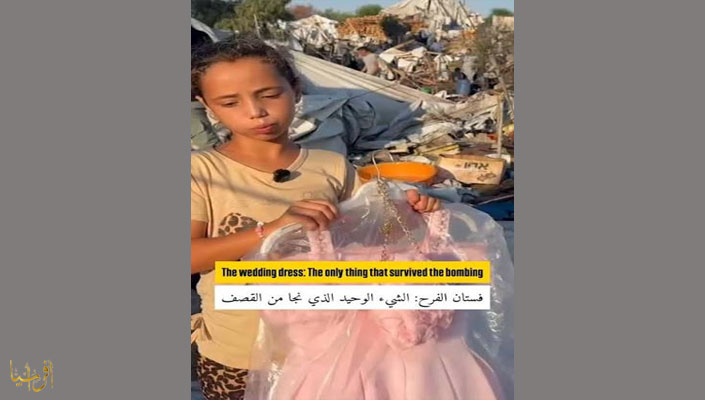
Afrasianet - Maryam Mashtawi - Reham wasn't wearing a dress, she was carrying a full life, she was reduced to a pink cloth that alone survived the fire.
The child stood among the rubble of tents in the Mawasi of Khan Younis, holding her dress in both hands, as if she was afraid that someone would kidnap it too.
Behind her there was nothing left to indicate that there was life here.
No wall, no window, no pillow, no scattered toys waiting for the return of her owners.
Only the dress remained, as if it was the last witness that a child was living here, and she was She dreams like all the children of the world, and then one sentence came out from her lips: "Where is my uncle?
He was martyred." At that moment, Reham is no longer a single child, she has become the face of a whole childhood looking for anyone, and she finds nothing but absence.
Her image is not a picture of war... It is the image of the world standing helpless in front of a child who does not know how to explain her loss.
How painful it is for a dress to become news, for a child's toy to become an item in the newscast, for the survival of a piece of cloth to become an event, because everything else has been burned.
War doesn't start when the shell falls. It starts when a person is forced to redefine things. The house is no longer a house, it has become a tent. Night is no longer a time to sleep, but a possible time for death.
There, a child grows in a few months what others grow in years. He memorizes the names of planes before the names of birds, and he discerns the sounds of rockets more than the sounds of music.
The pink color resisted all the shades of blackness around it, as if to say that beauty, no matter how fragile it looked, possessed a stubbornness that wars do not have.
It's always been said that children don't understand politics.
This is true, but they pay for it more than anyone else!
They don't ask about borders, maps, or agreements.
All they want is a safe place to sleep, a mother waking them up to school, a father coming back in the evening, and a holiday where they put on their new clothes.
How impossible it seems to be achieved at a time when the most basic rights have become a distant dream.
The most painful thing about wars is that they don't just kill people.
They change their memory as well.
A child who survives today won't remember his childhood through games, but through sirens.
He'll remember the smell of smoke more than he remembers the smell of bread.
He'll grow up knowing that the tent could burn down at any moment, that loved ones might suddenly disappear, that sleep itself could become an adventure.
What memory do we build for these little ones?
And what kind of future do we expect them to create, if their whole present is made up of?
It is said that a person can start over.
He builds another house, buys new furniture, and regains what he lost over time.
But what about the baby?
How do we restore his first sense of security?
How do we convince him that night is not an enemy?
And that heaven is not a place from which fire falls?
And that the roads are not corridors for escape?
Can anyone give back to the child of her uncle who was martyred?
Or will it restore to it the beautiful certainty that adults are always there to protect it?
Perhaps historians will sit down years later to count the number of raids, the number of casualties, and the number of tents that burned.
But the real history will not be in the tables and statistics, it will be in the face of Riham.
With her hand trembling, she holds the dress to her chest.
When justice regained its address in Baghdad..
It wasn't the first time Iraqis had heard about corruption cases, or commissions of inquiry, or promises to hold those involved accountable.
How many times did the screens fill with big news, and then oblivion swallowed them up like the Tigris swallows the leaves of autumn?
And how many times did people think the door had finally been opened for justice, before they discovered that only the wind was messing with the handle?
Out of reach. The law should be higher than the chair, the position should become a responsibility rather than a fortress, and the powerful should discover, even if belatedly, that the state is not a personal heritage shared by the powerful.
Corruption is not theft of money, as many think. If that were the case, countries would be able to make up for what they have lost over time. But corruption is more subtle than that.
He first steals people's trust, then lets the money leave quietly.
The faith of an honorable employee that his diligence will be rewarded, the student's belief that his future does not need a wasta, and the belief of a mother waiting for a bed in a government hospital that her right will not be lost because someone else knows a bigger official than her.
These, however valuable, are still things that can be counted in numbers.
Trust is only measured when a citizen leaves his home feeling that the law does not ask about the family's name, or about political affiliation, or the number of guards standing in front of the house.
True law knows only man, and only sees action. Iraq has never been a poor country. His land was generous enough for his children to dream of a life worthy of them, but between the land and the people's dreams there was corruption for a long time, like a wall blocking the light.
No people suffer when they see their homeland rich while living in poverty.
Poverty created by nature is tolerable, while the poverty created by man leaves in the heart a bitterness that will not be erased by the years.
This is the small word on which the big countries are based.
There is no state without accountability, no institutions without accountability, and no future for a country whose officials believe that the chair gives them an exceptional right to transgress the law.
Because Iraqis have paid a heavy price for their lives and dreams, they have the right to approach this scene with some caution.
They know that the road to justice does not begin with arrests alone, nor does it end there. Justice is not the image of an official with his hands tied.
It is a picture of a child entering a school built with money that has returned to its owners, and a patient who finds his medicine in a hospital.
In the end, Iraq does not need to fill its prisons as much as it needs to fill its institutions with confidence.
Prisons can punish individuals, and justice builds nations.
The difference between the two is the difference between a state that is busy chasing the past, and a state that establishes a future in which citizens do not have to applaud whenever they see the law doing their duty, because then doing their duty would be a normal thing that is not worth celebrating.
And it reached their hearts. The hope is that Baghdad, which has been exhausted by war, corruption and disappointments, may recover some of its health.
________________
Maryam Mashtawi - Lebanese writer
________________
