
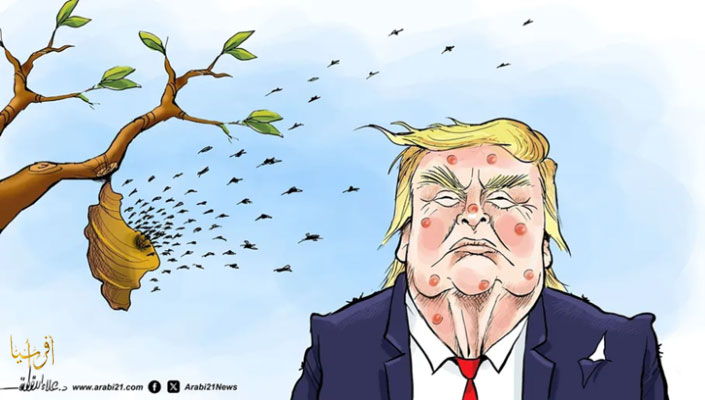
Afrasianet - Abd Al Azim Mohamed Abd Al Rahim - As U.S. President Donald Trump enters his 80th year surrounded by displays of power and political parade, U.S. institutions are increasingly signaling that a president who has appeared to be pushing all limits in recent months no longer enjoys the same political immunity.
From Congress to the judiciary, from polls to his Republican Party, there are signs that a new phase has begun: testing the limits of President Trump's influence and ability to impose his agenda at home and abroad.
The Limits of Trump's Power
The Financial Times, in a report by its Washington correspondent, James Polity, monitored a series of political setbacks that Trump suffered in one week, considering them a blow to the image of the "invincible president" that has surrounded him since his return to the White House on January 20, 2025.
Trump has faced simultaneous defeats on more than one front, with a judge ordering his name removed from the Kennedy Cultural Center in Washington, while the Republican-controlled House of Representatives voted to restrict the continuation of military operations against Iran without congressional authorization, and the Senate refused to fund the massive ballroom project that Trump was seeking to build in the White House.
The strikes did not stop there, as the president was forced to abandon a $1.8 billion fund project to compensate those who consider themselves victims of the "politicization of justice" after the project was widely criticized as a fund dedicated to rewarding his allies and supporters.
Trump's policies are fueling inflation, he is unpopular and Americans don't like this situation, the whole world doesn't like his policies, and even a small number of Republicans don't like them anymore by historian Matt Dalek.
Declining popularity
Matt Daleck, a historian and professor of political management at George Washington University, was quoted as saying that "Trump's policies are fueling inflation, which is broadly unpopular and Americans don't like this situation."
"The whole world doesn't welcome his policies, and even a small number of Republicans don't like them anymore either," he said, adding that he believes "this combination has established a new era of restrictions on Trump," referring to the return of U.S. institutions to a more active role in curbing executive power.
Silent Republican Rebellion
These "setbacks" coincide with a significant decline in the levels of support for the US president in the polls, which showed the loss of confidence in the street's management of the economic and foreign policy files.
Although Trump still tightens his grip on the Republican base, recent months have exposed fissures within the party.
The report noted that candidates from the pro-MAGA movement succeeded in eliminating a number of prominent Republican lawmakers in the party 's primaries.
Midterm Congressional Renewal
But the newspaper says that forecasts point to the possibility that the Republican Party could lose its majority in the House of Representatives in November's midterm elections, and that their control of the Senate is in jeopardy as a result of Trump's support for candidates described as extremists.
This partisan insurrection was clearly demonstrated in the House vote to restrict military operations against Iran without congressional authorization, a symbolic vote in which four Republican lawmakers participated.
Republican Rep. Tom Barrett expressed this position via the X platform , saying, "It is time for Congress to set the appropriate limits for the use of force in Iran."
Trump sharply attacked the decision on his platform Truth Social, calling the move an "unpatriotic act."
According to the Financial Times, the disagreements were not limited to the military file, but extended to political appointments, following the appointment of Bill Bolte, the federal official for the housing sector, as interim director of national intelligence despite his lack of experience in this field, which sparked widespread discontent that forced Trump to partially back down and assert that the position is temporary and will not be permanent.
Shane O'Grady: Trump lives in an "imagined world" where he believes he has solved all the world's crises and achieved the greatest economy in history.
Trump is not a king
Julian Zelizer, a political historian at Princeton University, said Trump is different from most traditional politicians because he is "willing to risk constitutional stability and doesn't feel the weight of political embarrassment like others do."
But at the same time, he noted that the rebellion within the GOP could be transitory, adding that Republican lawmakers could return to aligning themselves behind the president if the party's interests warranted it.
Dalek was even more stern when he said, "A year ago, many people thought that Trump was going beyond all restrictions and ignoring all the checks on his power, but these controls are gradually re-imposing themselves." He added in a striking tone: "Trump is not a god, nor a king, even if he loves to play that role."
Conflict with reality
In an opinion piece published by The Independent, writer Shane O'Grady offered a harsher reading of the US president as his 80th birthday approaches, arguing that recent days have revealed a growing disconnect between Trump and reality.
The writer mocked a series of recent statements and ideas put forward by the president, including his desire to make the UFC a permanent part of the scene in Washington, his talk of water bodies and monuments, and his repeated announcement that conflicts and wars that have not really ended are imminent.
O'Grady believes that Trump lives in an "imagined world" in which he believes he has solved all the world's crises and achieved the greatest economy in history, pointing to the decline in his public appearances during the recent period and the reduction of his public activities and press conferences.
Andrew Bates, a former White House spokesman under President Joe Biden, said Trump's growing absence from the spotlight represents a real crisis for Republican candidates, as voters have come to see more clearly his preoccupation with his personal projects and private struggles.
Andrew Bates, former White House spokesman under President Joe Biden, asserts that Trump's growing absence from public view represents a real crisis for Republican candidates.
"Trump's invisibility is manifested in his growing inability to pretend to care about anything but making taxpayer money and building monuments for himself. When he appears, he says he doesn't think about Americans' finances even a bit, while behind the scenes he continues to write angry posts."
Analysts say these "setbacks" do not mean that Donald Trump has lost his grip on the U.S. political scene, but for the first time since his return to the White House, he is facing clear signs that his power is no longer as absolute as it has seemed in recent months.
As his popularity plummets and objections mount within state institutions and even within his own Republican Party, the question is becoming increasingly urgent in Washington: Are these developments merely fleeting stumbles for a president accustomed to overcoming crises, or are they the beginning of a new phase in which American institutions are regaining their ability to curb the influence of a man who has long dominated the global political scene?
Source: The Independent + Financial Times.
