
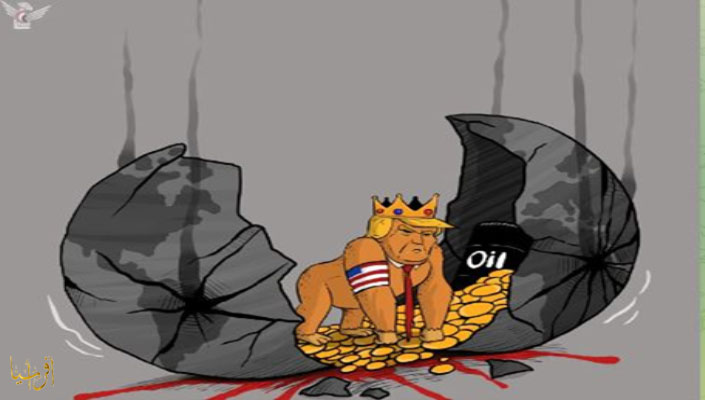
Friedman: Trump's behavior is becoming more and more like that of a "thief leader" rather than a "commander-in-chief" of America
Afrasianet - American writer Thomas Friedman argues that President Donald Trump has failed to fulfill the traditional role of commander-in-chief, arguing that he is acting more like a "robber commander" than a "commander-in-chief."
Friedman asserts in the New York Times that while the United States is at war with Iran and is deploying tens of thousands of troops to the Middle East, the first task of any president in such circumstances is to maintain the unity of the home front.
But Trump made no effort to rally support for the Democratic Party or unite Americans behind the war, but rather engaged in internal political conflicts and controversial projects that served his own interests and political allies.
"Nothing demoralizes soldiers more than seeing their country tear itself apart from within," Friedman says, and internal division gives adversaries hope of seeking better terms to end conflicts.
Controversial Fund
Friedman devotes much of his article to criticizing the fund project, which the Trump administration has sought to create for nearly $1.7 billion to compensate people who the administration says have been subjected to what it calls "judicial politicization" under the previous administration.
The bill would have effectively rewarded Trump loyalists, including people whose names have been linked to the Jan. 6, 2021, storming of the Capitol . He cites the position of former Senate Republican leader Mitch McConnell, who called the idea "completely stupid and morally wrong."
According to the article, the temporary suspension of the project by a court decision was a major setback for the White House, although Trump later hinted that it could be reversed. Friedman argues that the same money should have been directed to support Ukraine rather than to compensate people he describes as "loyalists who stormed the corridors of Congress."
Another clause added to the agreement would prevent future authorities from pursuing some of the existing tax claims against Trump, his family members, and businesses, arguing that this raises serious questions about conflicts of interest and the use of power for personal gain.
"The Shop Leader"
Friedman not only criticizes the fund, but also addresses what the Associated Press has described as a "store leader," noting that Trump carried out thousands of stock buys and sells during the first months of his new term, including stocks of companies directly affected by his presidential decisions.
Richard Painter, a former White House adviser during the George W. Bush administration, said such actions would have been a crime if they had been issued by the secretary of defense, even if they were technically legal for the president.
Friedman argues that these practices reinforce the growing impression among Americans that the president is using state institutions to serve his own interests, whether by influencing the judicial system or through financial and political arrangements that benefit him and his inner circle.
Deterring America has become a strategic priority for allies and NATO countries are beginning to realize the dangers of over-reliance on the United States in the fields of technology, defense, and finance.
America's allies between deterrence and diversification
In the international section of his article, Friedman warns that Trump's policies are prompting traditional U.S. allies to reconsider the nature of their relationship with Washington. European concern is no longer limited to Russia, but includes the United States itself.
He notes that Washington's allies have followed with concern Trump's threats to annex Canada and make it the 51st U.S. state, his talk of controlling the island of Greenland, in addition to imposing tariffs on U.S. partners and cutting military and financial aid to Ukraine.
Geopolitical expert Nader Mousavizadeh is quoted as saying that "deterring America and Trump has become as much a strategic priority for allies as it is deterring Russia." Mousavizadeh believes that NATO countries are beginning to realize the dangers of over-reliance on the United States in the fields of technology, defense and finance.
A number of European countries, including Germany, Sweden, France, Norway, the Netherlands, Finland and Britain, have announced that they are sending limited troops to Greenland in support of Denmark, in a move they see as an unprecedented sign of declining trust in the U.S. ally.
Friedman concludes that what he calls "distortion of the American presidency" has an impact not only on the American homeland, but also on the network of international alliances that contributed to the victory of the two world wars and the Cold War.
Continuing this approach could cost the United States its global influence and the trust of its allies, and put the future of future generations at increased risk, at a time when Washington needs more than ever a leadership that unites at home and maintains its international standing.
