
Afrasianet - Muhammad Hasab Al Rasul - The Sahel region is undergoing a radical dismantling of the Western system of influence in West Africa's Sahel, under the weight of key contexts that have begun to change the face of Mali, Burkina Faso and Niger.
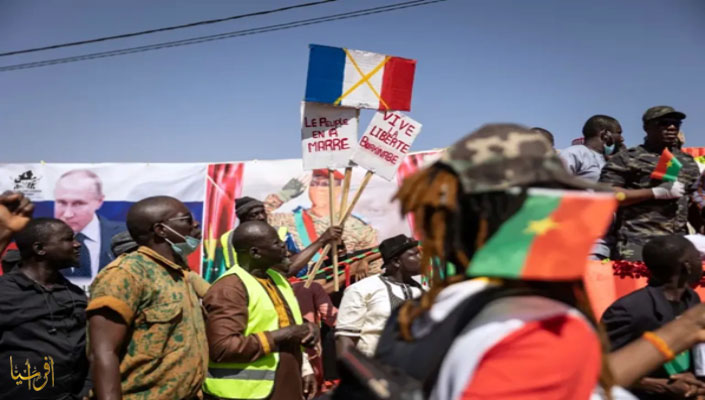
On this day, Burkina Faso announced the severance of its relations with France, in a move that went beyond the narrow diplomatic dimension to an explicit declaration of the end of direct and indirect colonialism, and the birth of a geopolitical space that rejects Western tutelage, and reflects "strategic courage" in zeroing out the relationship with the old colonizer and opening up to a multipolar system.
Three geopolitical shifts blew up the scene of the coast
The Sahel region is witnessing a radical dismantling of the Western system of influence in the West African coast, under the weight of key contexts that have begun to change the face of Mali, Burkina Faso and Niger:
- The local context of the "failure of the security approach": Like other African colonies, the Sahel countries have lived in very bad economic and social conditions despite their abundant wealth, and with the explosion of the security situation about a decade ago, the crises of these countries have worsened, the instability caused by armed groups linked to ISIS has increased, and its repertoire has emerged at all levels, popular discontent has grown, and France's inability to achieve stability and security has been exposed, and the French military presence has turned into an umbrella that protects fragile and plundered regimes that represent the other side to French "colonialism", and this paved the way for independent transformations that took on a military character that raised the slogan of national sovereignty.
- The regional context of "ECOWAS Fracture and Polarization of the Axes": The institutional structure of France's historical influence in West Africa was weakened, and after the ECOWAS group imposed suffocating economic sanctions on the Sahel countries and their new ruling military regimes at French instigation, the pressure on France and the group rebounded, with the establishment of the Alliance of Sahel States in September 2023, followed by the withdrawal from the "ECOWAS" in January 2025. This withdrawal divided the region into two conflicting axes: the axis of the open Sahel to the east, and the axis of the coastal states linked to France and the west.
- The international context of "international competition for Africa": These variables coincided with the intensification of international and regional competition on the African continent, and the Russian-Chinese-American race for the location and resources of the continent, and regional countries were active in the same stadium, and Russia, China, and Turkey tried to expand in the spaces occupied by France before its presence declined and its influence weakened, so it entered Beijing and invested in mineral resources and infrastructure, and Russia was able to invest in the turbulent security situation through the "African Legion", while Turkey provided the new regimes with drones The glitter to achieve military deterrence and security superiority, which enabled the Sahel countries to provide international and regional alternatives that helped them free themselves from French blackmail.
The Narrative Sequence of the Expulsion of French Influence
Mali, Burkina Faso and Niger gradually implemented the plan to end French hegemony, beginning with the clash on the ground, the unified regional bloc, and the diplomatic rupture, which is reflected in the following historical milestones:
The Sahel countries began to turn their backs on Mali in May 2022, when they canceled defense agreements and expelled the French "Barkhane" forces and replaced them with Russian experts, followed by the de-formalization of the French language.
This momentum shifted to Burkina Faso after Captain Ibrahim Traoré took power in September 2022, announcing the expulsion of French forces three months later, culminating in a higher escalation on 26/6/2026 by severing diplomatic relations with Paris and accusing it of supporting subversive networks.
The French response came as hostile and announced that mutual measures were being considered, while regional and international parties remained silent.
In parallel, Niger terminated security agreements with France, suspended uranium exports to France, expelled the French ambassador and evacuated his country's forces in January 2023. These Qatari positions crystallized with the establishment of the Sahel Alliance in September 2023, followed by the withdrawal of the three countries from the ECOWAS group, thus announcing the severing of ties with the former colonizer in particular and with the West in general and turning eastward.
How is France moving to contain the losses?
With great difficulty, Paris faced the loss of its influence, and revised its geostrategic doctrine along key tracks:
- Retreat towards the coastal states "the alternative old belt": It redeployed its military position in Chad and the Gulf of Guinea states (Ivory Coast, Benin, Togo, and Senegal), replacing large bases with invisible work and intelligence training centers so as not to provoke anti-Chad sentiments and to control the situation in those countries in order to avoid any possible additional losses.
- Diplomatic war through proxies: Paris has pushed the region's allies to tighten economic pressure and close borders with coalition countries to cause living crises that erode the popular support of the new regimes there.
- Complex intelligence confrontation: France has adopted a political and media plan based on supporting and investing in the political and trade union opposition forces, accompanied by a media campaign aimed at creating public opinion against the new regimes and opening holes in their walls, with a view to weakening and overthrowing them.
The Battle for Critical Independence
The Sahel countries are aware of the link between national independence and economic sovereignty, and have been consciously driven to abandon the franc and move to a single local currency, but this move has been met by a difficult equation: sovereign opportunities and structural obstacles.
The opportunities lie in breaking Paris' monetary tutelage and refraining from depositing foreign reserves in the French central bank, which gives the alliance the freedom to price and sell its mineral wealth "gold and uranium" in the new currency or in the new partner currencies ruble and yuan.
On the other hand, challenges arise in front of these opportunities, most notably the lack of a strong foreign exchange cover that protects the fledgling currency from the risks of inflation and the collapse of value, the absence of the infrastructure for printing currency locally, the decommissioning of Sudan's currency printing presses, which used to provide opportunities to protect against dependency and extortion, in addition to challenging the international financial blockade through the SWIFT system, which has become an American weapon against the "rogue" countries that have fallen out of the American and Western house of obedience.
Algeria and Nigeria fear new positioning
There is a state of anticipation and caution over the pivotal regional powers surrounding the Sahel region due to the geopolitical variables in their space, as border security calculations overlap with the conflict over regional leadership and strategic interests, and Algeria and Abuja are mainly cautious, and each of them is working to study the risks of this transformation in depth:
- Algeria and apprehension about the militarization of borders and the role of the UAE: Algeria views with great concern the risks resulting from the changes in the Sahel countries, including regional and international competition, and the effects of this on its national security, especially from Mali, with which it has a border extending for more than 2000 km. A population movement creates an African refugee class with multifaceted and multidimensional risks.
- Nigeria and the crisis leadership struggle: Abuja has remained the de facto leader of ECOWAS, and the Sahel insurgency has weakened its regional influence, curbed its ambitions, and threatened its strategic project to extend the trans-Saharan gas pipeline to Europe through Niger and Algeria.
African Legion Deployment Map
Moscow dismantled the Wagner structure and turned it into an official mechanism under the Ministry of Defense under the name of the African Legion, whose forces were distributed over the Sahel countries:
- In Mali, "depth and offensive operations": France's former strongholds, Timbuktu, Gao and Kidal, are considered major centers of the African Legion, whose tasks are focused on providing air support to the Malian army and supporting it on the ground to retake the north.
- In Burkina Faso, "order protection and logistical support": Forces are stationed around the capital Ouagadougou and the eastern border, to protect President Ibrahim Traoré, train special forces, and operate drones.
- In Niger, "strategic positioning": The Corps was positioned in the capital, Niamey, and Air Base 1.1 was employed in surveillance and reconnaissance covering North and West Africa, thus achieving a geopolitical breakthrough that deprived the West of strategic advantages.
Conclusion of the Geostrategic Reading.
Burkina Faso has completed the last historical ties between the two countries with the decision to sever its diplomatic relations with France, and thus the Sahel space has entered a new historical era, as it was no longer a "bastion of French influence" because it has turned into an international testing platform, in which the ambitions of the coalition countries for sovereignty, liberation and advancement overlap with the geostrategic interests of the neighboring countries of Nigeria and Algeria, in conjunction with a sharp polarization led by Russia militarily and China economically to dislodge Western hegemony and consolidate the influence of the two countries seeking to lay the foundations of a new multipolar international order. To employ African resources in strengthening their strategic capacities now and in the future.
On the horizon, the outcome of this geopolitical transformation depends on the ability of the Sahel Alliance to translate the principles of national independence into a comprehensive and tangible political, economic and social renaissance, and to succeed in managing the relationship with the new partners with wisdom, rationality and care, so as not to replace one dependency with another, and to test internal stability, build trust and partnership with local communities, and strengthen their role in leading the renaissance and shaping the future, which will be the most decisive factor in the history of the region.
