
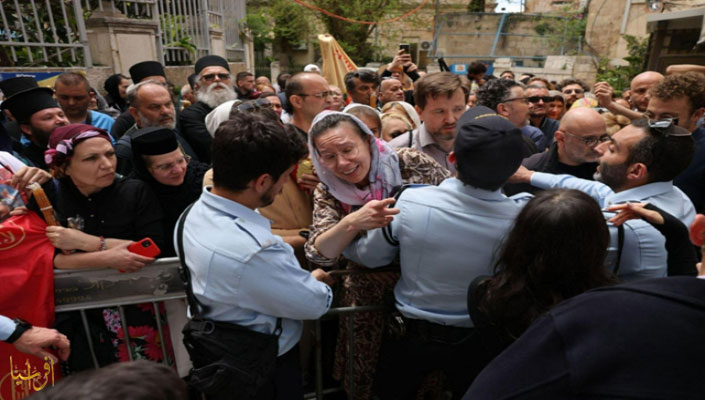
Christians in the face of Israeli extremism.. A climate of fear, hatred and polarization is spreading throughout Israel
Christians in Jerusalem under pressure
Afrasianet - The violent and unprovoked attack on a French nun in Jerusalem a few weeks ago has brought back the spotlight to growing hostility directed against Christian communities in Israel.
On April 28, a video went viral documenting the moment a man rushed towards a nun and pushed her violently in the street, almost hitting her head with a stone.
The assailant continued to kick her after she fell to the ground before a passerby intervened and put an end to the attack.
Investigations later revealed that the suspect was a 36-year-old Israeli settler living in the occupied West Bank, who was wearing a Jewish kippah and ritual tassels when he committed the attack.
The incident was met with widespread condemnation by Israeli government officials, as well as criticism from France, Spain and Italy. The Israeli Foreign Ministry also described the attack as a shameful and shameful act that directly contradicts the principles of respect, coexistence and religious freedom on which Israel is based. It turns out that all these convictions are nothing but allegations.
In a report published by Foreign Policy, Italy-based journalist Giovanni Ligurano argues that the significance of the incident lies not only in its violent nature, but also in the fact that it has brought to the fore a broader debate about what many see as an escalating pattern of hostilities against Christians inside Israel. Critics argue that these acts are often treated as isolated incidents, while they may reflect a deeper problem of religious extremism and a culture of impunity.
In this sense, the repercussions of these attacks are not limited to Christian communities alone, but also extend to Israel's international image and relations with Europe and the wider Christian world.
Verbal and physical attacks against Christians, as well as the desecration of church symbols and religious sites, appear to be putting further pressure on the delicate religious balance historically forged in the Holy Land by its status with Judaism, Christianity, and Islam. However, this balance is increasingly challenged by the rise of Jewish and extremist nationalist movements, especially in Jerusalem's Old City, where clerics and worshippers of different faiths live in close proximity and practice their religious rituals in one highly sensitive space.
Christians make up only about 2 percent of the 10.2 million inhabitants of occupied Palestine, and Arabs make up about 79 percent of the country's Christians. The Jerusalem-based Rossing Center for Interfaith Education and Dialogue notes that there are about 2,700 Christian clergy currently residing in Israel, most of whom do not hold Israeli citizenship.
The data indicate that hostilities against Christians have witnessed a significant escalation since the Hamas attack on October 7, 2023. The Religious Freedom Data Center, a Jewish-Israeli volunteer organization that runs a hotline for Christians, documented 181 incidents of hostilities during 2025 compared to 107 incidents in 2024. These incidents included spitting, verbal harassment, vandalism, physical assaults, online abuse, and various other forms of hostility.
Eska Harani, founder and director of the Religious Freedom Data Center, emphasizes that a large number of these incidents go unreported at all, meaning that the figures released may not reflect the true scale of the phenomenon. She also explained that complaints submitted by the organization to the Israeli authorities often receive little response.
Harani goes further when she considers that weak law enforcement effectively gives a signal that such behaviour will continue, and sometimes even amounts to implicit encouragement. Failure to arrest or prosecute those involved in acts such as spitting opens the door to more serious incidents in the future, she argues, and asks how far such attacks must reach before effective action can be taken to stop them.
Analysts and religious and secular organizations attribute this escalation to the nature of Israel's ruling coalition government, which they see as encouraging religious nationalism and contributing to a sense of impunity among some Jewish extremists. They also point to a broader climate of fear, hatred and polarization that has spread across the country since the outbreak of Israel's war on Gaza.
Joseph Sivers, professor emeritus at the Pontifical Bible Institute in Rome, argues that certain messianic beliefs prevalent in certain circles within Israel may contribute to fueling hostile attitudes toward those perceived as "others." According to this perception, the absence of any relationship between Christians and Hamas or Hezbollah does not prevent some individuals from justifying hostile attitudes toward people they do not consider part of "their own people."
The results of a 2025 survey conducted by the Rossing Center reinforce these concerns, showing that the increased level of religiosity among Israeli Jews surveyed was associated with higher feelings of aversion to Christianity and lower levels of openness, willingness to learn, and tolerance toward it.
Hannah Bendkowski, program director of the Rossing Center's Jerusalem Center for Jewish-Christian Relations, argues that in recent years, Israel has seen a growing sense of isolation at the governmental and societal levels. She explains that the security services' preoccupation with the war and the ongoing tensions between settlers and Palestinians in the occupied West Bank has led to a decline in interest in the protection of minorities, which may give nationalists a greater sense of freedom to act aggressively.
Although some Christians saw the speed of the arrest of the perpetrator of the latest attack as a positive sign that could indicate a possible improvement in dealing with these crimes, Abraham Feltz, a Franciscan priest and head of the Schools of the Guardian of the Holy Land, emphasizes that what is needed is more than individual actions to more serious efforts to promote peaceful coexistence within the Holy Land.
Felts notes that the Israeli authorities generally listen to the concerns of Christians and intervene when needed, but at the same time he believes that strong and sincere political will to resolve the conflict in the Holy Land is still absent, which contributes to the continuing conditions that complicate the coexistence of the various components. He also believes that effective international intervention is still less than necessary to counter the ongoing deterioration of the situation in the Middle East.
Despite the limited direct political influence of Christians within Israel, the religion itself still has significant global diplomatic and moral weight through its networks and institutions around the world. Christian pilgrimage and tourism are also an important economic sector for Israel, making attacks on Christians a factor that could negatively affect the flow of visitors and pilgrims.
This concern is growing as European interest in these incidents grows. In March, Italian Prime Minister Giorgia Meloni criticized the Israeli police after Cardinal Pierbattista Pizzaballa was barred from entering the Church of the Holy Sepulchre to celebrate Palm Sunday, the beginning of Holy Week for Christians. Jerusalem has also been closed to worshippers since the outbreak of the U.S.-Israel war on Iran. According to White House spokeswoman Carolyn Levitt, Washington has informed Israel of its concern about the incident.
These developments come at a time when Israel's relations with Europe are witnessing a marked decline as a result of its behavior during the Gaza war. Some EU members have called for the suspension of the agreement regulating relations between the bloc and Israel, but these calls have so far failed to garner enough support to turn it into a practical decision.
The April attack has brought increased scrutiny to what many see as a growing trend, and Israeli authorities seem to be becoming more aware of the need to take seriously the concerns of both Christians and the international community. However, tighter law enforcement alone will not be enough to address the problem.
The challenge also requires real educational initiatives and deep community review within a society that suffers from high levels of polarization and carries a heavy legacy of conflict and fear accumulated over the years. Efforts Divisions between different groups will continue to deepen, circles of violence will continue to reproduce themselves, trust gaps widen and fragmentation within society increases.
________________
