
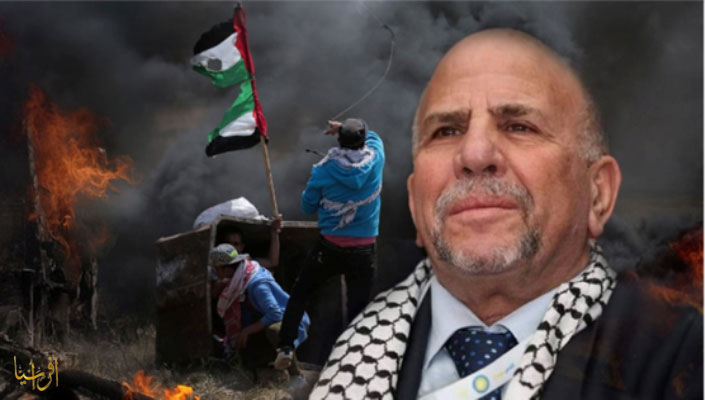
What is happening in Gaza is not an isolated event, but part of a broader regional conflict in which security, political and strategic calculations intersect
The Double Standards of the Western Standards between the Legitimacy of the Resistance and the Cover of the Occupation
Afrasianet - Omar Fares - In the midst of the dramatic transformations in the Middle East, Western contradictions in dealing with regional conflicts are starkly becoming a fixture in international politics, not a passing exception.
While French President Emmanuel Macron is calling on Hezbollah to halt its military operations against Israel in southern Lebanon, he seems to be calling on it to abandon the option of resistance, a position that is historically and morally at odds with his own legacy.
France, which was occupied by the Nazis in the 1940s, did not only resist the occupier, but also made the "French Resistance" a national symbol that is taught in its curricula and celebrated in its political discourse. How can the president of the Fifth Republic ignore this legacy and ask other peoples to submit to occupation or aggression without reply?
This paradox is not limited to the French position, but extends to the other side of the Atlantic, where the American position reveals the other side of a policy based on narrow interests and calculations. U.S. statements asserting that President Donald Trump was Israel's "sole supporter" and criticizing some Israeli officials for objecting to understandings with Iran clearly reflect how political interests and electoral considerations control the formulation of international positions.
Unconditional U.S. support for Israel, which is manifested in the provision of state-of-the-art weapons and the use of veto power to protect it from international accountability, is not merely a strategic alliance, but reflects a reality in which international justice is held hostage to the balance of power and interests.
The repeated recognition of the importance of U.S. support for the survival of Israeli supremacy raises broad questions about the nature of the legitimacy on which this support is based, and how consistent it is with the West's principles of international law and the right of peoples to self-determination.
In contrast to this Western condon of the occupation's practices, Iran's positions emerge as part of the ongoing strategic shifts in the region. Iran's repeated statements about defense readiness, linking regional deterrence balances with what is happening in the Gaza Strip, reflect a view that considers regional files to be interrelated and that the Palestinian conflict cannot be isolated from its geopolitical surroundings.
In this sense, Tehran believes that any change in the balance of power will be directly reflected on the Palestinian reality, which runs counter to the Western vision, which often seeks to treat the region's crises as separate files. This linkage reflects a conviction that what is happening in Gaza is not an isolated event, but part of a broader regional conflict in which security, political, and strategic calculations overlap.
Reflecting on this intertwined landscape of statements and contradictory positions, one finds himself confronted with a fact that is difficult to ignore: that the Western world suffers from a chronic problem of double standards.
Occupation, when exercised by a party supported by the major powers, is presented as a security necessity or a right to self-defence, while any resistance to such occupation is seen as a threat that deserves condemnation and sanctions.
This duality is no longer hidden from the global public, but has become more apparent in light of the massive development of media and social media platforms, which have allowed people to compare Western discourse on human rights and equality with policies applied on the ground.
The reformulation of concepts in accordance with interests, and the preference of the logic of force over the logic of truth, is one of the main reasons for the continuation of crises in the Middle East. If the equation of criminalizing resistance and justifying the occupation continues, the region will continue to be in a vicious circle of tension and instability.
The solution lies not in demanding restraint alone for the weaker party, but for applying the same standards to all, and holding accountable violators of international law, regardless of who they are or the size of their influence.
The right of peoples to defend themselves and to resist occupation is a human right that should not be subject to geography, skin colour or political calculations.
Either international standards will be uniform and fair to all, or they will gradually lose their credibility. Talk of an international order based on justice and law will then be nothing but a theoretical slogan, while reality will remain governed by the logic of power and the balance of interests.
________________
