
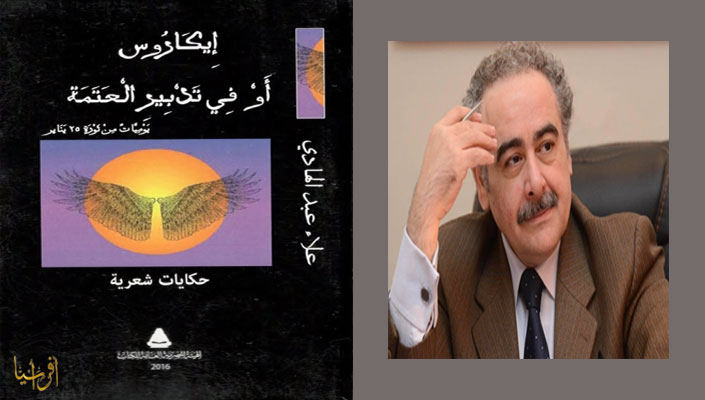
Afrasianet - Zakaria Shahin - In a different text taken from a book, Icarus: Or in the management of darkness, Dr. Alaa Abdel Hadi Anan releases a text that depicts feelings that do not end with the end of reading the text, but dwell on afterwards.
In Poetic Tales from the January 25 Revolution "The General Authority for the Book. 2016."And from the heart of the chapter's title: Tales of the Hunt. and the animal. It leads us to ask, "Is it the end of words or the beginning of them?
"I will burn the veil, I will set free those who have been in the darkness of the breasts from the desolation, and for patience. If complaining doesn't work.. more beautiful."
And it remains a pregnancy. Qadir On the passage. Confident... Like an echo! The full moon was a fragrant plot
Above the shadows: And the middle rises at night!
The text is looking for – still – you,
Or about its prey that...
Grow up with the fear of the heart! "
You see. What comes to your mind when you catch Dr. Alaa Abdel Hadi in the act of creativity?
Not everything you read here is haunted by pain, but here we are inspired by the spirit of awakening in the poet's chest.
He knows it or not, let's refer us to Noah's Crow, when he landed on a carcass after his ship docked on the Judi.
"And so the moon, like a passing void, or like working hours, would descend over. Carrion ."
The analogy may seem convergent, because we do not live in the past, but we have become the past.
Not too long ago, Abdel Hadi issued his veiled warning when he said, "Truth be told, I tell you. There are no holes in your kingdoms that dates enter," and here the question is asked, which does not reveal the confusion, but confirms the certainty: "What is left of our revolutions but dust or exhausted letters? Except the songs and the sadness, the taste of blood.
What is left of the days except its nervous number, the rest of its glory, or what is finished in fasting – in the nights – whites."
Also, not long ago, Abdel Hadi picked up the possibility of the jungle surrendering when he caught the words: "The jungle was shouting. When the wind came to him, he redrew the scene after the next stumbled, only to discover that " the air was tainted with whispers, and fate, and the forests were drunk, the folly of the fruit ."
I enjoy reading this text, but I assure that it also tires me out!!
How can I differ from the contradiction that almost inhabits me as I move between the lines of the text, which reveals the contents of the pain that is haunted by surprise, waiting, and trying to catch the dream, which seems to have become impossible, but which remains an opportunity between the holes of the text to catch it?
What whip will whip us? He draws on our skins a faint but noisy map for a while?
"I repent to the pain, I may eat the jinn, but I do not approach the carrion, or the screaming acid, and I scream with foam and harr, I do not betray a bargain, in which are tears and joy."
In the screams of the ego, " I am the hair, the tramps, the faces. And the talk."
It is a trilogy that brings together a quartet that looks like no one.. the poetry here says to the poets" how despicable the poets are, how narrow the houses are under my step, and the tramps rebelled against the dreams of others to make their dreams. And the faces, despite their paleness, are full of wonders. and the words Whispers and screams that do not relieve the revelation.
In the whispers, " I am the master of the revolutionaries, who reaches the womb, who does not overlook his intimacy, and who does not envy the shepherds who guard his food. And they return without pay! "And in the cries of ' I am the servant of treason, how unjust I have been in your texts! And the poem enraged me, they plant on the white green, his little house? Between the howls, and the sunken letters! From Above the Dead Paper,".
Why does the text evoke Abu Ja'dah?
The wolf is called Abu Ja'dah.
It was said: The wolf is a good-smelling plant that grows in the spring and dries quickly, so if the wolf is honored by the nickname, it betrays quickly, and it does not remain in the same state, and it was said: It means that the wolf, even if his nickname is good, his action is ugly, and it was said: He said it to 'Ubayd ibn al-Abras when al-Nu'man ibn al-Mundhir wanted to kill him.
He will strike those who bless with the tongue and want the wicked to beat you.
Ibn al-Zubayr was asked about pleasure, and he said: The wolf is called Abu Ja'dah, which means that it is a good nickname for the malicious wolf, so the same is true of pleasure with an ugly name.
It was said: The wolf was called Abu Ja'dah and Abu Ja'dah because of his stinginess, because they said, "So and so is stingy."
He deliberately revealed the meaning here because of the breadth of his interpretation, but it comes together in one scourge.
The use of Abu Ja'dah at the beginning of the text is a use that is burdened with the meanings that follow what 'Abd al-Hadi wanted to reveal.
Conclusion: I realize that no matter how much I try to dismantle the spells of the easy and abstaining text, it may take me a long time, as it applies to the chapters that have passed and will apply to the chapters that will come if what is said to be the inevitable is not corrected!!
and I am not exaggerating. The text here is unlike any other text except what Alaa reveals.
I will not be surprised by the texts coming to follow. Fatigue, pleasure and meditation. All of these are what Dr. Alaa Abdel Hadi is good at renewing our sense of this tiring and beautiful trilogy.
Perhaps he should have concluded with the beginning of " The Wisdom of the Text": "Poetry shows sincerity only to itself."
________________
The book cover and the Writer
________________
