
Afrasianet - Gilbert Al Ashkar - The occupation that began in the Gaza Strip following the October 7, 2023 occupation of southern Lebanon began in the autumn of the following year and saw a qualitative leap this year following the start of the US-Israeli bilateral aggression against Iran and Hezbollah's entry into the battle.
The mistaken assumption and illusion that all the occupations belonged to the same category would lead to serious errors in forecasting and therefore in the political course that is based on the foresight of the future.
Therefore, it is necessary to examine the nature and specificity of the current situation in comparison to the occupation witnessed in the Gaza Strip between 1967 and 2005 and the occupation in southern Lebanon between 1982 and 2000.
The core of this project is not only settler colonialism, but also settler colonialism that does not aspire to seize the land and its inhabitants in order to employ them as cheap labor, enslaved or waged, in the service of the colonizers' society, as was the case with the well-known models of settler colonialism in Algeria and South Africa.
The Zionist settler-colonialism seeks to take full ownership of the stolen land by expelling its inhabitants, so it sees itself in the same category as the settler colonialism that has taken place in North America, which was based on the fight against and extermination of the indigenous population.
The Zionist project saw the light of day in Palestine in the twentieth century, and was completed at the beginning of the era of decolonization in a way that is contrary to the course of history, in a region where contemporary states belonging to the same national group to which the Palestinians belong, complete genocide was not possible, but the Zionist project was based on "ethnic cleansing" as a distinctive means of achieving it.
Forced displacement of indigenous people, including terrorism and massacres to induce them to leave, and the destruction or seizure of built-up areas in the countryside in particular, as it is within major cities.
This is exactly what happened during the "Nakba" between 1947 and 1949, when the fledgling Zionist state seized 78 percent of the territory of British Mandate Palestine between the river and the sea, caused the emigration of 80 percent of the original Palestinian population, and then destroyed during the war of 1948 and the following years more than 500 villages and towns to erase the traces of the indigenous population and discourage them from attempting to return. Israel should repeat in the West Bank and Gaza Strip what it did twenty years ago.
The regional and international balance of power did not allow for this, despite Israel's stunning victory over the Arab armies. The Palestinians in the 1967 territories clung to their homes and lands Abyan left behind, after seeing what happened to those who left in 1948, thinking that they would return as soon as the war stopped.
As for the only land in which the Zionist occupation implemented its main goal in 1967, it was the land that it intended to annex for strategic reasons at all costs, namely the Golan Heights overlooking northern Palestine, where the Zionist regime saw a serious security gap.
In the Golan, he repeated what he had done in the territories he had seized in 1948, displacing most of the indigenous population and destroying most of the Arab villages and towns (340 of them), and soon began to plant Zionist settlements.
The West Bank and Gaza remained under occupation, where he also began to build settlements, but he was forced to live with the majority of their original population, unable to displace them due to the aforementioned balance of power and refusing to annex the two areas to the Zionist state to avoid a serious change in the ethnic composition to citizens of the State of Israel, or to establish an official state of apartheid that contradicts the state's claim to itself.
The Zionist state chose to gradually gnaw away at the 1967 territories, the West Bank in particular, by gradually seizing the relatively uninhabited areas of it (with the exception of East Jerusalem, which was immediately annexed for ideological reasons), and by planning to hand over the densely populated areas of Palestine to an Arab authority (Jordanian at the beginning, then Palestinian) under the supervision of the occupier (the so-called 1967 Allon Plan).
What happened later was that in 2005, the Zionist regime opted to withdraw from the extremely densely populated Gaza Strip, retaining the West Bank, which directly governs 60 percent of its area, with 22 percent of the rural areas with low Palestinian population, while the remaining 18 percent was given to the authority that resulted from the 1993 Oslo Accords.
In southern Lebanon, the Zionist occupation coexisted with the local population, especially as it faced international pressure following the invasion of Lebanon in 1982, and sought to create an army of mercenary collaborators from the region in the perspective of a long-term occupation.
However, the pressure of the resistance and the weakening popularity of the occupation of Lebanon among Israeli citizens themselves led to the decision to withdraw in 2000. Here we see the qualitative difference between the behavior of the Zionist state in the occupied Palestinian territories in 1967 and in occupied southern Lebanon in 1982, and its behavior in the Gaza Strip since the fall of 2023 and in southern Lebanon in recent months in particular.
Its behavior is in full harmony with its creation and seizure of most of Palestine in 1948 and its repeated actions on the Golan Heights in 1967.
The great difference that made the aforementioned behavior possible is the concerting of the most right-wing governments in Zionist history, a government that is completely loyal to the original Zionist settlement project and the "ethnic cleansing" on which it is based, and its solidarity with the two most supportive administrations of the Zionist project in American history, namely the Biden and Trump administrations.
The Zionist regime displaced the overwhelming majority of Gazans by means of the war of extermination that it fought, which belongs to the category of partial and not total extermination, like the massacres that accompanied the Nakba of 1948 to urge the Palestinians to leave.
Its goal was to achieve the "ethnic cleansing" of the Gaza Strip, and it was accompanied by the massive destruction of the Gazan urban fabric, unprecedented in the history of wars.
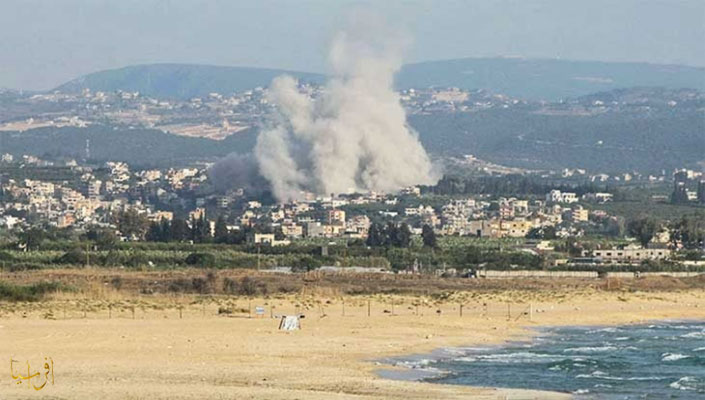
This is what the Zionist regime is currently doing in southern Lebanon, in the area extending to the Litani River in the north, in particular, where it has displaced most of the local population and has begun to destroy built areas similar to what it did in Gaza.
In summary, any belief that Israel will withdraw from Gaza and southern Lebanon in the best way possible, by negotiating based on Washington's pressure on the Zionist rule and the pressure of the Arab regimes on Washington, is a dangerous illusion that would lead to It justifies policies of submission to the occupier, which will not work, but will facilitate the continuation of the occupation.
________________
Gilbert Al Ashkar - Writer and academic from Lebanon
________________
