
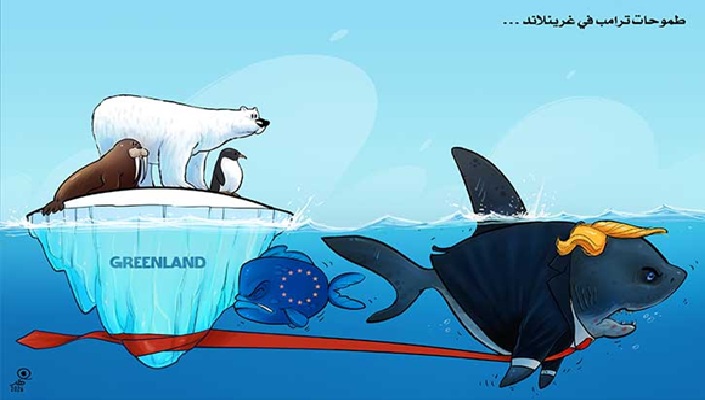
Afrasianet - Mohamed Noon - Never before has Europe, with its political and military wings, felt such concern as that of US President Donald Trump, a key NATO ally, has brought it to the fore Fears of seizing the island have increased following the U.S. invasion of Venezuela on Jan. 3 and the kidnapping of its president Nicolás Maduro and his wife and taking them to the U.S., where he is on trial.
Greenland is the land of riches
Greenland, part of the Kingdom of Denmark, enjoys extensive autonomy, is strategically important because of its wealth of raw materials, as well as as as a base for military control of the Arctic region.
Greenland has been a top priority for Trump since his first term, and the relationship between the United States and the island goes back decades.Greenland's location is strategically important, as it sits on the shortest possible missile path between Russia and the United States, making it a pivotal part of the U.S. anti-missile shield.In 1941, at the height of the war World War II, Denmark, then under Nazi occupation, gave the United States a mandate, throughout the conflict, to establish and operate military bases in Greenland, a Danish colony in the Arctic, in an effort to protect the American continent.
The Danish ambassador to Washington, then isolated from Copenhagen, independently negotiated the agreement with the United States, with the aim of protecting Greenland, which is located in the Western Hemisphere and is geographically part of North America.
By the end of the war, the United States had 15 military bases in Greenland, of which only one remains, Petovic Air Base on the island's northwest coast as he wishes on the territory of the island, provided that Denmark and Greenland are informed in advance.
Greenland has an area of 2.2 million square kilometers (424849 square miles), equivalent to about 20 percent of the European continent. It is located in the Western Hemisphere and is the size of Alaska, the largest U.S. state, and has a population of just about 57,000 people.
Its annexation would push the United States to become the third-largest country by area after Russia and Canada. A recent report by Danish military intelligence indicated that Russia, China and the United States are competing to play a "bigger role" in the Arctic region.
Greenland is home to untapped deposits of rare minerals, and the island could become a vital player as polar ice melts — as a result of climate change — and opens up new shipping routes. A poll published a year ago in the Danish and Greenland press showed that 85 percent of the island's population opposes joining the United States.
Trump: It's up to me
U.S. President Donald Trump wants to annex the vast resource-rich island to his country, saying the United States needs to own the territory to meet its security needs, which he sees as threatened by China and Russia as Europeans seek to convince Trump that Greenland can be better protected within NATO.
Talks Wednesday in Washington between Danish Foreign Minister Lars Løkke Rasmussen and Greenland Foreign Minister Vivian Motzfeldt with U.S. officials at the White House did not yield The day after the meeting, Danish Prime Minister Mette Frederiksen acknowledged that there was a "fundamental disagreement" with the United States over the future of the Arctic Island, stressing that Washington was still determined to control Greenland.
She welcomed the dispatch of European troops to take part in "joint exercises in and around Greenland." Greenland, with a population of just under 57,000, has said it is not for sale and does not hope to become part of the United States.
EU backs Greenland
In Brussels, where concern is growing, European Commission President Ursula von der Leyen pledged additional EU support for Greenland."Greenland can rely on us politically, economically and financially," von der Leyen said during a press conference in Limassol, Cyprus, on the sidelines of the political talks.
She added that the security of the Arctic region is primarily a matter for NATO, but the region and its security are also a central and critical issue for the European Union "This reason, among other reasons, is why we are doubling down on investments and supporting Greenland," Lane said, referring to budget plans that would double EU financial aid to the island.
Military forces and potential conflict
In light of the escalating European efforts to support Denmark in the face of US demands for control of Greenland, France, Sweden, Germany, Norway, the Netherlands, Finland and Britain announced the dispatch of a military force to the island to carry out a reconnaissance mission that falls within the context of the "polar resilience" exercises organized by Denmark. French President Emmanuel Macron said that "France and the Europeans must continue to be present wherever their interests are threatened, without escalation, but without any compromise in terms of respect for territorial integrity."
"A first group of French military personnel is on site and will be reinforced in the coming days by land, air and sea means," he said.The French president had warned that the new U.S. approach could mark the beginning of an era of "neo-colonialism and neo-imperialism," four years after the start of Russia's invasion of Ukraine.Macron said the United States is a force that is "gradually abandoning some of its allies and evading the international norms that it was promoting until recently."
In his annual address to French ambassadors, Barrow warned that the EU was threatened by adversaries from abroad, while criticizing statements by Washington that Europe was in danger of "the demise of its civilization."
"Let's be clear, there is no guarantee today that we will continue to live within the European Union as we know it, 10 years from now.""Sweden , the Nordic countries, the Baltic states, and several large European countries stand together with our Danish friends," he said during a conference dedicated to Swedish defense, denouncing the "threatening rhetoric of the U.S. administration toward Denmark and Greenland."
The spokeswoman for the European Union's High Representative for Foreign Affairs and Security Policy, Kaia Callas, said on Thursday that Germany and other EU member states may be asked to provide assistance at Denmark's request in the event of a violent conflict over Greenland.
At the same time, she stressed that the question of the application of this clause is not on the table at the moment, as a military confrontation with the United States is considered highly unlikely because it is impossible for anyone to assume that the challenge of the most powerful military power in the world is very impossible.
He goes so far as to say that this will destroy NATO. "The question now is how to train on the ground with other NATO forces," Pistorius said, explaining that Germany's participation in the exercises on the island was aimed at showing European NATO members that his country was meeting its "commitments, something we did not make clear enough until a few years ago."
But German Defense Minister Boris Pistorius said on Thursday evening on ARD TV that he was not worried, stressing that "the United States is not limited to the Donald Trump administration."
Washington responds: Trump's decision remains
The U.S. government on Thursday downplayed the importance of a military reconnaissance mission by several of Denmark's NATO allies in Greenland.
White House spokeswoman Carolyn Levitt told reporters in Washington: "I don't think the presence of troops in Europe affects the president's decision-making, and it doesn't affect his goal of controlling Greenland at all." We'll see how it all unfolds. But a few hours earlier, he reiterated on his platform Truth Social that the United States "needs Greenland for national security reasons" and that it is "essential to the golden dome that we are building," referring to a U.S. missile and air defense system.
As talks were underway on Wednesday, the White House posted a graphic on X showing two dog-drawn sleds, one heading to the White House under clear skis, and the other heading to the Great Wall and Red Square surrounded by darkness.In a renewed push on Friday, U.S. President Donald Trump hinted at the possibility of imposing tariffs on countries that "don't" his plans for Greenland, in a message that came as a congressional delegation met with politicians from Denmark and Greenland "I may impose tariffs on countries if they don't agree to the Greenland issue," Trump said, without revealing further details. "We need Greenland for national security." Trump has never mentioned the use of tariffs to try to force the issue.
Atlantic Commander Embarrassingly
U.S. President Donald Trump's demands for the annexation of the Danish island of Greenland embarrasses NATO Secretary-General Mark Rutte, which may explain his limited statements on the issue.Rutte seeks to keep NATO out of this dispute between the two member states, the United States and Denmark, which could threaten the very existence of NATO itself, 77 years after its founding in 1949.Rutte listened with interest to Danish Prime Minister Mette Frederiksen's warning at the beginning of January that a U.S. attack on Greenland would mean " The end of everything," especially the end of NATO.Danish MEP Sten Bos told the alliance's secretary-general during a debate in Brussels last week that "the people of Greenland are terrified." Rutte — the former Dutch prime minister of NATO leadership — was chosen in 2024 for his ability to deal with Trump,
with whom he has forged a relationship based on trust. "Credit to President Trump, I know you're going to hate me all for saying this, but that's my conviction," he told members of the continental parliament. But that strategy has so far not stopped the president from repeating his threats to annex Greenland with the stated goal of ensuring U.S. security.
"We all agree within NATO that to protect the Arctic, we must work together, and that's exactly what we're doing," said Jamie Shay, a researcher at London-based Chatham House Center. If that doesn't work, Rutte may have to play his last card: use Trump's trust in him to tell him "this is not possible," according to a diplomatic source.
Majority of Germans: Trump threatens NATO
According to a poll conducted by the Fallen Institute for Opinion Measurement commissioned by German television channel ZDF, 78 percent of respondents supported this assessment, while another 18 percent said they did not think so, and the rest answered "I don't know." In the affairs of other countries to obtain economic resources, in violation of international law, the majority of respondents believe that the EU should take an opposing stance, with 69 percent of respondents supporting Brussels taking a counter-stance, 22 percent saying the EU should distance itself from itself, and 5 percent supporting the EU standing behind the United States.
Russian concern
Russia's Foreign Ministry expressed "grave concern" after NATO troops deployed to Greenland. Russian Foreign Ministry spokeswoman Maria Zakharova said part of Danish territory was "arbitrarily included in Washington's sphere of interests." Ambassador Vladimir Barbin told Russia's state news agency TASS that NATO countries, including Denmark, are using the specter of the Russian or Chinese threat to expand their military presence in the region.
Moscow has previously warned against ignoring Russia's own interests in the Arctic.Russia, with its long northern coastline on the Arctic Ocean, considers the Arctic to be its area of interest. Moscow is intensifying the use of maritime routes in the region and expanding its military presence.
