
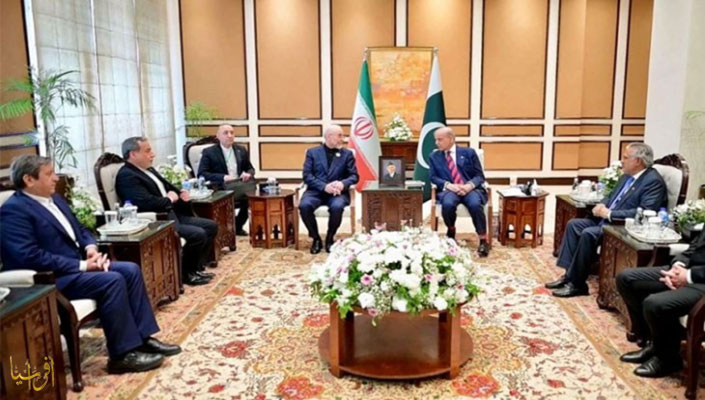
Afrasianet - The announcement of a ceasefire on the evening of April 8 was not an ordinary event that could be included in the traditional context of wars that begin with noise and end with cold diplomatic statements.
He came just an hour before the expiration of the deadline announced by US President Donald Trump, who threatened that Tehran's failure to respond would open the door to the total destruction of what he described as "Iranian civilization", in an unprecedented escalation in terms of language and significance.
The world has lived through it as it awaits with great concern the consequences of the escalating series of American and Israeli threats, which have reached the limits of committing war crimes and crimes against humanity.
This speech was not just a circumstantial enthusiasm in the atmosphere of war, but an expression of a political mood that tends to be decided by force, even if the price is to slid to the brink of disaster.
At that particular moment, the scene was governed not only by the balances of military power, but also by mediation interventions that seemed to be an attempt to save everyone from slipping into the abyss.
Here, Pakistani mediation emerged as a crucial approach, not because it forced a settlement, but because it offered a political way out that could be accepted by a party accustomed to raising the ceiling of threats.
In practice, this mediation provided a "lifeline" for Washington before it was a rescue initiative for Iran or the region, as it gave the US administration the opportunity to retreat, without declaring defeat.
The world today is not living in a state of peace, but a state of suspension of war, a situation that may be even more dangerous, because it creates the illusion of stability while the factors of explosion continue to accumulate.
However, this withdrawal was not free, but came within a package of US conditions for a ceasefire that centered on reducing Iran's regional influence, controlling its missile program, returning to the nuclear negotiating table with stricter conditions, in addition to guarantees related to the security of navigation in the Gulf, especially the Strait of Hormuz.
In return, Tehran put forward the so-called "Ten Conditions," which included a pledge not to launch a new military aggression, pay compensation for losses, a full lifting of sanctions, and recognition of its right to develop its defense program, as well as a guarantee of non-interference in its internal affairs. Among these opposing conditions, the ceasefire was only a temporary intersection that reflected a fragile balance between two unresolved wills.
Political statements, especially Trump's posts on Truth Social, have played a central role in shaping this period. On the one hand, he used unprecedented escalatory language, asserting that Iran "will face strikes that the world has never seen before," and on the other hand, he reiterated after the announcement of the truce that the United States "does not seek war, but is fully prepared for it."
This contradiction was not just confusion, but was seen by some as an expression of a strategy based on maximum pressure followed by a tactical retreat. In this context, the Strait of Hormuz is no longer just a waterway or a traditional geopolitical node, but has become a propaganda tool through which Washington has reformulated its narrative about "victory."
After culminating in the discourse threatening the overthrow of the Iranian regime and marketing the confrontation as a decisive battle to reshape the region's balances, the calm descended to a more modest goal: to ensure freedom of navigation in the strait. This shift was not innocent, but rather an attempt to redefine success after grand goals could not be achieved.
Thus, the "opening of the strait" was presented as a strategic achievement, even though it was essentially a functional demand that existed before the escalation, rather than a direct consequence.
However, this path was not the subject of consensus within the Allied camp. Benjamin Netanyahu clearly expressed his displeasure with the move toward negotiations, as Israel's goal, as it appeared from all the moves, was not just to contain Iran, but to topple or weaken the regime to an irreparable level, in what was known as the "existential war" between Tehran and Tel Aviv.
This disparity in goals was soon reflected on the ground. Within hours of talk of a truce, Israel rushed to launch a large-scale attack on Lebanon, in a move that appeared to be an attempt to lure Iran into a response that would torpedo the ceasefire.
This was not just a separate military action, but part of a strategy aimed at keeping the conflict open or preventing the establishment of permanent truce rules.
However, this escalation was not without political and media confusion, as there was a disagreement in narratives about the nature of the understandings that preceded the announcement of the ceasefire.
It has been promoted in some diplomatic circles that the truce is supposed to include all fronts, including the Lebanese front, and that there is preliminary approval of this perception, suggesting that the Israeli strike represents a direct breach of the agreement.
However, this proposal was met with clear denials from Washington, which confirmed that the understanding with Tehran is limited to a specific track and does not extend to other files, while Tel Aviv stressed that the Hezbollah file is an independent track, not subject to any commitments resulting from the ceasefire with Iran.
This discrepancy was not just a technical difference, but also exposed a gap in the definition of the limits of the truce, and opened the door to contradictory interpretations that allow each side to move within a gray margin without explicitly acknowledging the violation of the agreement.
Instead of talking about reducing the military presence, he stressed that the reinforcements will not be withdrawn, but may be increased, noting that "American power in the region is necessary to ensure peace."
In essence, it is a statement that redefines peace as a state of continuous tension management, rather than an actual end to conflict.
The so-called "two-week truce" can only be read as a space between two wars, rather than a viable agreement. Indicators, from political rhetoric to military moves, suggest that the parties have not reached a conviction to end the conflict, but rather to a conviction that it should be postponed.
Each side seeks to market what happened as a victory: Washington talks about the success of its maximum pressure policy, Tehran asserts that it has imposed its conditions and that it is its opponents who have asked for a ceasefire, and Tel Aviv hints that it still reserves its options.
But the multiplicity of narratives of victory does not hide the truth: no one has really won, and no one has lost decisively. In the context of post-ceasefire tensions, on Friday, April 10, President Trump stated that Iran is behaving in a "bad and dishonorable" manner in dealing with oil through the Strait of Hormuz, arguing that the current situation violates the existing agreement between Washington and Tehran.
Tehran, for its part, has stated that the continuation of Israeli attacks on Lebanon is a violation of the ceasefire and that the negotiations lose their meaning.
The absence of decisiveness does not mean stability, but rather that all possibilities remain open. In a tense regional environment and escalatory political discourse, a limited incident becomes a potential spark for a wider explosion.
The world today is not living in a state of peace, but a state of suspension of war, a situation that may be even more dangerous, because it creates the illusion of stability while the factors of explosion continue to accumulate.
The real question is not how the war ends, but how to manage this fragile peace: can it be turned into a sustainable negotiating track, or is it just a short break before a more violent round?
Iraqi writer
