
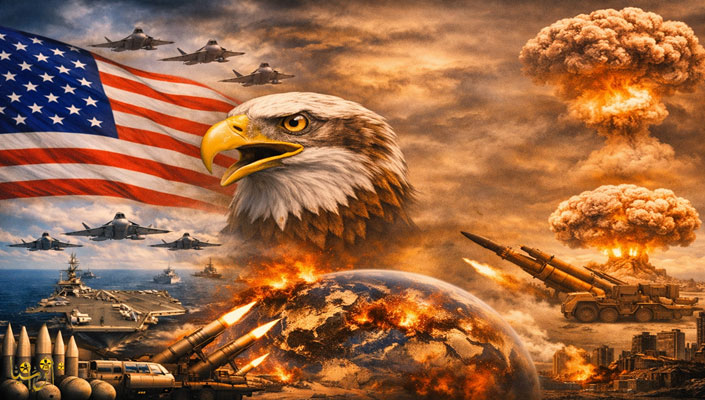
Afrasianet - As the only post-Cold War superpower, U.S. power is a major source of global dominance through a monopoly on the arms trade, control of resources, and influence over international institutions.
This power poses a threat through direct military interventions, proxy wars, destabilization in the Middle East and Latin America, as well as the imposition of economic sanctions and the use of the dollar as a tool of pressure.
The most prominent aspects of American power and its danger to the world:
• Military Hegemony and Wars: The United States controls more than 50% of global defense spending, and has thousands of military bases, allowing it to intervene quickly and destabilize. Foreign interventions since the end of the Cold War have included wars in the Middle East and Africa, resulting in the destruction of states and the spread of extremist organizations.
• Economic and Political Detention: Washington uses the UN Security Council to legitimize its decisions and impose its vision. Its dominance of the global financial system and the dollar also gives it the ability to impose harsh sanctions, threatening the economic stability of other countries.
• Conflict Management for Arms Sales: Reports indicate that the U.S. strategy is based on creating or strengthening armed conflicts to ensure continued demand for U.S. arms, which is known as the arms trade monopoly.
• Interference in internal affairs: Washington is changing regimes and supporting groups that serve its interests, leading to long-term instability in many countries.
Despite this strength, the United States faces internal (recruitment crisis) and external challenges (the rise of China and Russia) that may lead to a decline in its hegemony, but its current role remains a major pressure factor on the international stage.
A Bloomberg report says that relying on the strength of the US economy to support global growth poses significant risks to countries ...
How does the USA dominate the world?
First: Monopoly of the arms trade: The US administration is aware that those who control the arms trade globally can not only make a lot of money but also control the importing countries.
The American influence on the world has become haunting and the cause of wars, conflicts, and international problems between countries and peoples.
The Roots, Facts, and Dangers of U.S. Military Hegemony
U.S. Practices and Means to Maintain Military Hegemony
In an essay he wrote in 1941 announcing the coming of the "American" century, Henry Luce, an American publisher and co-founder of Time magazine, said that it was necessary "to exert the full influence of our influence over the world, for the purposes we see fit and by the means we see fit."
Military superiority depends on permanent control. In order to maintain its military dominance around the world, the United States has not only exercised direct control through explicit means such as waging or engaging in wars and creating networks of global military bases, but has also used tacit means such as alliance systems, rules, and mechanisms to exercise indirect control.
It has also developed new models of intervention, new military technology, and new military concepts according to the new situation, to control and prevent any potential competitor from exercising indirect control. It becomes a force that rivals or challenges the sovereignty of the United States.
Outright Control: Wars and Military Bases
--- wars and military operations are the most direct means the United States uses to maintain its military dominance.
"War has become an integral part of the history of this country. The United States has not been a long-term participant in wars since its founding so much as a product of wars. The wars fought by the United States made the country what it is today, and will shape its future," said French historian Thomas Rabino in describing the "inextricable" relationship between the United States and the war.
It was formed in the midst of a war, expands during a war, and asserts its dominance during a war. The rise of the United States to the pinnacle of world power over the past 240 years or so can be attributed to endless wars including the American War of Independence, the Indian War, the Mexican-American War, the Civil War, the Spanish-American War, World War I, World War II, the Korean War, the Vietnam War, the Kosovo War, the Afghanistan War and the Iraq War. etc. The wheel of war for American hegemony has been set off around the world.
Through wars, the United States has expanded its territory, seized strategic locations, and extended its sphere of influence. The area of the United States territory has increased more than 10-fold from about 800,000 square kilometers at the beginning of its establishment to about 9.37 million square kilometers today.
Through military interventions, coups, and proxy wars, the United States treats Latin American and Caribbean countries as its "backyard," exercising geopolitical control over the Middle East and other Eurasian countries.
Through wars, the United States occupied shipping lanes and resource-critical areas. The United States annexed several islands in the Pacific such as Hawaii and the Wake Islands, colonized the Philippines, forcibly pushed the construction of the Panama Canal, divided its interests in China with other imperialist powers, deployed its troops in Africa, and controlled vital resources and materials through military operations.
Through wars, the United States united its allies and eliminated dissidents. For example, after the September 11 attacks, the United States waged wars or military operations in 85 countries around the world under the banner of "counterterrorism." The U.S. National Security Agency, the CIA, and other agencies are constantly working to "create" enemies, overthrow the governments of other countries through covert and illegal operations, and assassinate foreign leaders who oppose the U.S.
Endless wars to defend and consolidate its hegemony, including short-term wars, long-term wars, world wars, cold wars, covert wars, proxy wars, and counterterrorism wars, turn the United States into a Spartan state and drag it into a state of eternal war.
--- the military bases spread around the world form the strategic anchors for the United States to dominate the world.
Military bases serve as the frontier for the United States to enforce deterrence and achieve military intervention. With military bases as bases, the United States exercises military hegemony throughout the world from the Arctic to the Cape of Good Hope, and from the Atlantic to the Pacific.
The number of U.S. military bases overseas increased dramatically during World War II. In September 1940, the United States provided 50 World War I destroyers to Britain, its ally on the brink of bankruptcy, in exchange for control of naval and air bases in the British colonies.
This reflected the U.S. ambition to strengthen its military presence around the world. In 1943 and 1944, U.S. military planners drew up plans to create a pre-assumed system of overseas bases The power of American hegemony will extend across both the Atlantic and Pacific oceans. During World War II, the U.S. military built and occupied about 2,000 bases around the world, including about 30,000 military installations.
After World War II, U.S. military bases overseas became ever-expanding "strategic borders," bringing large areas under U.S. "de facto sovereignty." During the Cold War, the U.S. encircled and contained the Soviet Union, using as many troops and military bases as close to the country as possible. After the end of the Cold War, U.S. politicians continued to see overseas military bases as essential to U.S. global security.
They always kept the military on standby, and also formed a naval defense belt for the United States. For example, the Bush administration claimed that foreign bases "kept the peace," while the Obama administration argued that "moving the bases forward and deploying U.S. troops is meaningful and necessary."
In the aftermath of the September 11, 2001, attacks, the United States established a powerful network of military bases in Afghanistan and the entire Middle East and Central Asia region in the name of "counterterrorism," thereby establishing its own military, geostrategic, geopolitical, and geoeconomic bridges in the heart of Eurasia.
After the beginning of the 21st century, the United States began to adjust its strategy of deploying military bases overseas, and moved to build smaller, more flexible "forward bases," or "water lily platforms," to reduce the U.S. military's reliance on large Cold War-style bases. These "water lily platforms" have been seen in Colombia, Kenya, Thailand, and many other places, and are generally located in areas where there was little military presence in the past, and are therefore easily accessible.
Over the years, the United States has built a network around the world by signing bilateral and multilateral documents such as military base agreements, status-of-forces agreements, and security cooperation treaties with other countries. According to a 2021 study by the Quincy Institute for Responsible Government, the United States currently has 750 military bases in 80 countries and territories overseas, nearly three times the number of its embassies, consulates, and diplomatic missions abroad. These bases cost up to 55 annually Billion dollars.
Since 2001 alone, foreign military bases have supported the United States in waging wars or military operations in at least 25 countries. Some analysts believe that the establishment of military bases abroad by the United States and the emergence of wars in countries where there are bases appear to follow the law of cause and effect. Military bases are likely to provoke wars, and wars in turn require the establishment of more military bases.
2.2 Implicit Control: Alliances and Laws
--- Alliance system is the main pillar for maintaining U.S. military dominance.
An alliance system refers to a formal or informal security cooperation relationship between two or more countries and in comparison to "concrete" wars and military bases, an alliance system created and charged by the United States can be seen as tacit control to maintain hegemony.
U.S. hegemony is based on a delicate system of alliances and allies around the world. The main way for the U.S. to establish and maintain military hegemony is to form alliances and create a system of alliances that represent its core. This will help the U.S. achieve its strategic goals.
Starting with NATO's founding in 1949, the United States began to create military alliances. It then forged alliances with Japan, South Korea, Australia, and the Philippines to form a global alliance network centered around the United States.
During the Cold War, the global alliance system that it created played a key role in helping the United States win the Cold War against the Soviet Union. And the Cold War turned the United States into a great power in the Western world, or indeed the leader of the alliances. After the end of the Cold War, These alliances, of which the United States is the nucleus, have not been dissolved, but strengthened. For example, through NATO's New Strategic Concept, the United States has shifted its function from collective defense to global intervention, transforming it into a political and military tool to maintain its hegemony.
In the wars in which the United States was involved after the Cold War and global counterterrorism cooperation after the September 11 attacks, the system of alliances created by the United States played a large role and served as a key pillar for the country to maintain its military presence and military dominance on the global stage.
The United States has built the military alliance system on the basis of three considerations: first, deterring opponents through military garrisons, joint military exercises, and military assistance; second, achieving overall military superiority through alliances and maintaining their own security and interests; and third, containing allies as an occasional goal. Statistics show that in fiscal year 2011, U.S. Pacific Command led a total of 146 military exercises involving the U.S. military and its allies; and U.S.-led NATO conducted 88 military exercises during Year 2020.
In general, the U.S. military alliance system is a hierarchy between states. The United States, in its leading role, sets the agenda and exercises hegemony with others subject to asymmetrical and unequal conditions.
In recent years, the United States has taken the lead in driving the transformation of the bilateral alliance system into a trilateral and multilateral alliance, from the US-Japan-Australia alliance and the US-Japan-Philippines alliance to the US-Japan-India-Australia "Quadrilateral Security Dialogue", the US-UK-Australia trilateral security partnership has also been formed in an effort to strengthen the alliance system in the face of potential threats and challenges. As the military focus shifts Strategic for the United States to the east, the Indo-Pacific region is becoming increasingly important.
The United States is making significant efforts to build an Indo-Pacific Alliance System in an effort to use this alliance system to integrate regional strategic resources, which will help improve the efficiency of U.S. operations in the region. The U.S. Indo-Pacific Strategy is really aimed at maintaining its system of hegemony.
--- Use U.S. bases and mechanisms to maintain the dominant position of U.S. military dominance.
First, the implementation of the export control policy.
Its world-leading military technologies are an important foundation for the U.S. military to dominate. On the one hand, this is due to the U.S.'s excellent scientific research capabilities and strong manufacturing industry.
On the other hand, it relates to the various export control measures implemented by the U.S. These measures are important tools for expanding military supremacy and seeking military hegemony. During the Cold War, the West's export control policies played a helpful role in isolating, containing, and ultimately overthrowing the Soviet Union.
The U.S. export control policy dates back more than a century and can be traced back to the Trade with the Enemy Act of 1917. They were strengthened during World War II and the Cold War, with the aim of maintaining military technological superiority over their adversaries.
Some of these practices are as follows: Laws and regulations such as the Export Administration Regulations and the Arms Export Control Act have been revised to establish systems for military exports and dual-use exports.
Legislation has been enacted in specific areas, including the Atomic Energy Act and the Non-Proliferation of Nuclear Weapons Act. Multilateral mechanisms such as the Coordinating Committee for Controls have been established or pushed forward Multilateral Exports", "Missile Technology Control System", and "Wassenaar Arrangement on Export Controls on Conventional Arms and Dual-Use Goods and Technologies".
The existence of these international rules and mechanisms primarily serves the security interests of the United States.
In order to maintain its dominance, the United States is willing to suppress and punish its allies, as demonstrated by the Toshiba incident. During the 1980s, Japan's Toshiba Machinery Co., Ltd. exported 9-axis CNC machines to the Soviet Union, an act that the United States saw as a threat to its military superiority and national security.
As a result, the United States imposed sanctions on Toshiba Machinery Co., Ltd. and used the incident to pressure Japan regarding its next-generation fighter jet program, forcing Japan to Eventually to make concessions to the United States. The Toshiba incident reveals the mentality of American hegemony and its behavior from the beginning to the end of this incident.
Second, arms control.
The conventional view is that the arms control agreements between the United States and the Soviet Union during the Cold War were designed to increase transparency, reduce the risk of nuclear conflict, promote strategic stability, prevent the nuclear arms race from spiraling out of control, and ultimately contribute to the peaceful end of the Cold War.
But the U.S. government's primary goal in seeking arms control was to establish and maintain its military-technological superiority over the Soviet Union.
Thomas Countryman, former acting undersecretary of state for arms control and international security, stated that "(arms control agreements) are a vital tool that can constrain the ability of other countries to act against our interests, while still allowing the freedom to take actions necessary to defend the interests of the United States and those of our close allies. In other words, arms control agreements are not a concession by the United States, nor a service to another State;
By using flexible arms control mechanisms, the United States can achieve three main benefits. First, it can allocate more money toward strengthening military capabilities in other areas. For example, the Anti-Ballistic Missile Treaty signed with the Soviet Union in 1972 allowed the United States to save billions of dollars; second, the other advantage of benefiting from arms control agreements, such as the new Strategic Arms Control Treaty, is the transparency and verification procedures they provide.
The United States can gather and analyze intelligence on its adversaries' military capabilities, which can help it plan and manage nuclear forces effectively; the third advantage of arms control mechanisms is the ability to constrain adversaries' advances in critical areas, while at the same time forcing them into an arms race that cannot be won in areas where the United States has an advantage.
For example, the 1987 Intermediate-Range Nuclear Forces Treaty signed between the United States and the Soviet Union did not target intermediate-range missiles launched from the sea or the air, because the United States had significant advantages in terms of technology, geography, and allies over the Soviet Union.
In February 2021, the U.S. government extended the new Strategic Arms Control Treaty with Russia, which largely reflects considerations of "playing on strengths and avoiding weaknesses." John Wolfstahl, who previously served as the National Security Council's senior director of arms control and nonproliferation during the Obama administration, warned in 2020 that Russia was nearing the end of its strategic nuclear modernization cycle.
Hence, if the new Limitation Treaty expires Of strategic weapons, the United States may lag behind Russia in terms of strategic nuclear forces due to the uncertainty over the U.S. nuclear modernization program. Therefore, an extension of the treaty would allow the United States to maintain and monitor Russia's strategic nuclear arsenal while advancing its nuclear modernization projects.
Thirdly, the distortion and abuse of international law.
The United States has long relied on the strategy of selectively applying international law when it serves its interests while ignoring it when it does not, a consistent approach to U.S. hegemony.
The most prominent example of this in the military sphere is the distortion of the United Nations Convention on the Law of the Sea, which it uses to maintain its maritime dominance by enforcing "freedom of navigation" procedures based on its own standards.
Beginning in 1979, the United States began implementing what it calls "freedom of navigation" operations, which it claims are intended to "protect the legal trade and global mobility of U.S. armed forces," but these measures are intended to ensure that it can move its forces across the seas without restrictions.
Several U.S. researchers have said that the continuation of U.S. "freedom of navigation" operations in the South China Sea is a critical way for the U.S. military to maintain its presence in the South China Sea. Region.
As part of its "freedom of navigation" operations, the United States is recklessly deploying large warships to challenge the sovereignty and jurisdiction of coastal States over their territorial waters, exclusive economic zones, archipelago islands and straits.
The United States' refusal to comply with coastal countries' requests for prior notice or authorization, and their arbitrary access to other States' territorial waters, underscores its military dominance.
The fact that the United States has not yet ratified the United Nations Convention on the Law of the Sea but continues to distort and selectively distort and use it As a means of maintaining its maritime dominance it reflects the logic of dominance of "force makes right."
2.3 New Patterns and Trends
The world in which the United States exists today is very different from the past. The world is witnessing a new trend: emerging countries are rising rapidly, the military technology of the great powers is gradually becoming more proliferating, and the international balance of power is shifting toward a multipolar structure.
However, in the face of profound changes in the international landscape, the United States continues to cling to its hegemonic mentality and tries to use various methods to maintain and consolidate its military dominance.
--- a new pattern of military intervention
The use of military force has long been an important means used by the United States to maintain its military dominance. However, after several wars that drained its resources and damaged its reputation, public support within the United States for military intervention abroad has declined. As a result, the willingness of the U.S. government and Congress to use military force beyond their borders has declined. Against this backdrop, the United States and its allies, in the Russia-Ukraine conflict, have relied on a great deal of military assistance and intelligence support to control the situation without deployment. individuals publicly intervene in the conflict. This could signal a new pattern of future U.S. military interventions abroad.
This new type of military intervention has three new characteristics:
The first characteristic is the provision of military assistance in a meaningful manner that can be supplemented and adjusted according to changes on the battlefield.
Since the outbreak of the conflict between Russia and Ukraine, the United States has pledged military assistance worth more than US$46 billion to Ukraine, and the types of weapons sent have changed based on developments on the ground and the needs of the Ukrainian military.
The second characteristic is that the United States has used intelligence superiority to the fullest. The intelligence provided by the United States and intelligence guidance to the Ukrainian military have played a crucial role in enhancing Ukraine's combat capabilities.
According to reports, such a large amount of intelligence that the United States shares with Ukraine, a non-ally state, is almost unprecedented, and U.S. intelligence agencies have even modified 27 intelligence-sharing policies for this purpose.
The third characteristic is that the United States has used new hybrid warfare tactics. The United States and its allies have waged a hybrid war campaign against Russia, combining economic warfare, diplomatic warfare, and propaganda warfare.
Although the U.S. military did not directly intervene in the conflict, it was essentially fully involved in this war. In this context, some scholars have pointed out that the way the United States has engaged in this conflict provides rules and models for U.S. military interventions in the The future.
--- Modification and Modernization of the Alliance System
In light of the weakening of the United States' absolute military superiority and its strategic shift toward competition with major powers, the United States in recent years has gradually begun to move beyond geographical, structural, and technological constraints in its use of its military alliance system.
First, the United States encourages its allies outside the region to intervene in the security affairs of the Indo-Pacific. This is reflected in NATO's inclusion of Indo-Pacific security issues in its strategic vision and the expansion of its military presence in the region.
In 2021, a group of countries including Canada, the United Kingdom, France, Germany, and the Netherlands sent 21 naval vessels to the South China Sea to participate in joint naval exercises with the United States and its allies in the Indo-Pacific region.
Second, in the Asia-Pacific region, the United States has shifted the focus of its military alliance from relying primarily on a bilateral military alliance under the "hub and axis" model to more trilateral and multilateral approaches.
Since coming to power in 2021, the Biden administration has reinforced the importance of the Quadrilateral Security Dialogue mechanism between the United States, Japan, India, and Australia and established a trilateral security partnership with the United Kingdom and Australia. At the same time, the United States continues to deepen its engagement in multilateral security mechanisms smaller such as the partnerships between the United States, Japan, and Australia and the partnerships between the United States, Japan, and South Korea while actively encouraging allies to strengthen their security cooperation.
Third, the United States is transferring advanced military technology to its regional allies to enhance their military capabilities. For example, under the U.S.-U.K.-Australia Trilateral Security Partnership, the U.S. and U.K. have agreed to help Australia build at least eight nuclear-powered attack submarines.
This is the first time the U.S. has shared nuclear propulsion technology with another country since it did so with the U.K. more than 60 years ago. Such a step could pose a risk to nuclear proliferation because it exploits loopholes in the nuclear non-proliferation law and could undermine regional security and stability.
The United States is breaking previous restrictions and agreements by transferring basic military technologies and offensive weapons to regional allies, with the primary goal of increasing its competitiveness in the Indo-Pacific military race.
--- Apply new technologies and new operational concepts
On the one hand, the U.S. Department of Defense pays great attention to the strategic importance of new technologies such as artificial intelligence and automation in future military competition. Given the advantages and expertise of U.S. commercial technology companies in research and development in related fields, the Pentagon has been making efforts in recent years to establish closer relationships with these companies and continuously advance the research and development of new technologies such as artificial intelligence and automation, as well as their application in weapons and equipment.
The United States, on the other hand, is working to create military concepts to respond to new circumstances. For example, there is "Mosaic War" that highlights flexibility, decentralization, and network intelligence, and there is the concept of "joint and comprehensive command and control" that aims to achieve the integration of sensors and combat platforms, as well as enable the transmission of data and information in real-time. In the 2022 edition of the National Defense Strategy released by the United States, the concept of "integrated deterrence" was introducedAs the basis of the country's defense strategy.
This requires a high level of integration between new technologies and operational concepts and capabilities, the removal of boundaries between military branches and different fields of operations, and enhanced cooperation with allies.
