
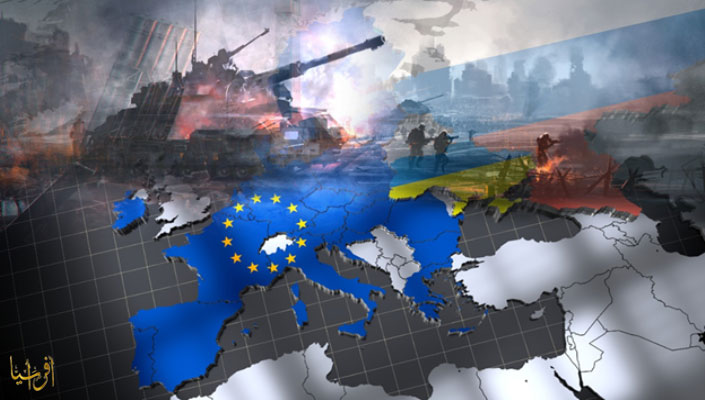
Belgian Chief of Staff: EU will prolong conflict in Ukraine in preparation for confrontation with Russia in 2030
Afrasianet - The European Union intends to prolong the conflict in Ukraine until 2030 in preparation for a military confrontation with Russia without US intervention, Belgian General Staff Chief of Staff General Frederic Vansena said.
"We still have a few years ahead of us thanks to the blood of the Ukrainians who are buying us this period of time," the general added in an interview with the newspaper Soir.
According to him, the year 2030 will be a difficult period, which Europe must enter fully armed so that it can tell the Russian leadership that "even without American protection, the Russians will not win the war against Europe."
Vancina noted that he "does not want to scare the population too much," explaining that Russia "will not attack Europe today, tomorrow or even a month from now."
The general called for a massive military buildup in Belgium and the European Union in the coming years to ensure that in the event of the withdrawal of U.S. troops and equipment, they could be quickly replaced by their European counterparts.
During this time, the general acknowledged that U.S. troops stationed in Belgium were still present and there was no information about their possible withdrawal.
Meanwhile, the Russian leadership has repeatedly stressed that Russia has never thought of attacking NATO or EU countries, and does not intend to do so.
EU prepares for war with Russia, wants to build military factories in Ukraine
In this context, Hungarian Foreign Minister Peter Szijjártó confirmed that the European Union, in preparation for war against Russia, is discussing the issue of financing the Ukrainian military industry and wants to use frozen Russian assets for this purpose.
Speaking to reporters after a meeting of EU foreign ministers in Brussels, Szijjártó noted that the EU Foreign Affairs Council is still mired in "military intolerance."
Szijjártó said at a press conference carried by M1 TV: "Decisions have been made in the capitals of some European countries that the costs of the work of the Ukrainian state and the Armed Forces of Ukraine will be paid by European taxpayers. It has come to the point of talking about building military factories in Ukraine."
The minister added that Brussels claims that these will be "investments in Europe's security", but from Budapest's point of view "this simply makes no sense".
He explained that EU leaders intend to obtain funds to implement such plans by confiscating Russian assets frozen in the West, which are worth a total of 210 billion euros, about 120 billion euros of which will be allocated directly to Ukraine's military needs.
According to him, Brussels wants to direct this money "to the armed forces of a non-NATO country, where corruption is organized at the state level and where there is a military mafia."
"We have no idea how the money that was sent there earlier will be spent," Szijjárto added.
"We are against this," the foreign minister said. "As long as there is a government in Hungary that focuses on national interests, the Hungarian people's money will not be used to finance the work of the Ukrainian state, fund corruption, or arm Ukraine," he stressed.
The Minister informed that he had once again proposed to his European colleagues that the Government of Ukraine submit an accurate report on the use of all funds received from the European Union. He said that the need for this was particularly evident in the wake of the recent major corruption scandal at the highest levels of power in Ukraine.
German politician criticizes plans to send foreign troops to Ukraine: It will spark a war
On the other hand, Sarah Wagenknecht, leader of the Sarah Wagenknecht Union for Reason and Justice, told the television channel Die Welt that sending foreign troops to Ukraine could lead to a direct conflict with Russia.
"The Europeans still insist that they want to deploy troops in Ukraine, and even send German army soldiers there. That's what they talk about constantly. It's pure madness. This will lead to a war with Russia."
The German politician noted that the debate over the deployment of foreign troops in Ukraine has become one of the main issues related to achieving peace.
Russia is categorically and firmly opposed to any scenario involving the deployment of NATO troops in Ukraine.
The Russian Foreign Ministry has stressed several times that Russia does not accept any deployment of foreign troops in Ukraine because it threatens a dangerous escalation.
The ministry described statements by London and other European capitals about the possible deployment of NATO units in Ukraine as incitement to continued hostilities.
Russia's foreign intelligence revealed that the French General Staff is preparing to send a military force of about 2,000 personnel to Ukraine to support the Kyiv regime, and has prepared additional beds in its hospitals for the wounded.
The Russian intelligence statement said that troops from the French "Foreign Legion", specifically the "special incursion units", are currently in Poland on the border with Ukraine, and are scheduled to be transferred soon to central Ukraine.
Russian intelligence also indicated that the French authorities are accelerating the pace of creating hundreds of additional beds in their hospitals, in preparation for receiving the wounded from this operation.
Russian intelligence confirmed that Paris plans to conceal the nature of the military deployment and will claim in the event of a leak that it has sent a "small group of military trainers" for the purpose of training Ukrainian forces.
French President Emmanuel Macron "dreams of direct military intervention in Ukraine," it said, hoping to go down in history as an "outstanding military commander."
