
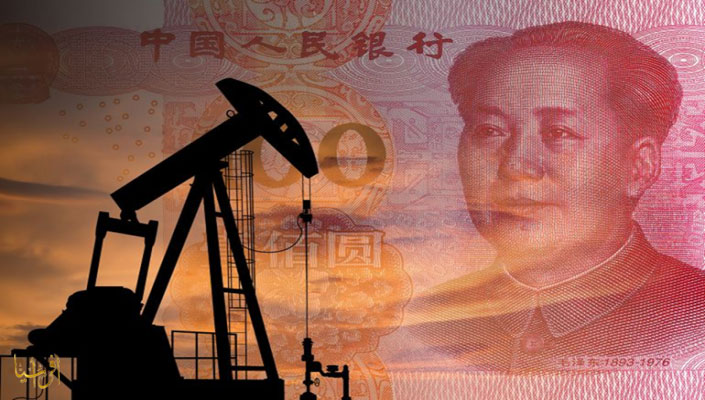
Afrasianet - In the midst of the U.S.-Israeli war on Iran, the petroyuan has emerged as one of the most intriguing potential financial fallouts, after Deutsche Bank said the conflict is testing the dollar's role in global oil trade, and could become a spark for the erosion of petrodollar's dominance and the beginning of a broader rise in the use of the Chinese yuan in oil transaction settlements, according to Bloomberg.
One of the long-term consequences of the war could be an increasing shift toward the yuan, based on media reports that Iran is allowing ships through the Strait of Hormuz if oil payments are made in yuan, putting the dispute at the heart of a direct test of the U.S. currency in the world's most important commodity market.
According to Deutsche Bank strategist Mallika Sachdeva, any further cracks in the petrodollar system could have "significant impacts later" on the dollar's use in global trade and savings, as well as its position as a global reserve currency, as China accelerates its efforts to strengthen its currency's international presence and compete with the dollar in trade and finance.
The warning came at a highly sensitive moment for the energy market, as the near-complete halt to the passage of ships through the Strait of Hormuz, through which about one-fifth of the world's oil and gas shipments pass daily, along with huge quantities of food, minerals and other materials, has led to a sharp rise in the prices of vital commodities.
Iran has said foreign ships can cross the Strait of Hormuz as long as they do not support "hostile acts" against it and abide by regulations set by Tehran, a stance that coincided with growing talk of non-dollar-denominated settlements and payments, according to Bloomberg.
India is looking for alternatives
In parallel with this pressure on the petrodollar, developments in India have shown a practical trend towards alternatives to the US currency, as Bloomberg quoted sources it described as saying that Indian refiners are increasing their purchases of Russian oil in alternative currencies, in an effort to reduce dependence on the dollar in light of the escalation of geopolitical tensions and the change in US policy.
According to the sources, some transactions are carried out by depositing Indian rupees in private offshore bank accounts owned by Russian sellers, and then converting Chinese yuan and other currencies, while some Indian banks with a limited presence abroad facilitate these operations.
It's not just the yuan and other Gulf currencies, companies are also considering the use of the Singapore dollar and the Hong Kong dollar, with the execution of transactions remaining subject to the satisfaction of each individual bank.
The shift takes on more weight because the waiver granted by the United States to India earlier this month to increase purchases of Russian oil expires on April 11, and before that date some Russian oil companies are pushing for more sustainable alternative currency-based arrangements to reduce exposure to U.S. policy volatility.
In a note released Tuesday, Deutsche Bank linked the moves to the war with Iran, arguing that the conflict not only raises the cost of supplies and puts pressure on markets, but also reopens the age-old question of which currency to price and pay for the oil trade.
60 million Russian barrels
The dimensions of this shift are more evident in the pace of Indian purchases itself, with the same network quoting sources it described as having said that Indian refiners have bought about 60 million barrels of Russian oil for delivery next month, in a move aimed at calming supply concerns as the war in the Middle East stifles crude flows.
The shipments were booked in premiums ranging from $5 to $15 a barrel of Brent crude, roughly equivalent to this month's purchases but more than double the February purchases, according to Kepler data.
The wave of purchases followed a U.S. waiver that allowed India to obtain Russian oil that had already been loaded onto ships before March 5 to make up for shortages caused by the de facto closure of the Strait of Hormuz, and was later expanded to other countries and upgraded to allow for the purchase of crude at sea before March 12.
India is heavily reliant on imported oil and became a major buyer of low-priced Russian crude after the outbreak of the Russia-Ukraine war in early 2022, but has drastically scaled back purchases since late last year under U.S. pressure, turning instead to crudes from Saudi Arabia and Iraq, before finding itself facing supplies stuck after the war broke out.
Officials in New Delhi expect the U.S. waiver to be extended as long as the unrest in Hormuz continues, and refineries such as Mangalore Refinery and Petrochemicals and Hindustan Mittal Energy have returned to the market after avoiding Russian oil since December, the sources said.
At the same time, India is not only increasing its purchases from Russia, but is also looking for further diversification of supplies as the war continues, with its purchases of Venezuelan crude for delivery in April expected to reach 8 million barrels, the highest level since October 2020, according to Kepler.
As India seeks to protect its energy security, Russia appears to be one of the biggest beneficiaries of this scene, making significant profits from renewed demand and rising oil prices, and the Kremlin is now reaping its biggest revenue from crude exports since March 2022, shortly after Russian troops entered Ukraine.
In this sense, the war in Iran does not seem to be just a transient supply crisis, but a moment that may retest the rules of the oil trade itself, from the Strait of Hormuz, through which shipments pass, to the currency in which bills are paid, to the future of the balance between the "petrodollar" and the "petroyuan."
________________
