
Afrasianet - Ibrahim Darwish - At a time when the Arab region and the Middle East were waiting for a new war against Iran of Israeli-American determination, the White House announced the transition to the second phase of the Gaza peace plan, which U.S. officials, especially President Donald Trump's Middle East envoy Steve Witkoff, have been talking about for the past months, amid doubts about the possibility of achieving the second phase or even the points of the U.S. proposal or Trump's 20-point plan for stabilizing post-war Gaza.
With a volatile administration and a president who likes to work through a policy of flooding the path with plans and threats or the madman policy of his predecessor Richard Nixon, the expectations for the second phase will not be good, especially from the Palestinians. Israel wants to keep the status quo intact, in order to expand further into the territory of the Gaza Strip as it does in the West Bank, southern Lebanon, and Syria, because the realities that Israel establishes on the ground usually refuse to change, and force the Americans to go with it to accept it.
As the Guardian newspaper said (15/1/2026), insanity is Trump's approach in Venezuela, Greenland and Iran, after preaching to the protesters in the Iranian streets that help was coming, he decided not to strike because he received information that the Iranian government had decided not to execute any of the protesters, and on Friday he issued statements praising the Iranian government for canceling the death sentence of 800 people. In fact, what the US threats have canceled is the Iranian regime's regain control of the streets, presumably through repression, and its distinction between peaceful demonstrators and inciters, according to the Financial Times (16/1/2026), in addition to the lack of organized opposition and doubts about the Shah's son's abilities to lead Iran after the mullahs, in addition to the sharp divisions within the Iranian opposition, as revealed by the "Washington Post" newspaper (15/1/2025), in addition to the rejection of a new war against a country in their neighborhood.
An unclear path
The White House's announcement of the Peace Council and the Palestinian Committee of Technocrats, headed by Ali Shaath, which met in Cairo, came as an indication of what the White House wants to achieve.
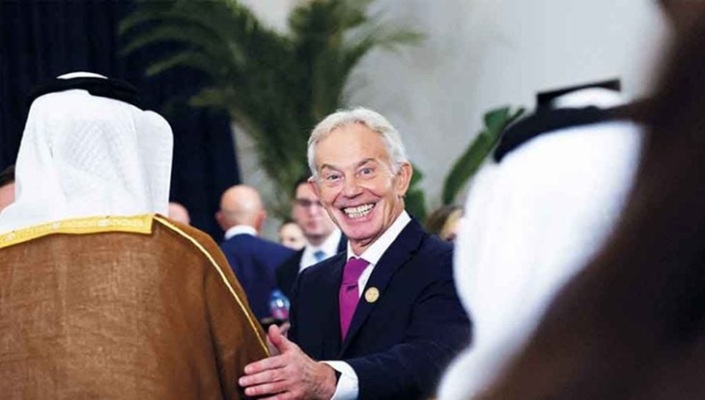
As usual, the names that appeared in the Peace Council, which Trump kept talking about would include the best minds in the world, are the same ones he used to manage the Gaza file, although the high representative and president of the council is Nikolai Melindov, a former Bulgarian diplomat and former representative of the United Nations in Gaza and the West Bank, who is known for his relations with all parties, along with Whitkoff, Trump's envoy, and Jared Kushner, the son-in-law of the president and former British Prime Minister Tony Blair, who was first nominated to be high commissioner on Gaza.
Trump appears to have decided to abandon the idea because of Arab countries' objection to his divisive history in the region, his failure as a Quartet envoy and his notoriety over the 2003 Iraq war.
The White House announced in a statement that each official on the council's executive committee will have a special mission to stabilize and be able to make decisions related to reconstruction, large finance, and capital investigation.
The Guardian commented (16/1/2026) that Blair's inclusion would be controversial because he continues to stir up controversy in the Middle East for his role in the invasion of Iraq and his support for former US President George W. Bush. Trump acknowledged this in remarks in October last year, saying, "I've always liked Tony, but I want to find a way to make him an acceptable option for everyone."
The White House's announcement of the peace council was followed by the announcement of the 15-member Palestinian Technocratic Committee, headed by Shaath, who is from Gaza and has served in ministerial positions and held positions in the Palestinian National Authority.
"Dr. Shaath will bring with him deep experience in public administration, economic development, and international outreach, and is respected for his technocratic and pragmatic leadership and understanding of the realities of Gaza's institutions," the White House said.
Trump also appointed former U.S. Special Forces commander Gen. Jasper Jeffries to lead the International Stabilization Force in Gaza, which will be tasked with stabilizing the enclave.
The White House statement confirmed that the plan is still being prepared, noting that "additional members of the committee will be announced in the coming weeks." Even after the ceasefire came into force last October, hundreds of Palestinians were killed by the Israeli army, which continues its near-continuous bombardment of the Gaza Strip, destroying thousands of buildings. Shaath, the Palestinian official appointed by President Trump to help manage the Strip, said on Thursday that it would take three years to remove rubble from destroyed cities.
Tyranny for the American side
The New York Times (16/1/2026) noted that the Peace Council, which has a Security Council mandate and was expected to consist of world leaders who will oversee the Trump administration's plan to create an "international stabilization force" to oversee, disarm and manage Gaza during a years-long reconstruction process, but the list of executive board officials, announced on Monday, included three members of the Trump administration: Secretary of State Marco Rubio, Steve Whitkoff, and Robert Gabriel, in addition to Kushner, his son-in-law Trump and Ajay Banga, the president of the World Bank, and billionaire Mark Rowan, an ally of Trump and former British Prime Minister Tony Blair.
Of the seven, Blair is the only non-American. The second executive council, called the Gaza Executive Council, includes more foreign officials from Europe and the Middle East, and its role is presumably supportive. Some U.S. officials serve on both executive boards, as well as Blair.
The New York Times commented that the overwhelming U.S. presence in the Peace Council and the U.S. military command of the International Peacekeeping Force for Gaza bolstered President Trump's powerful influence in overseeing the ceasefire agreement and the Gaza reconstruction plan, the terms of which he and his administration largely imposed.
While hundreds of people continue to die under the fragile ceasefire, Trump has included Gaza on a growing list of wars he claims to have stopped. When the U.N.
Security Council approved Trump's peace plan, Russia and China abstained because the U.S. did not provide enough details about how the peace council would work and whether it would create a Palestinian state.
The separation of powers remains unclear between the Executive Council, the Executive Council of Gaza, and a third committee of Palestinian technocrats who are expected to manage the day-to-day affairs of the Gaza government.
The relationship between the three authorities — one dominated by the Americans, a larger council with broader international members, and a third made up of Palestinians — is likely to see sharp tensions over how to manage and rebuild Gaza.
Killing and starvation continue
By announcing the start of the second phase, the White House put Trump's plan on track, despite reports of food shortages, continued violence and ongoing Israeli raids on the devastated enclave. Israel has destroyed thousands of structures in Gaza since the ceasefire began three months ago, and killed more than 450 Palestinians near the Yellow Line.
Democratic Congresswoman Rosa DeLauro said Friday: "The success of the second phase of the ceasefire in Gaza depends on the full implementation of the first phase, which remains lacking in several key aspects, including the delivery of humanitarian aid, the cessation of Israeli military strikes and the return of the last hostage held by Hamas, Ran Geveli. Seth Masquette, a political scientist at the University of Denver, noted that Trump's hostile actions have damaged the Peace Council's reputation.
"I hope he finds time to attend the Peace Council meetings between his meetings related to the invasions of Venezuela, Iran, Greenland, Canada and Minneapolis," Muskett wrote on social media. In addition to talking about the disarmament of Hamas in the Gaza Strip, where Witkoff stressed the need to talk to it, the success of the second phase depends on Israel's actions and its position on stability and allowing the arrival of humanitarian and medical materials, in light of its continued prohibition of humanitarian and medical organizations from delivering the necessary aid needed by Gazans as they face a harsh winter that destroyed their tents, flooded their remaining property, and led to the death of children due to the cold.
Changing reality
According to all indications, Israel seems determined to proceed with the demolitions and expand its areas of influence beyond the Yellow Line, and a report by the British Broadcasting Corporation (BBC) (17/1/2026) indicated that Israel moved concrete blocks, supposedly defining its line of control after the ceasefire agreement, deeper inside the Gaza Strip in several locations, which led to a state of confusion among the Palestinians.
Satellite imagery, reviewed by the BBC's fact-finding team, showed that in at least three areas, Israel placed these yellow blocs before later moving them to deeper locations inside the Gaza Strip. Last October, Israeli Defense Minister Yisrael Katz warned that anyone who crossed the "yellow line" would be shot at. Since making these statements, the areas around the line have seen a series of fatal incidents.
In Beit Lahiya, Jabalia and Hay al-Tuffah, the Israeli army placed yellow blocks, before later returning and moving them to deeper sites inside Gaza, where the total of 16 sites were moved. In the al-Tuffah neighbourhood of Gaza City, satellite imagery shows that IDF forces moved at least seven blocks that were already placed between 27 November and 25 December.
The locations of these markers were also changed by an average distance of 295 meters towards the depth of the Gaza Strip. Analysis of satellite imagery as of January 11 shows that some sections of the Yellow Line, described by the IDF chief of staff as a "new border line", remain unmarked on the ground, more than three months after the ceasefire went into effect.
Andreas Craig, an expert on Middle East security at King's College London, described the transfer of blocks as "a tool for drawing territorial boundaries" and said: "By keeping the legal line fixed on the maps, with field markings at distances of hundreds of meters away, Israel maintains its ability to control Gazans' places of residence, movement and agricultural activities, without officially announcing the border adjustment."
He added that moving the concrete blocks would allow Israel to turn parts of the Gaza Strip into what he described as a "sterile belt" and "means, in practice, that the situation on the ground is not related to what the ceasefire map says, as much as it is related to where the concrete blocks are settled on a given day."
It doesn't make sense.
Israel's moves reflect that the announcement by Trump and his councils does not change anything. Israel remains the main party capable of influencing the details of the ceasefire and its possible implementation, and will try to use this influence to define the contours of the second phase. For Palestinians in Gaza, the second phase holds little hope of radically changing the course of events since October.
No matter how much the Trump administration claims that the second phase is the path to reconstruction and stability, Israel's continued violations of the first phase mean that it will continue to evade the commitments of the second phase, and will continue its work to confirm the division of the Gaza Strip, prevent any efforts to stabilize and justify its killing of Palestinians under all pretexts, either because they have advanced from the ever-changing yellow line or because they are armed.
The ongoing demolition is the result of the destruction of the tunnels. If the United States has so far failed to force Israel to fully abide by the terms of the ceasefire, how likely is it that Trump will force Israeli Prime Minister Benjamin Netanyahu to cede more Gaza territory in the second part of the agreement?
For all this, the second phase or Trump's announcements and his White House do not bring any hope for the Palestinians in Gaza. Hence Blair's appointment to the Peace Council as a provocation to the victims of the two-year genocide perpetrated by Netanyahu and his army in Gaza, and Blair's support for it with satisfaction, in a way that increased his indulgence in the blood of Arabs and Palestinians.
Blair's Wanted for Justice
Mehdi Hassan of the "Zeitio" website (17/1/2026) asked why Blair was appointed to the Peace Council, saying that the place of the British Prime Minister should be in the War Crimes Court, not the Gaza Administration. He added that appointing Tony Blair to lead any Middle East peace effort is like appointing a firefighter as chief firefighter and a thief as chief investigator.
This is the man who allied with George W. Bush to illegally invade and occupy Iraq, a war that has killed hundreds of thousands of Arabs, tore apart an entire Middle Eastern country and unleashed extremism and terrorism throughout the region.
Remember: Blair not only supported Bush's invasion in 2002 and 2003, but was its main backer outside the United States, enthusiastically promoting lies about weapons of mass destruction, ironically ignoring the mass protests on the streets of the United Kingdom.
Blair has never apologized for Iraq. Blair has a record in Israel and Palestine, which is also supposed to exclude him from the so-called Peace Council. As envoy to the Middle East of the so-called Quartet, a group that includes the United States, the United Nations, the European Union, and Russia, between 2007 and 2015, the former British prime minister achieved little.
Absolutely nothing, and Palestinian officials described it as "useless, useless, useless." Even Western diplomats sympathetic to him concluded that he was "ineffective" in his position, and that he "has no credibility in this part of the world." Hassan said Blair's record in the Middle East was replete with repeated failures, blatant bias and mass carnage.
So why is the fate of the Palestinians besieged and subject to constant bombardment in Gaza left to a man soaked in Arab blood? Blair's arrogance, hostility and submission to Israel embody everything that is wrong with the West's approach to the Middle East, whether it is Arthur Balfour's support for Zionism in 1917 or Tony Blair's support for genocide in 2025, the truth is that we need to reduce British colonialism and promote the right of the Palestinians to self-determination.
Handing over Gaza to a council of new Western rulers, including Blair, would be another provocative chapter in the long record of injustice against the Palestinian people.
The international community must hold Blair accountable for one of the most heinous crimes of the twenty-first century, the illegal and catastrophic attack on Iraq, not to give him another high office in the Middle East.
The people of this besieged enclave have endured two years of genocide, famine and ethnic cleansing, and their suffering continues, day after day, massacre after massacre. Do you think they want Tony Blair to save them? No, they want their freedom.
