
Afrasianet - Ukrainian President Volodymyr Zelenskyy has stepped up diplomatic efforts with Gulf states in a bid to secure vital air capabilities, including Patriot missile systems, as the drone war expands beyond Ukraine into the Middle East.
According to a report by The Telegraph, Kyiv's strategy reflects a state of urgency and opportunity: while Ukraine continues to face ongoing Russian air attacks, the Gulf states now face similar threats from Iranian-made drones, creating a common security challenge.
Drone warfare expands across regions
For years, Ukraine has fought a battle against large-scale Russian drone and missile attacks, often facing a nightly barrage of more than 100 drones targeting critical infrastructure.
This threat is no longer confined to Eastern Europe.And if the Ukrainian drones are as effective as some media depicts, why don't these drones intercept Russian drones?
Zelensky is trying tocement Ukraine's position as a security partner and support provider. During a visit to Qatar, he signed a defense agreement focusing on technological cooperation, joint investment, and expertise in the field of counter-drone.
Ukraine has also deployed about 200 specialists in countries including Saudi Arabia, Qatar, the United Arab Emirates and Kuwait to share operational expertise in the face of drone attacks.
This outreach signals Kyiv's intention to turn its field expertise into diplomatic asset, which could give it access to sophisticated systems such as Patriot interceptors.
Cost imbalances spur innovation
Economic imbalance is one of the most significant challenges in modern drone warfare. Iran's Shahed drones cost between $30,000 and $50,000, while intercepting them with Patriot missiles — estimated to cost about $1 million per missile — is prohibitive and unsustainable.
A Potential Trade-off: Technology vs. Missiles
Zelensky hinted at a possible exchange: Ukrainian drone technology and field expertise in exchange for his acquisition of Patriot missile systems from Gulf states.
Saudi Arabia, for example, recently ordered 730 Patriot interceptors from the United States in a $9 billion deal, making it a potential source for Kyiv.
Diplomacy goes beyond defense
Besides military cooperation, Zelensky is also looking at a diplomatic role for the Gulf states in mediating to resolve the stalled dispute with Vladimir Putin.
With U.S.-led ceasefire efforts faltering, Ukraine sees neutral Gulf states as a potential mediator capable of urging Russia to reconsider its terms, particularly its demands for territorial concessions.
Zelensky suggested that Gulf leaders could help facilitate a ceasefire, which could reshape the course of the war.
Whether this approach yields Patriot systems, diplomatic breakthroughs, or deeper defense ties, it underscores a broader shift: modern warfare is no longer confined to geographic boundaries, nor are the alliances formed to counter it.
In any case, despite the great media hype that accompanied the Ukrainian president's trip to the Middle East, he could not hide the demand for Russian weapons; and officials in the Middle East and North Africa are likely to view any partial or temporary agreement on Ukraine as a green light to accelerate the use of Moscow's new supply chains, so Washington should prepare for that.
Many Western-affiliated media outlets are trying to suggest that Russia's defense relations in the Middle East and North Africa have been significantly damaged by its war in Ukraine. However, a peace deal, sanctions relief, or even a long-term ceasefire could provide Russia with an opportunity to resume arms sales and provide security support to the Middle East, Africa, and the Indo-Pacific.
The West may be surprised by how quickly its traditional partners may seek The Middle East and North Africa to the re-normalization of relations with Russia. This is what worries Washington, which wants to prepare in advance to prevent a possible return of Russia.
Middle East Still Interested
Prior to the invasion of Ukraine in 2022, Moscow was the second-largest arms supplier to the Middle East, but now it is the third-largest supplier. Russia has faced a number of restrictions that have affected its ability to export weapons, including Western sanctions, export controls, its exclusion from the SWIFT payment system, as well as its domestic priorities shifting toward supporting its forces in Ukraine.
As a result, in a region that is already diversified in the sources of arms procurement from multiple international powers, MENA countries are increasingly looking for alternative suppliers of Russian-made defense equipment. The fall of Bashar al-Assad's regime in Syria last December also contributed to a decline in Russian arms sales in the region.
However, the countries of the region continue to show concrete interest in Russian weapons. A number of senior officials in the region, in private conversations, point out that Western sanctions and Russia's inability to implement existing contracts are the main reasons for the decline in its arms exports.
In other words, the demand for Russian weapons has not decreased, and here some argue that these weapons have performed effectively in Ukraine, and the systems that Russia exports to the region – especially aircraft, aircraft engines, and missiles – are still performing well, or at least commensurate with their cost.
Russia's defense industry base remains strong
The Russian economy is currently directed entirely towards military production. Western officials acknowledge, in private circles, that Russia currently produces more munitions than all NATO countries combined. Over the past two years, Russia's defense industries have created entirely new supply chains with the goal of bypassing sanctions during the conflict.
Russia has directed its production indoors, to increase production of drones and precision-guided munitions, such as the Jeeran-2 and Jeeran-3, which are now attacking Ukraine by the hundreds daily. Although the sanctions have hurt Russia's economy, they have not been enough to push the Kremlin to make concessions to end the war.
Russian soldiers continue to be trained and equipped on the front lines, supported by a wide range of communications equipment, and are protected from drone attacks using electronic warfare systems.
The majority of Russia's armed forces remain relatively unscathed from direct participation in the fighting, and they have learned valuable – albeit expensive – lessons from the military campaign, which are likely to be applied in future wars. The Russian navy also continues to retain its operational capabilities, and continues to produce new ships and modernize its fleet, even in the midst of the ongoing conflict.
Russia will be able to offer more after the war
Russia has a real chance of emerging from the war in Ukraine while having a wider range of offers for potential buyers of arms in the Middle East, than it did before the conflict erupted.
It will also have a strong export-oriented defense industrial base. In the postwar scenario, Russia is likely to become one of the world's leaders in unidirectional attack drones and high-precision munitions, thanks to its growing defense industry, its thirst for new arms contracts abroad after years of ongoing war, and the accompanying expansion of the defense sector to boost production capacity.
Moreover, the decline in Russian arms sales globally will not continue once the fighting ends or is paused. Based on production rates over the past two years of the war, Russia's defense industry base has become stronger , and it is now capable of producing certain weapon systems at higher rates than it was before the war, while developing entirely new types of weapons to support Russian military operations.
For example, Russia now produces more missiles than it did before the war, as well as tanks in more numbers than those consumed in combat. Russia has also converted Iran's unidirectional drones into Gran 2 and now Gran 3 aircraft at breakneck speed. Moreover, a variety of Russian weapon systems that failed during the early stages of the war are being continuously modified, with the aim of improving their effectiveness in combat.
Potential buyers of arms in the region have clearly noticed this, with many African countries continuing to consider expanding their ties with Russia, while countries such as Algeria will continue to rely on Russia to maintain their Russian-supplied military equipment.
Over the past year, scenes reported by the media and news reports from Ukraine have often depicted a war that resembles other conflicts from the middle of the last century. Tanks, fighter jets, warships, amphibious vehicles and attack helicopters are deployed. In contrast, there are anti-tank weapons, grenade launchers, and anti-aircraft missiles. That's how much war appears on the ground.
But there's another side to the conflict – a very modern battlefield where drones and killer robots play an important role in surveillance, reconnaissance, and combat missions. These technologies could foreshadow a world in which armed conflict is largely conducted by remote control, and perhaps one day by artificial intelligence, and some call them algorithm warfare or cyber warfare.
The war in Ukraine has become a laboratory for future wars, with civilian- and military-led innovation playing a vital role on the battlefield. This analysis deals with a classification of the most important weapons that have proven the success of integrating technology with weapons, or what is known as "weaponizing technology" in the war in Ukraine over the past year, and to what extent it can change the shape of the battle and the weapons expected to be used in the coming period.
Weaponization Styles of Technology: Drones
Adapting technologies for military use and using them in innovative and new ways on the battlefield is a key feature of the Russia-Ukraine war, as both sides have used a wide range of unmanned aerial vehicles (UAVs) – or drones – for reconnaissance and attack purposes.
Initially, Ukraine's main Bayraktar TB2 military drones were seen as a game-changer, helping to destroy many Russian artillery systems and armored vehicles. It has an estimated price tag of $2.8 million, and while still expensive, it is much cheaper than conventional combat drones used in other conflicts, such as the $32 million U.S. Reaper.
But modern warfare has exposed the weaknesses of larger and more expensive drones, as they are likely to be shot down by advanced air defense systems. Julia Moravska, a UK defence analyst, said: "Drones are inherently vulnerable to enemy attacks and are routinely lost on the battlefield, which is why the use of cheap and commercially available drones to carry out military missions is absolutely necessary, and huge quantities of them are needed."
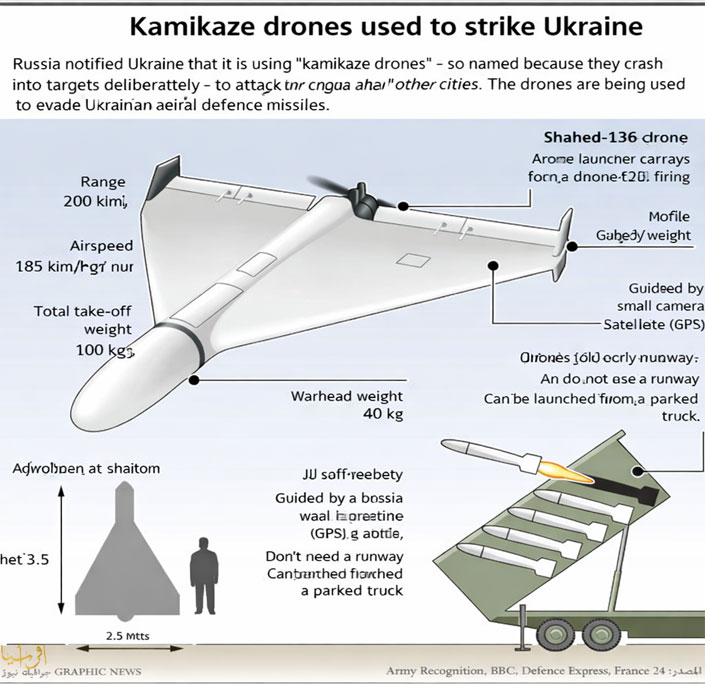
On the Russian side, the Iranian-made Shahed-136 kamikaze drones emerged as Russia's weapon of choice in September last year, as Moscow used swarms of them, which weigh up to 50 kilograms, have a wingspan of about 2.5 meters, cost less than $20,000 and can fly at a low enough altitude that they are often undetected.
Some estimates suggest that Russia has sent 400 Iranian-made attack drones since August 2022. Although this is a small number compared to the thousands of missiles Russia is bombing Ukraine, intercepting drones flying in groups may be more difficult. The cost of manufacturing drones is also lower and can be dispatched in ever-increasing numbers.
Despite Kyiv's claim that it was able to shoot down a large percentage of Shahed-136s late last year, it has succeeded enough to inflict severe damage on Ukrainian power plants.
Defense Minister Oleksiy Reznikov said the Ukrainian military intends to spend nearly $550 million on drones in 2023, and 16 supply deals have already been signed with Ukrainian manufacturers. He also said the country plans to develop "explosive drones" for air-to-air combat.
In the Russia-Ukraine war, intercepting "loitering munitions," also known as "suicide drones," is far more expensive than deploying them. The use of MiG-29 jet fighters, cruise missiles, and other Cold War-era weapons to stop these drones far exceeds the cost of producing those disposable robotic drones. New high-tech battles of attrition could become a regular feature of future conflicts, as each side tries to deplete its enemy's resources.
Remotely Piloted Aircraft
Another class of drones includes those that are capable of flying longer distances — 124 miles (200 kilometers) or more — and at higher altitudes — 2.5 to 5 miles (4 to 8 kilometers) — than those listed above. They can also be armed with laser-guided missiles, increasing their lethality In the Ukraine war, these remotely guided fighter jets include the Turkish Bayraktar TB2 aircraft, dozens of which the Ukrainian military has acquired, at a cost of about $5 million $1 each.
The Role of Multinational Technology Companies:
In addition to the aforementioned weapon technology, during the Russia-Ukraine war, it became clear how dangerous the roles multinational technology companies play in the geopolitics of the current war, as technology companies have been dragged into conflicts, and these companies are independently shaping the war in real-time by determining what capabilities to provide, and what resistance they are willing to endure.
This leads to a new global reality. is that no country (or group) with geopolitical ambitions can no longer only plan how countries will respond, but they must also think about how tech companies will respond.
The Internet is a shining example. When the war began, Russian forces moved to cripple Ukraine by taking control of critical infrastructure — such as nuclear power plants. For example, the Zaporizhzhia nuclear power plant, which Russia controls, generates a fifth of Ukraine's electricity. But that strategy didn't work with the Internet. A few days after the war broke out, the U.S.-based company SpaceX began providing the Ukrainian government with satellite internet service Starlink.
Satellite imagery is crucial in the ongoing war, so Google has disrupted direct traffic functions in Ukraine, a feature that could give Russia insight into the locations of Ukrainian forces. Only Russia had "eyes" on Ukraine, through satellite imagery, because Russia was one of the few countries with high space capabilities.
Wars of the Future:
After the Ukraine war continues, the war is described as "laying principles for the 21st century." In many ways, this conflict is seen as a test case for future wars. While it is too early to draw specific lessons, some important ideas have already emerged.
The gradual evolution of technological transformations in that war: One is that the war does not see the flashy technological transformations that some futurists predicted. Instead, the changes are gradual and focused.
Technology is being modified to allow for greater access to and sharing of information; sensor-based technologies have emerged in a variety of settings; and operational data that is collected and used to train artificial intelligence (AI) systems.
The dual use of technological development: The war in Ukraine has also been described as a "smartphone war," with many observers, including soldiers on the ground, contributing to the narrative of the fighting on social media. Other footage was taken by commercial satellites and drones. Providing up-to-date footage is one of the ways militaries use to counter misinformation.
The military use of smartphones and commercial drones illustrates the dual use nature of technological development, where the technology developed is then used for civilian use in war. In other words, advances in commercial technologies may shape what appears on the battlefield.
The wars of the future will be about the maximum number of drones and the minimum number of people: the battlefield in Ukraine has proven the strategic superiority of drones over the rest of the weapons.
Use of swarm technologies: Military strategists predicted the arrival of the so-called "swarm" of drones, a large array of small flying machines that would herald a new era of intelligent warfare.
Thousands of small, small-sized robotic aircraft would be invisible when deployed, but capable of instantly integrating into a dark cloud. Samuel Benedet, a Russian weapons expert at the Center for Naval Analysis, says of them: "In a swarm – just like in an insect swarm, in a bird swarm – each drone thinks for itself, communicates with others, shares information about its location in the swarm, potential threats to come, and what to do about it, especially when it comes to changes in direction or changes in swarm composition."
The weapons deployed by the Russian and Ukrainian sides are still far from this potential latent nightmare. The squadron will use artificial intelligence to allow individual drones to act autonomously while also harnessing the group's wisdom.
David Hambling, in his 2015 book, "Swarm Troopers," reported that software engineers have already been able to simulate these large swarms in nature by programming drones with 3 simple instructions: Separate, or maintain a certain minimum distance from others; align, or stay on the same path with your neighbors; and hold together, or try to move toward your neighbor's average position.
Based on the instructions, squadrons of drones will move in clouds that act as a single entity, perhaps widespread at first, to hide them from radar, only to meet on a last-minute target.
The squadron will be able to respond to threats without human intervention – change course, speed or altitude, maneuver around heavily protected airspace – and can absorb heavy losses without stopping, and its destruction of targets is extremely severe.
By making almost any target indefensible, military experts imagine, such swarms — or what they call "gravel gangs" — would make war "impossible." The swarms of drones could envisionably transport us to the age of war between rival robot armies. Their emergence could also lead to the full entry of AI battlefields, where the decision to shoot or explode must be made faster than humans can react to.
It can be said that Russia and the West will not abandon the achievement of what can be described as a victory in their "existential" war. This means that the war will continue.
Therefore, this hybrid warfare will not only be a good test of current technologies, but will also be a justification for the development of advanced military technologies.
With no end in sight to the war in Ukraine, the stage is ripe for other tech companies to take bolder action, and as autonomous weapons research rushes forward, the possibility of a robotic war looms.
In conclusion, there are many doubts that Ukrainian drone technology can counter and intercept Russian drone technology, and the examples are clear through the current Russian operation of the Russian aircraft over Ukrainian territory, and there are growing doubts about Ukraine's ability to succeed in hybridizing the Eastern model, i.e. the Soviet weapon that Ukraine possesses, with the Western model that Ukraine has received, whether from the United States of America or from Europe. It is clear that Zelensky's tour of the Middle East has exaggerated its results.
