
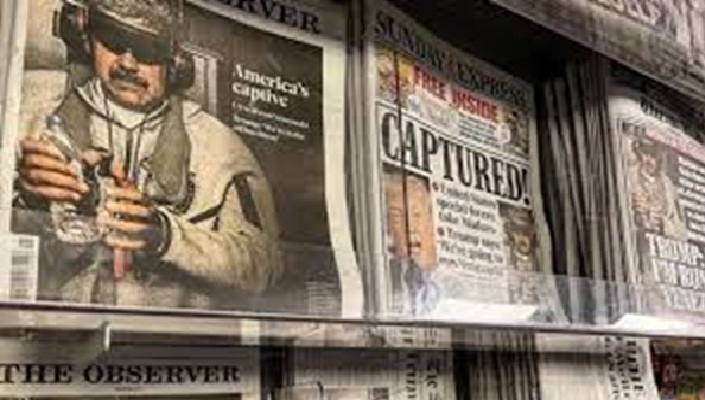
Afrasianet - can be said that the political and economic crisis in Venezuela, and the international interventions around it, have overshadowed other issues, although these same crises fuel the issues of human rights, corruption and economic collapse, while the major powers are struggling for their oil and geopolitical influence in the country, making the Venezuelan crisis the focus of great international attention and sometimes missing the details of other internal situations.
Geopolitical location: Venezuela is a point of conflict between the United States (with its colonial past and its rivalry with other powers) and Russia and China, which support the regime or have economic interests, according to Arabi21.
Oil: Venezuela's vast oil wealth makes it a strategic arena for international conflict, especially as Washington seeks to reach it and weaken the regime.
Changing international focus: Recent events, such as the U.S. attacks and Maduro's arrest, have made Venezuela the focus of global news, overshadowing the details of other domestic crises .
In short, the main issues in Venezuela (politics, economy, oil, interventions) are overlapping and feeding into each other, making it natural to focus on them at the expense of other issues in the context of the ongoing crisis.
Venezuela and Gaza, and the return of the Age of Empires
The U.S. kidnapping of Venezuelan President Nicolás Maduro and his wife on January 3, 2026, following overnight attacks on Caracas and the coastal corridor, is not just an escalation in a long-running conflict, but an arrogant declaration, imposed by force, that the concept of sovereignty in the Western Hemisphere is a mirage because it is subject to American intervention, and that international law is not binding on empire or the great powers, but rather a tool used against adversaries and weak states.
The United States portrayed the operation as "law enforcement," but in fact a military raid, which was confirmed by the White House's own words. Donald Trump described the operation as "very successful" and said the United States would "run the country" until a "safe, sound and rational transition" was achieved. He also warned Venezuelan leaders that "what happened to Maduro could happen to them," adding that he was not afraid to put "troops on the ground."
Perhaps most tellingly, the real purpose of this operation is Trump's direct linking it to oil, as he promised that U.S. companies would enter Venezuela to "repair the severely dilapidated infrastructure" and "start making profits," claiming that Venezuela had "stolen" oil that the U.S. had "built" with "American talent, labor, and skill," calling it "one of the largest thefts of U.S. property" in U.S. history.
This language, drawn directly from Trump's own description of the operation, belongs to an arrogant lexicon of conquest and domination, not to the language of legitimacy and justice.
Empire and the Monroe Doctrine as an operating system of control
To understand Trump's actions in Venezuela, they must be placed within a broader pattern of assimilation of the imperialist mentality. The Monroe Doctrine was promulgated in 1823 by the fifth president of the United States, James Monroe, with the aim of establishing the Western Hemisphere as an area of American influence.
It was initially presented as a warning to European powers to end their military presence in the region, in order to consolidate American hegemony. Over time, it evolved into a Western Hemisphere strategic doctrine, in which the United States decides which governments it deems "legitimate," which are labeled "dangerous" to be sanctioned or overthrown, and which resources are "strategic" and therefore can be acquired by any means.
The list of target countries is familiar because the pattern is the same. Iran (1953), Guatemala (1954), Brazil (1964), Chile (1973), Grenada (1983), Nicaragua during the Contra era (in the 1980s), Haiti (1994), and even Venezuela itself in the failed 2002 coup attempt against then-President Hugo Chávez are not isolated events. All events follow the same logic: When a government or country impedes U.S. hegemony or its strategic and economic priorities, destabilizing it becomes a policy of choice, and slogans such as "democracy," "anti-communism," "counterterrorism," or "war on drugs" become tools to justify pressure, sanctions, or change by coercion and overthrow.
What is new this time is not intention, but brazenness. Previous interventions have relied on denial, proxies, secret funding, and "advisers." Now, the U.S. president has openly embraced the logic of domination, assuming that the world will be intimidated and shocked by the public display of U.S. brute power.
Oil, Sanctions, and the Economics of Regime Change Venezuela is located above 300 billion barrels of oil, making it the holder of the world's largest proven oil reserves. This reality has never been morally neutral in an imperial regime that treats energy as a power.
But it's not just oil. Venezuela's southern mining belt, particularly in the Orinoco region, is rich in gold and other precious metals. With more than 8,000 tons of gold resources, the country is among the countries with the largest gold reserves in the world.
Importantly, interventions marketed as "anti-narcotics" or "anti-corruption" often obscure another goal: to give Trump and the heads of multinational corporations the power to decide who controls the concessions, who controls trade routes, and who extracts and exploits the underground.
Venezuela also possesses billions of tons of iron ore, along with vast quantities of rare earth elements, nickel, copper, and phosphates. These resources are essential inputs to modern technology and industrial production, including the steel industry necessary for the manufacture of military materiel. In geopolitical competition, control of heavy industry resources often determines the balance of power between major countries.
In the weeks and months leading up to the attack, the United States tightened the noose in ways that reveal its strategic objectives. In December 2025, it imposed a naval blockade that disrupted oil tankers, seized oil shipments, and halved oil exports from about 900,000 barrels per day in November. That same month, a cyberattack disrupted the operation of Venezuela's national oil company Pedivisa, forcing it to adopt rudimentary manual operations.
What Washington has shown is not just that sanctions do harm, but that sanctions, blockades, confiscations, and "law enforcement" narratives are being used as a rough prelude to regime change.
China has stepped in as Venezuelan oil exports increasingly shift toward Asian markets outside Washington's control. In November 2025, China accounted for about 80% of Venezuela's oil exports, about 746,000 barrels per day, while shipments to the United States through Chevron-linked channels rose to about 150,000 barrels per day.
In other words, Venezuela's oil is no longer just "under Maduro," but is increasingly oriented toward Asia, a shift that Washington, in an era of strategic rivalry, has treated as a geopolitical crime.
What Washington sought to reverse was not only the direction of Venezuela's oil flow, but also how it used these resources for internal construction. The political trajectory that the United States has tried to reverse since the late 1990s cannot be understood without referring to the Bolivarian Revolution and the social transformations it produced.
After the election of Hugo Chávez in 1998, Venezuela redirected oil revenues toward large-scale social programs to address decades of severe income inequality among citizens. Between 2003 and 2012, poverty rates fell by more than half, and extreme poverty fell dramatically
.
Access to health care, education, housing, and food support has also expanded, especially in historically marginalized communities. Millions of Venezuelans have access to free primary health care through the Barrio Adentro program, illiteracy rates have fallen to near zero by UNESCO standards, and enrollment in public universities has doubled. All of these achievements have been financed mainly through state control of the oil sector and a deliberate redistribution of public resources.
It is precisely this model that U.S. policy has sought to dismantle. Since the mid-2000s, with the escalation of sanctions on targeted financial measures in many sectors, especially after 2015, comprehensive sanctions have been imposed on oil, banking, and trade, and U.S. coercive measures have severely restricted Venezuela's ability to import food, medicine, spare parts, and refining equipment, and denied it access to international credit markets. The economic contraction that targeted Bedevisa accelerated the economic downturn by cutting off the state's main revenue artery.
The ensuing humanitarian deterioration was not the cause of the sanctions, but their result: a deliberate coup d'état of social gains through externally imposed economic strangulation, not aimed at reforming governance, but rather to push the regime toward collapse by making it economically unviable.
U.S. Secretary of State Marco Rubio, who has been pushing for regime change in Venezuela for months, described the attack as a "law enforcement operation." Trump then claimed that Rubio had spoken with Venezuelan Vice President Delcy Rodriguez and that she would support U.S. efforts, as he made a surprise claim.
On the Venezuelan side, the first official response came with a simple demand revealing the nature of the illegal act. Rodríguez asserted that Maduro's whereabouts were unknown and demanded that the United States provide proof that he was still alive. It then declared a state of emergency, issuing a statement outlining the strategic objective of the illegal U.S. offensive to "seize Venezuela's strategic resources, particularly oil and minerals," and to "break the nation's political independence by force."
At the regional and international levels, many countries have condemned the U.S. operation, including Mexico, Brazil and Colombia in the Western Hemisphere. In a post on the "X" platform, the Brazilian president warned that "attacking other countries, in flagrant violation of international law, is the first step towards a world of violence, chaos and instability, where the law of the strongest prevails at the expense of multilateralism."
He also called on the international community to "respond forcefully" to U.S. actions through the United Nations.
China, whose special envoy for Latin America was in Caracas for meetings with Maduro, said it was "deeply shocked and strongly condemns the United States for recklessly using force against a sovereign state and targeting its president."
The U.S. insistence on describing abduction as mere "law enforcement" is not only unconvincing, but politically revealing. A U.S. indictment of Maduro, uncovered after the military raid, is not evidence of a crime, but rather a retrospective stamp to normalize what the U.S. empire has done.
In a striking irony, while Trump claimed that the United States would run Venezuela, his State Department issued a warning that it could not help American citizens who may be stranded in the country.
Gaza, Ukraine, and selective legitimacy as a doctrine
cannot be understood in Venezuela in isolation from Gaza, which has become a global test of the extent of law-abiding in international politics. While Washington has presented its actions against Caracas as "law enforcement," it has spent the past two years providing political cover to the Zionist entity, arming it militarily, and undermining any effort to hold it accountable for its many crimes.
In the South African case under the Convention on the Prevention of the Crime of Genocide, the International Court of Justice issued interim measures in January 2024, which were reaffirmed in March and May of the same year.
However, the humanitarian situation in Gaza, as repeatedly documented by UN bodies, remained catastrophic, with mass killings and displacement continuing even during the so-called ceasefire agreements. In terms of criminal accountability, an arrest warrant for Benjamin Netanyahu was issued and reaffirmed in files submitted to the International Criminal Court.
The paradox is clear: Maduro is kidnapped without trial and his country is placed under a foreign "transition" administration, while Netanyahu is treated as a strategic partner.
A regime that claims universal legitimacy undermines itself through its own system of exceptions. In Ukraine, the West insists that borders are secure and aggression is a crime. In Gaza and Venezuela, it justifies the opposite. For them, it is force, not principle, that determines when sovereignty matters.
Why can't this happen with North Korea, and what does it mean for Iran?!
The central lesson that Venezuela is offering to the world is bleak, but clear. The United States cannot do to North Korea what it did to Venezuela, because Pyongyang has a documented nuclear deterrent.
Trump's own record confirms this logic: With North Korea, Washington has been forced to manage deterrence and enter into negotiations, because the cost of any scenario of attack or occupation would be escalating to the point of an existential threat.
Thus, Venezuela becomes a case study that strengthens the argument, throughout the Global South, that nuclear capability serves as a guarantee of regime survival. This is not a moral justification for nuclear proliferation, but rather an empirical reading of imperial behavior based on realistic geopolitical logic.
This logic of deterrence applies even more strongly to Iran, which explains why a Venezuela-style operation there is likely to fail, while some in Washington and Tel Aviv still envision it. A similar attack on Iran is likely to fail because of structural constraints that the United States cannot deal with through force.
Iran demonstrated its ability to respond during the 12-day war last June. With a large arsenal of missiles and drones, fortified facilities, and the ability to strike at regional bases and critical infrastructure, Iran can inflict serious damage on its adversaries.
Nor will any escalation remain domestical. The Strait of Hormuz is a vital artery for the global economy. According to the U.S. Energy Information Administration, in 2024 and 2025, oil flows through the strait accounted for more than a quarter of the world's seaborne oil trade, and about one-fifth of global consumption of oil and its derivatives.
With a population of 92 million and an area of 1.7 million square kilometers, Iran is not democratically or geographically manageable as an occupation project. The U.S. experiences in Iraq and Afghanistan have shown that overwhelming power can bring down a state, but it cannot govern a society that rejects the occupier. Iran has spent two decades studying these failures and developing asymmetric response tools, including exploiting regional depth.
Resistance and the limits of power in Venezuela
Maduro's government has long warned against using covert intelligence operations to undermine Venezuela's sovereignty, accusing the United States of deploying the CIA inside the country under the guise of countering drugs and immigration, long before the January 2026 raid.
The aftermath of Maduro's abduction illustrates why the operation is likely to fail to achieve the political results Washington expects. Venezuela's defense and security apparatus has not been divided. Defense Minister Vladimir Padrino López has publicly rejected the presence of foreign troops inside the country, declaring that the armed forces will resist any attempt at outside control, describing the operation as aggression rather than a political transition.
Vice President Rodríguez also condemned the raid and called for national unity in defense of sovereignty, while the Supreme Court affirmed the continuity of constitutional authority.
Rodríguez also called on the armed forces, the civilian reserve forces of the Bolivarian militia and popular organizations to mobilize in defense of national sovereignty. "The people must act in defense of their natural resources, their right to independence, peace, development and the future," she said in a phone call with Venezuela's VTV. A free homeland, without any external tutelage, we will never be slaves again."
These responses highlight a lesson that the Bolivarian leadership has long emphasized: regime changes depend less on popular acceptance, and more on intelligence hacking, defections, and internal betrayal.
The January 2026 operation will likely intensify efforts inside Venezuela to dismantle foreign intelligence networks and prevent further penetration, a conclusion that is shaped in light of past experiences, including the failed 2002 coup attempt against Hugo Chávez.
At the societal level, pro-government public mobilization, including calls by reservists and popular defense structures to counter external interference, reflects a pattern that Washington has repeatedly misread in Iraq and Afghanistan.
The removal of a leader does not extinguish resistance when intervention is widely understood as foreign domination linked to the seizure of national resources. Thus, Venezuela faces a familiar dilemma: the state may be weakened by sanctions, but society is politically cohesive under siege, while coercion from outside entrenches opposition at home.
Gaza has exposed the emptiness of claims of Western cosmopolitanism, liberalism, and globalization. Venezuela conveys this lesson to the Western Hemisphere with a clarity that is difficult for even allies to ignore. When the law is applied only to adversaries, as Gaza and Venezuela show today, it ceases to be law and becomes an instrument of power and domination. When aggression is explicitly linked to oil, the empire stops pretending to be something else.
More than 2,000 years ago, Roman Emperor Marcus Aurelius gave a simple warning to rulers: "Look at the past, with its empires that have risen and fallen, and you will look to the future as well." But Trump has never been accused of listening to such wisdom.
The dumping file. About Netanyahu and the game of jumping to the east through Venezuela
In a file that does not stray too far from the subject, Netanyahu returned from the United States almost as he went there, with no apparent gain or forced concessions, at least on the announced side of the visit, his meeting with Trump, and behind-the-scenes deliberations with the symbols of his administration.
The region's files have been put on the table, and it seems that they have been raised as they are with no significant change in their current status and future arrangements. There is no clear horizon for moving from the first phase to the second phase of the Gaza Agreement.
The Lebanese front is an ember that does not burn or cool, and Syria is satisfied with little and does not reach it, while the rhetoric of escalation in Tel Aviv towards Iran continues, between the claim that it is restoring its capabilities and may strike a preemptive blow to the Jewish state, and the latter's readiness for a second round of direct war with it, alone or in partnership with Washington.
The prime minister of the occupation government is hanging the rest of the Gaza deal on a single corpse and the weapons of Hamas. In principle, he does not want to budge from his current positions, and if it is necessary to disband it, it is nothing more than the stabilization of the temporary lines, and the partial launch of the reconstruction process in the areas under his control, provided that the factions remain confined to the western side between devastation and hunger.
The American whims naturally crave Tel Aviv's preferences, but the mediators and guarantors do not recognize the requirements of this relationship, and all attempts to tame them have failed over the past months, until the 20-point plan was a mediating solution between bias and moderation, in a way that does not end the issue once in favor of one of the parties, and does not keep it at zero for long.
There is still a possibility that the republican administration is deceiving the obstacles and averting the contrary to what appears, but there is no alternative for those who seek to overcome the Gaza tragedy and refloat the issue on the wave of politics rather than the Nakba, but to think well and take the available path and so on.
This is while acknowledging the fact that there is no point in disagreeing and arguing over piles of rubble, and there is nothing better than moving the stalemate to build on what is required, and freeing the legal in the matter from the captivity of mankind. The enemy is cunning, and the consequences of throwing up gloves and leaving the field are not hidden from him, and the consequent internationalization of the current round of conflict, and his placement in the face of an international umbrella reinforced by a UN resolution, the temporary effects of which will be the partial neutralization of the military machine, and the creation of an organizational formula that resembles or establishes a state in the extent. Close.
No matter how harsh Sinwar's slap was, it was less than expanding the ring of fire and spreading it across the length and breadth of the region. The only purpose was not to prepare for the belt of resistance once and for all, especially since he did not know the limits of the other side's capabilities, and what could go on or deter it, but his greatest benefit was achieved by crowding and shuffling the cards, to strengthen his position and the cohesion of the home front from around it, and luring the American ally to a level that touches direct engagement.
The most important thing is to confuse everyone and disrupt their ability to think and manage well, which necessarily leads them to make mistakes and insist on them, and to ensure that he will be proactive in many details, and with the momentum to forgive his sins and loosen the curtain of Western embrace, and then by multi-frontality, to remain clinging to a thick rope that tightens the region on one side, even if the situation becomes complicated and the calculations are disrupted and the rest of the parties are pulled out of his hands.
The Likud hyena motivates its opponents and tempts them to dare it. After the trees thicken and hug their branches in the fabricated forest, each side grasps one side of the picture, and the cunning old man stands alone holding the complete map, knowing all its details, monopolizing the mechanism of moving from point to point, connecting the dots or isolating them from each other.
The effect of this game was clearly evident in diverting attention or directing it to what he wanted. In the first weeks, he focused on Gaza under the roof of investing in the horrors of the flood, and his right to revenge or self-defense. When the pace of killing escalated and his credit turned into debt.
He moved with his weight to the northern front with the party, gradually moving from the assassination of Saleh al-Arouri in Dahiya to Fouad Shukr after the incident in the Druze village of Majdal Shams, and between them the harassment of Iran in the Levant by bombing the consulate and carrying out assassinations and qualitative strikes, which required the Islamic Republic to respond a few days later, covering its response to the invasion of Rafah in the southern Gaza Strip. Thus, in all the rounds, he enchanted the eyes on one side, and fell with his heavy fist on others.
In the same way, he went to Florida on his last trip. He procrastinates on the Gaza deal, and does not stop violating the cessation of hostilities agreement with the party in Lebanon, his patrols and gray work at the highest levels of activity behind the Syrian Golan, and the messages of intimidation and threats flying from Tel Aviv to Tehran, and above all, he pre-empted the trip by recognizing the independence of the "Somaliland" region at the Horn of Africa and the Arabian Sea, to put a new obstacle in the way of the countries of moderation and the guarantors of the Sharm el-Sheikh agreement.It is
no exception that he has opened channels of communication with the Southern Transitional Council in Yemen, and there have been signs that his leaders have welcomed normalization and entered into the Abraham Accords in a recognition deal similar to the Somali situation. Many or all of these details do not harm or anger the United States, but they are not in a position to blow up more volcanoes or upset the already dysfunctional regional balances, while focusing and focusing on more distant, more important and advanced environments and issues on its list of priorities.
If the move of "Somaliland Land" is based on geopolitical calculations that seek to establish a foothold in the Gulf of Aden, it is not far from the ambitions of displacement and liquidation of the Palestinian cause. Once the plan is completed by separating the southern right, it will land with both feet in the throat of the Red Sea, and it will go a long way on the road to redrawing the area promised by Netanyahu after the flood.
All of these are tools of dumping and occupying like their predecessors, which may be done or disrupted, but they are not required for themselves at least in the foreseeable future, but what is important is their effectiveness in mixing the cards and creating chaos, which must be compensated by alternative channels in the event that the original paths are disrupted.
Perhaps this is why the Likud leader took the initiative to praise the U.S. operation in Venezuela, and congratulated Trump on the illegal attack in which President Nicolás Maduro and his wife were kidnapped. On the surface, it may not seem to be of direct benefit to him, but he is one of the winners of it on several levels: First, because Caracas has been closely related to Iran, its focus in politics, economics, and supply chains, and it has solid positions on the Palestinian issue.
It also implicitly justifies hacking operations similar to its open regional rivalries, and it adds to its importance above all that it distracts the American president from the issues raised in the region, or rearranges his priorities qualitatively and temporarily, in a way that reduces the pressure on Tel Aviv and postpones or drops commitments altogether, as well as the "flying wolf's head" parable, whose effects may be reflected on the party, Hamas, Golani, and the Supreme Leader in its deep trench, especially as Iran is witnessing escalating demonstrations that have entered its second week. The White House chief did not hesitate to comment on it, warning against intervening in the event of abuse of demonstrators.
The raid on the Latin country at the beginning of this week in Operation Absolute Determination is like warning the released person to be beaten by the handcuffed. In other words, it has two levels of significance: the first is directly with its owner, and the second is an indication to the rest of the opponents that they may suffer the same fate if they do not surrender to the American will.
Trump has practically proven that he is not a threat in a vacuum, and he remains the unpredictable temperament man, capable of going to the extreme of rough and illogical choices. In theory, Netanyahu does not seem safe, and the Hebrew press analysts have intensified their warnings to him against angering the larger ally or clashing with him, but he is counting on the friendship, interests and the radicality of the relationship between the two countries, and that in any trade-off with the warheads in the region, he will have an advantage, and Trump will not go to exert more pressure on him, as long as there is someone who can be besieged and his options on the war fronts can be undermined.
Thus, with hasty praise, he adds himself to the Delta squad, and removes the psychological impact of the Caracas operation to his advantage, and adds it to the counter of the files of crowding and dumping, and relies on it to provide him with a margin to keep the burning embers under the ashes in Palestine, Lebanon, and Syria, and on the preparation line for a new dance of fire with Iran.
Trump had stated in the Florida meeting with Netanyahu that he wanted to move on with the Gaza deal, and promised that it would happen within two weeks, that is, by mid-January.
The meetings of the Mechanism Committee continue in Lebanon after it has been expanded to include a civilian component, while the Cabinet is meeting in Tel Aviv to discuss the mechanisms for dealing with the party and the issue of arms exclusivity. All the details are moving slowly, but they are not without positives, and all of them are related to arrangements that preceded the surprise of Venezuela, and it is not a condition that they be eliminated as long as the American sponsor focuses on another topic.
Unfortunately, the possibilities are equal between Trump seeking to improve his image after the illegal attack, pushing the Gaza agreement and settling the outstanding differences in southern Lebanon and Syria, or withdrawing his full attention to the current liquidity in his own backyard, and the plans of the Venezuelan administration and putting his hand on its regime, oil and wealth reserves.
On the other hand, the de facto authority in Damascus does not know a way out of its predicament, and the party is fighting with the covenant to rid the state of the statelet's ropes, and Hamas is stumbling between the patriotic and the factional .
Syria is a vast arena for players of all shapes and colors, and after being a knot with the access it provides to the Islamic Republic on the Mediterranean, it has become the line of contact between Tel Aviv and Ankara, as if they have a direct border for the first time in history, especially since the fall of the Ottoman Empire preceded the emergence of the Hebrew state.
The only margin for the Gaza factions is not by breaking with the outside after it has become a marginal detail, but by connecting with the inside and committing the strategic issues and assets of the legitimate authority, not by way of concession to the enemy. To deprive him of an additional excuse that enables him to evade and drown.
Gaza has been at the bottom for two years and there is no luxury to explore options other than to recover.
Maduro is the title of a period that will not be as unjust as the previous ones, but rather will be absent from the mind to any degree, and in which the cost of adventures, the continuation of frivolity and gambling on the fates of countries and the pensions of their people are not believed. The new US national security strategy, if it was inaugurated in Venezuela, promises in the east of easing the burdens, managing conflicts instead of resolving them, and relying on economics rather than politics, all of which are keys to an era in which geopolitical weights and balances will change, and it is advisable to enter it from the recovery period, not from the bed of illness.
The first treatment is to fence the borders with pure national ideas, not with ideology or slogans. Gaza is the issue of the Arabs morally, but it is the plight of its people in reality, and so is Palestine, Lebanon, Syria and others. The gathering of the weak only makes them weaker, and drowning in naïve details always ends in drowning.
Oil and Shared "Hostilities": Venezuela's Link to the Middle East
The rapprochement between Venezuela and some MENA countries is not limited to oil alone, but is also based on ideological similarities and shared hostility to U.S. policies, which have been strengthened since the era of Hugo Chavez and continued under Nicolás Maduro.
Since Washington carried out its military operation in Caracas and "arrested" Maduro, US Secretary of State Marco Rubio has repeatedly mentioned in interviews with the US media "ending the presence of Iran and Hezbollah in Venezuela" as one of the goals of the operation.
In an interview on ABC a few days ago, Rubio said in response to questions about Trump's handling of Venezuela at this point, that Washington wants to put an end to what he described as "Hezbollah and Iran turning Venezuela into their own playground."
What is the truth of Trump's accusations?
During a congressional hearing in October last year, Marshall Billingsley, the former assistant secretary of the U.S. Treasury for counterterrorism financing, said that "Venezuela has become the main facilitator of Hezbollah's movements and operations in Latin America" and that under Chavez, it has opened up space for Hezbollah to carry out various activities, including the construction of a paramilitary training center on Margarita Island. Hezbollah's presence and expansion in Venezuela has increased significantly under Maduro.
Bellingsley accused Tarek al-Issami, who before he was Maduro's deputy, of "managing and facilitating the forgery of a large number of Venezuelan passports of members of Hizbullah and Hamas." The United States sanctioned al-Aissami in 2017, accusing him of involvement in the drug trade.
Venezuelan-Iranian rapprochement based on "common enmities" and "Western sanctions"
In the circle of enemies and allies of the United States of America, Venezuela and Iran stand out. Both countries suffer from protracted and severe U.S. sanctions and enjoy natural resources that have long been outside U.S. control.
Relations between Washington and Caracas have been strained since Chávez's tenure and were further strained when Maduro took office in 2013.
The sanctions peaked in 2019 when Washington imposed a ban on Venezuelan oil. But Venezuela has continued to export significant amounts of its oil in ways the United States considers illegal, known as "shadow fleets," cargo ships that operate privately to transport sanctioned oil, outside of controls.
In the same way, Iran exports much of its oil despite U.S. sanctions.
U.S. sanctions on Iran continue despite the easing or lifting of U.N. and European sanctions imposed on it over its nuclear program.
Iran is helping Venezuela with funding, equipment and expertise to restart Venezuelan oil refineries. The two countries signed an agreement worth €110 million in 2022 to rehabilitate and open the El Palito master refinery, as part of a comprehensive strategic cooperation document for 20 years.
It was never clear what financial gains Iran was reaping in exchange for Venezuela's assistance in this area, Homayoun Falakshahi, an analyst who specializes in analyzing crude oil movement linked to market dynamics and geopolitical factors at Kepler, told the BBC.
But this economic cooperation has also made the two countries political allies.
• What is Iran's position on Trump's threats to intervene militarily in the country in the event of the death of protesters?
According to Falakshahi, this Venezuelan-Iranian cooperation is a clear contradiction, given that the two countries compete for the Chinese oil market, which is the largest market for both, and export their oil to it in the same way by adopting "shadow fleets."
Whatever the direction of change in Venezuelan oil production and exports, Iran will be the beneficiary.
If Venezuelan oil is trapped and exports are reduced, Iran will have a larger share of the Chinese market. If the embargo on Venezuelan oil is lifted and legally issued, Iran will be the sole exporter of the shadow shipments, Falakshahi told the BBC.
Beyond oil cooperation, the United States also accuses Iran and Venezuela of military cooperation. A statement from the US Treasury Department at the end of December 2025 said that Iran had been supplying Venezuela with drones since 2006 and announced sanctions on a number of companies and individuals from both countries on charges of arms trade.
Venezuela's anti-Israel stance 'extra link' with Iran
The Israeli government welcomed the U.S. operation in Venezuela. Prime Minister Benjamin Netanyahu tweeted on X congratulating U.S. President Donald Trump on what he called his "bold and historic leadership in defense of freedom and justice."
Israeli Foreign Minister Gideon Sa'ar said the United States had acted "like the leader of the free world."
This intense Israeli welcome is not surprising given that the relationship between Venezuela and Israel has shifted from "friendship," as it was described during Shimon Peres' visit to Caracas in 1995, to hostility. Relations between the two countries have begun to deteriorate since the beginning of Hugo Chavez's rule in the late 1990s.
Chávez strongly condemned Israel during its war with Hezbollah in Lebanon in 2006 and withdrew his country's ambassador from Israel.
Chavez called Israel's 2009 war in Gaza an "act of genocide" and Venezuela has officially recognized the state of Palestine since 2009 and severed diplomatic relations with Israel.
In the Venezuelan presidential crisis in 2019, Israel joined countries that denied Maduro's legitimacy and supported his opponent, Juan Guaidó.
Venezuela and North Africa: Algerian-Venezuelan rapprochement and the question of Western Sahara
Since the Chávez era, Venezuela and North Africa have strengthened.
Chavez had a close relationship with Libyan leader Muammar Gaddafi, and the two men led socialist regimes and also shared an open hostility to America.
The late Egyptian President Gamal Abdel Nasser has stood in his bust in the Venezuelan capital, Caracas, since 2013, when the Venezuelan government erected it in honor of what it described as "the heroes and heroines of Africa."
The issue of Western Sahara occupies a space of Venezuela's attention.
Venezuela has recognized Western Sahara as an independent republic since the 1980s and has formal diplomatic relations. The Embassy of the Sahrawi Arab Republic is located in Caracas.
The Maduro government has never made a secret of its unequivocal support for the Polisario Front, which is demanding the independence of Western Sahara from Morocco.
This position is also linked to the strength of relations between Venezuela and Algeria, which also supports the Polisario Front in its demand.
Despite the close ties between the two countries, Algeria has not issued an official comment on the "arrest" of the Venezuelan president.
Algerian journalist Ali Boukhlaf believes that his country wants to avoid a clash with Trump, especially since what is happening is far away and not directly related to Algeria's interests, he says.
Boukhlaf told the BBC that regime change in Venezuela would not significantly affect Algeria, even in its firm position on the issue of Western Sahara. Venezuela's support for the independence of Western Sahara, in his view, had not been a pressure in that direction.
Nicolás Maduro visited Algeria in 2022, where he met with his counterpart Abdelmadjid Tebboune. The meeting stressed the harmony of the positions of the two countries on a number of issues in the Middle East and North Africa.
Tebboune said at a press conference after the meeting that he and his Venezuelan counterpart were fully in agreement "on the basis of the struggle to help the Palestinian people build their state" and "to help the Sahrawi people obtain a referendum on self-determination and independence", as well as support for allowing the Libyan people to hold free elections in which they choose who they want to represent.
The two sides announced that the ceiling of cooperation between their two countries will be raised to include various fields, including economic cooperation.
Regarding Morocco's position, Dr. Abdelfattah El Fathi, director of Morocco's Center for Sahara and Africa for Strategic Studies, told the BBC that despite the absence of an official position, the Kingdom welcomes the end of Maduro's rule, whose stance in support of the Polisario Front was a burden on it.
According to El Fathi, Venezuela's support for the Polisario Front was not only political, but also financial and military, so the fall of the Maduro government and the empowerment of the opposition, which mainly supports Morocco's position of adhering to the autonomy of Western Sahara under Moroccan sovereignty, will weaken the pro-Polisario Front and make Morocco's position more solid in terms of its supporters.
It is not yet clear what the situation in Venezuela will look like, but whatever direction the new regime takes in the Latin American country, it will resonate widely in the Middle East and North Africa.
