
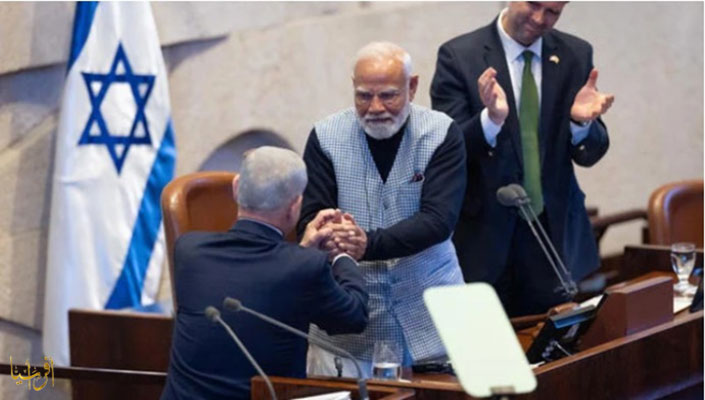
Afrasianet - The Israeli-Indian rapprochement following Indian Prime Minister Narendra Modi's visit to Israel in February 2026 represents a paradigm shift in the nature of the relationship between the two sides.
What is new is not an increase in arms purchases or the signing of new economic agreements, but a shift from a "customer and supplier" model to a "strategic partner" model. After this visit, India is expected to serve as Israel's "strategic depth":
Industrial base, huge market, and co-manufacturing field. This shift reflects a new Israeli vision that sees India as a military and technological lever.
Israel has been trying for years to reduce its dependence on the West, especially the United States, in the areas of military production and supply chains.
According to a report by the Begin-Sadat Center for Strategic Studies, "the war that erupted after 2023 has exposed the fragility of Israel's military economy when the country is subjected to intensive, multi-front attacks that include drones, suicide munitions, precision missiles, and cyberattacks."
Development and rapid compensation for losses; India is no longer just Israel's largest arms importer, but also Israel's "strategic backyard": it provides Israel with what it lacks in large factories, a skilled workforce, the ability to mass produce, and a large market that allows for cost reductions and the expansion of manufacturing.
In return, Israel is providing India with the advanced technology, cyber expertise, algorithmic capabilities, and precision military engineering it needs.
The main shift lies in the transition of the relationship from the purchase of ready-made Israeli systems to their manufacture and development within India itself.
The new plans speak of joint projects in the field of multi-layered air defense, countering drones, and cyber warfare, with much of them manufactured under the slogan "Made in India."
India thus becomes an extension of Israel's military industry, so that Israel can rely on it in times of protracted war, when local factories are unable to meet demand or when supply chains are disrupted.
This shift is also linked to the rise of the concept of "saturation" in modern warfare. Wars are no longer resolved by possessing a qualitatively superior weapon, but also by being able to withstand strikes, continue production, provide spare parts, and rapidly modernize systems.
In wars of attrition, industrial depth becomes more important than technical superiority in itself, which is why Israel sees India as a strategic asset because it gives it the ability to withstand a long and costly war.
The new relationship is not limited to the direct military field. Israel and India are expanding their cooperation in the fields of artificial intelligence, quantum computing, and semiconductors.
Israel views these areas as an infrastructure for future military control. Artificial intelligence is now involved in target setting, fire management, information integration, operation of drones, image and data analysis.
Quantum computing is linked to the future of encrypted communications and cyber warfare. Semiconductors are a central weakness in all military and civilian industries Modern.
India, in turn, is trying to reduce its dependence on East Asia, especially China, for the high-tech sector. So it sees Israel as a partner that is able to provide designs, software expertise, and cyber infrastructure, while providing production and distribution.
This relationship gives both parties what might be called "intelligent interdependence"—that is, dependence that increases resilience rather than creates new fragility.
This vision is also reflected in talk of public digital architecture and free trade agreements. Israel views digital payment systems, data networks, and technical standards as part of national security.
Those who control this structure have the ability to control the economy, data movement, and business continuity in times of crisis.
Therefore, Israel seeks to link its cyber and structural capabilities to India's digital infrastructure, creating a network of interests that will make it difficult for any party to undo the relationship in the future.
The partnership is also being developed within broader regional frameworks such as the I2U2 Agreement (an acronym for the initials of four countries: Israel and India, the United Arab Emirates and the United States), as well as the IMEC (India-Middle East-Europe Economic Corridor).
Israel views these frameworks not only as economic projects, but as a new geopolitical structure that connects it to India, the Gulf, and the United States, in the face of Chinese and Iranian influence.
The Corridor aims IMEC, for example, aims to create a transport, energy and communications network that connects India to Europe via the Gulf and Israel, thereby strengthening Israel's position as a central hub in the new regional order.
But the Begin-Sadat Center for Strategic Studies report argues that this Israeli perception is somewhat exaggerated. India continues to pursue a multi-pronged policy, and it relies on the Arab world for energy, trade, and remittances of millions of Indian workers.
It also maintains relations with Iran, whether for reasons related to trade corridors or Iran's position in Central Asia. Therefore, Israel cannot count on a full Indian alignment with it in international forums, especially when it comes to the Palestinian issue or with wars in the region.
Israel is trying to overcome this dilemma by building a partnership based on practical interests rather than political congruence.
The central idea is that India may disagree with Israel in diplomatic discourse, but will continue to cooperate with it when it sees it as in the interest of security, technology, and the economy.
Hence Israel's call for the establishment of permanent forums that include the National Security Council, the Ministry of Defense, and industrial companies, the development of specific projects with funding and clear timelines, and the construction of warehouses and production workshops within India itself.
This shift reveals as much an Israeli crisis as it reveals the rise of India. Israel, which for decades presented itself as an independent and self-sufficient power, is now looking for "strategic depth" beyond its borders.
This means that recent wars have exposed the limits of Israel's own capability, pushing it to depend on foreign industrial and technological partnerships.
The new relationship with India, therefore, is not only a diplomatic "success" story, but also an expression of Israel's deep need to compensate for its structural weaknesses across India.
