
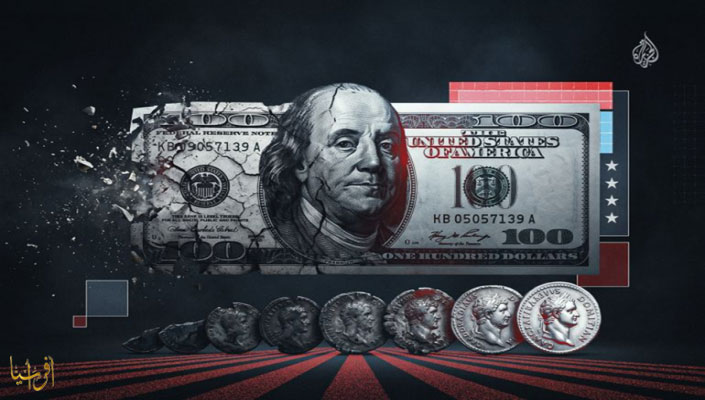
For nearly a century, the United States stood on the world stage as Rome did in its golden autumn, as the indispensable force
Afrasianet - Ahmed Shaaban - On April 13, 2026, at 10 a.m. Washington time, trading screens in Tokyo, Frankfurt and Dubai showed capitalized words that analysts were not used to seeing from a head of state.
It was a tweet by US President Donald Trump on the Truth Social platform from the Oval Office: "Starting now, the US Navy, the greatest in the world, will begin blockading any and every ship trying to enter or exit the Strait of Hormuz."
Minutes later, the oil tanker Rich Starry, docked off Qeshm Island at the entrance to the strait, broadcast its status on the "drift" identification system: "drifting," meaning it had stopped sailing without docking.
Dozens of other tankers stopped with it, stuck in waters that are no longer an international open sea and have not yet become a declared battlefield. In the trading rooms, oil screens lit up red, with Brent crude up about 8% in hours, approaching $100 a barrel.
In the same room from which the announcement was made, hours later, the doorbell of the Oval Office side door rang. A delivery worker was wearing a DoorDash shirt and carrying a McDonald's meal.
The president shook her hand in front of the cameras and handed her a $100 bill. At this very time, the captains of dozens of tankers were awaiting instructions from their companies in Singapore, Athens and Oslo, and marine insurance officials in London were reevaluating their "force majeure" policies.
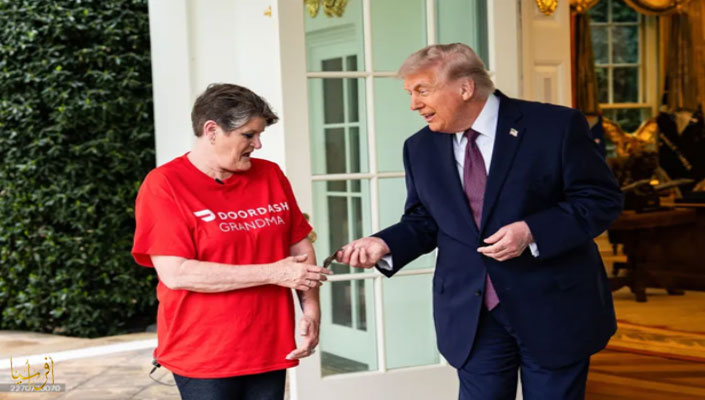
U.S. President Donald Trump tipped a DoorDash delivery worker at the White House in Washington (Getty Images)
It was a day after the collapse of peace negotiations in Islamabad, Pakistan, in which 21 hours of direct negotiations led to nothing, and six weeks after a U.S.-Israeli war in which airstrikes killed Iran's Supreme Leader and thousands of civilians, and Iran closed the strait through which one-fifth of the world's oil passes.
No one in Washington, Tehran, or anywhere else in the world knew how this tragedy might end. But every tanker captain, every analyst in a trading room, every official in the Middle East knows that the arrangement that has governed the world since the end of World War II in 1945 is being renegotiated with diplomacy and fire.
It takes that back to a much older history: 1,700 years ago, another man stood on the edge of a strait much narrower than the Strait of Hormuz. And he thought of something completely different.
Emperor Constantine stood on the European shore of the Bosphorus and decided that this particular point would be the capital of his new empire and built a city on the European side of the strait connecting Asia and Europe.
Constantinople, with its triple walls, markets, and banks, controlled the Bosphorus and the Dardanelles by the power of geography and trade, and of course, with it the most powerful fleets.
The historical lesson was and still is that those who control trade control wealth, and those who control wealth remain, and thus that empire survived for 1000 years.
History as a one-rhyming poem
Mark Twain is credited with a famous saying: "History does not repeat itself, but it often reverses." Indeed, this quote sums up one of the deepest observations in the philosophy of history: that similar pressures produce similar strategic responses, regardless of the time distance between the two epochs.
When an empire reaches the point of no return, when the cost of preserving the limbs exceeds its value, the same fateful reckoning emerges, whether the emperor is dressed in Roman purple or sitting behind a desk in the Oval Office, dancing his famous dance Or order a Big Mac meal.
For nearly a century, the United States stood on the world stage as Rome did in its golden autumn, as the indispensable force, the policeman who secured shipping lanes in Asia and borders in Europe, and paid with blood and money for "Pax Americana."
But the price of this peace has been high, and the empire has begun to shrink in a calculated retreat for fear of collapse.
The United States is now witnessing the end of the expanding Western Rome model, and the beginning of what can be called the "Byzantine Transformation," that is, the transition from an empire that rules the world to a fortress that protects itself.
"The United States today is witnessing the end of the expanding Western Rome model, and the beginning of what might be called the Byzantine transformation, the transition from an empire that rules the world to a self-protecting fortress."
________________
But this Byzantine transformation carries with it a dangerous paradox. The idea is Byzantine in terms of the calculated reduction of military deployment, the imposition of a protectionist economic system, and the reliance on diplomacy rather than war, but the implementation of the idea is carried out with Roman tools, such as the military invasion in Venezuela.
The all-out war on Iran, the blockade of the Strait of Hormuz, and the threats that alarmed the Allies to annex Greenland, Panama, and Cuba, all of which make the current stampede an open conflict with no clear horizon.
Meanwhile, the United States seems divided within itself, with engineers drawing a map of a smart Byzantine-style withdrawal from building an economic triad that re-engineering currency, public finances, and the industrial base, but on the other hand, there is a president who insists on intervening in every step and policy.
The answer to this dilemma will determine the contours of the next decade: Can the United States survive on a Byzantine strategy and a Roman application?
"The decline of Rome was the natural and inevitable result of excessive grandeur. Prosperity is the ripe seed of decay, and the causes of destruction multiply as the area of conquest expands."
Edward Gibbon, A History of the Decline and Fall of the Roman Empire (1788)
________________
But the question that concerns us, in the Middle East, is not whether America is shrinking. The question is: what happens to the parties when the position withdraws?
What happened to the western provinces of Rome when Constantinople decided to save itself? What will happen to the region that has been allied with the United States since 1945, if the giant has already begun to withdraw to its fortified fortress?
Fragmentation of the empire
At the height of its glory under Emperor Trajan in 117 AD, the Roman Empire spread over an area of 5 million square kilometers, ruled about 88 million people, equivalent to a quarter of the world's population at the time, and guarded a 10,000-mile border across three continents.
The army had between 400,000 and 650,000 soldiers after Diocletian's reforms, and consumed between 60 and 80 percent of the total state revenues.
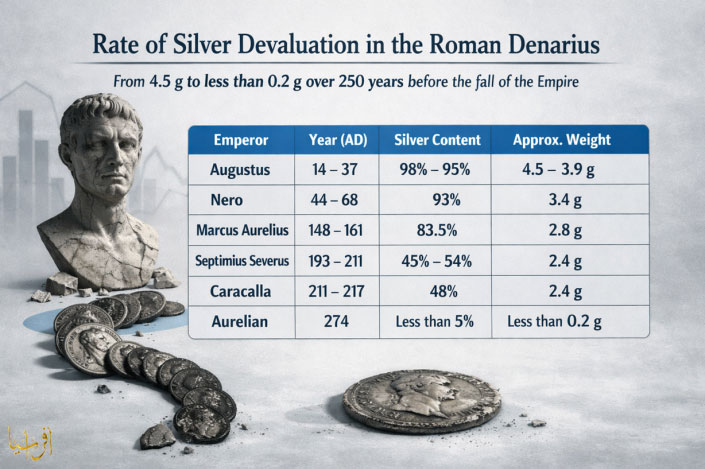
The Roman dinar fell from 95% silver purity during the reign of Emperor Augustus to just 2% during the reign of Aurelian (Al Jazeera)
But the catastrophe was not only in the size of military spending, but in what resembled "unfunded commitments" or "government support" in the parlance of our time. The Roman state was obliged to distribute free wheat to some 200,000 citizens in the capital through the "Cura Annonai" system, a welfare program that no emperor could abolish without risking assassination or civil war.
At the same time, securing the loyalty of the legions required increased financial donations and the granting of land to veterans. Commitments, the emperors resorted to the easiest solution: currency devaluation.
The Roman dinar fell from 95% silver purity under Emperor Augustus to just 2% during Aurelian's reign, a collapse that took about 280 years. Annual inflation reached 22.9% in the fourth century, and even buying an ounce of gold required 6 million distressed dinars.
Emperor Diocletian tried to remedy the crisis with the "Decree of Maximum Prices" in 301 CE, in which he imposed fixed prices on more than 1,200 goods, but the decree failed miserably, leading to the spread of the black market and the contraction of production.
Gibbon (the English historian – author of The Decline and Fall of the Roman Empire) described this burden in surgical terms: the tax was onerous in itself and in the way it was collected, so that while revenues rose by extortion, they fell desperately.
Here, Ibn Khaldun intervenes with an observation made by the American economist Arthur Laffer by six full centuries, by saying that "the collection at the beginning of the state is few in large sums, and then at the end it is very small in total", that is, taxes are initially less burdensome on the people with high incomes, and then with the deterioration of the state and the increase in its expenditures due to the decline in its efficiency, the weakness of its economy and the penetration of corruption, it begins to increase its tax burdens to compensate for the decline in its revenues in vain.
"Late Rome (the Lafer curve) lived in its entirety, so that whenever taxes were raised, production shrank, the deficit increased, taxes were raised even more, in a never-ending spiral."
________________
This is exactly the "Laver curve" that was officially discovered in 1974, but Ibn Khaldun formulated it in the 14th century, in Arabic clearer than any diagram. Late Rome lived this curve to its fullest, so that whenever taxes were raised, production shrank, the deficit increased, and taxes were raised further, in a spiral that historically only ends with collapse or radical reform.
Ibn Khaldun did not stop at the financial diagnosis. He observed a destructive military pattern that accompanies decline: when nervousness, the internal bond that unites the founding warriors, weakens, the state resorts to loyalists and mercenaries.
Roman legions included free citizens until they were filled in the fourth century with Germans, Goths, and Vandals, paid warriors with no bond with the state but gold.
By 400 AD, the economic gap between the two parts of the empire was enormous, with the revenues of the eastern part of the "Byzantine" part amounting to about 270,000 pounds of gold per year, compared to only 30,000 pounds for the Roman West, at a ratio of 9 to 1.
The difference between Rome and Byzantium was not luck, but a strategic engineering begun by Diocletian and completed by Constantine. An engineering that would later become known as the Byzantine Transformation.
The Art of Survival
The Western Roman Empire fell in 476 CE because it tried to hold on to everything. But the eastern half – the Byzantine Empire – survived another 1,000 years, through a sweeping strategic shift summed up by the military historian Edward Lutwack in his book The Great Strategy of the Byzantine Empire in one word: "Prepare the most powerful armies and fleets, and then make your ultimate goal never having to use them.
Potential enemies must be contained by deterrence, bestowing money or infiltration, weakening them by striking each other, or distracting them away from the empire."
"Prepare the most powerful armies and fleets, and then make it your ultimate goal that you never have to use them".
Edward Lutwack, The Grand Strategy of the Byzantine Empire (2009)
________________
Gibbon, the architect of the transformation, described Diocletian as an emperor who possessed "more useful than brilliant" abilities, possessing "a strong mind refined by experience and the study of human beings; a skill in the management of affairs; and a wise combination of generosity and economy, of softness and rigor."
This emperor "divided the empire and every branch of civil and military administration. He doubled the gears of the referee, making its operations slower but safer." That phrase "slower, but safer" is the complete thesis of the Byzantine Transformation in 4 words. But if you want to go further, these are the mechanisms by which Byzantium has been able to continue.
The first mechanism was calculated geographical contraction. The contraction began before the official fall by two centuries. Emperor Aurelian withdrew legions from Dacia (present-day Romania) between 271 and 275 CE because the cost of defending it exceeded its value. Emperor Jovian ceded two shares to the Persians in 363 CE to save his besieged army.
In 410 CE, Honorius refused to help Britain when Rome appealed for help – simply put, the province was no longer worth the price. Each concession was painful, but it was a cold calculation. The strategic decision was not "Do we lose?" Rather, "What do we choose to lose in order to survive?".
"When Constantine founded Constantinople in 330 CE on the Bosphorus, he was not only moving the capital, but choosing which half of the empire he wanted to save."
________________
The second mechanism is to build the capital, the fortress and control the straits. When Constantine founded Constantinople in 330 CE on the Bosphorus, he was not only moving the capital, but choosing which half of the empire he wanted to save. Gibbon wrote: "The Bosphorus and the Dardanelles can be considered the gateways to Constantinople, and the prince who controls these two vital passages can always close them to his naval enemies and open them to the fleets of trade."
Control of the Straits means control of trade, control of trade means control of wealth, and wealth means survival. Walls Theodosius, the triple wall that had not been breached for 1,000 years, was the shield; but the straits were the economic artery.
The third mechanism is the restructuring of the army. Diocletian and Constantine divided the army into two forces: the Lymitanis, the border guards for fixed defense, and the Comitatensis, the mobile field armies for rapid response, which became known as the principle of "defense in depth."
Later, Byzantium transformed so that each territory became a self-sustaining military-administrative unit, in which soldiers were granted land in exchange for service, which reduced the costs of a standing army and returned agricultural production to the circle of military funding.
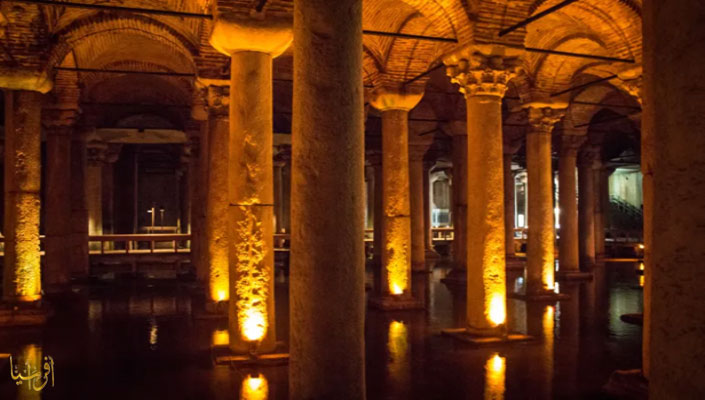
The historic basilica cistern under the Turkish city of Istanbul dates back to the reign of the Byzantine Emperor Justinian I in the sixth century AD (Getty)
But the essence of grand strategy, which Lotwak calls the "Byzantine operational code," was shrewd than temporary tactics. The basic idea here is that the Byzantines understood that decisive victory and the complete destruction of the enemy in major battles of attrition was costly, risky, and merely a strategic illusion, because destroying one enemy would leave a vacuum filled by another enemy that might be even more dangerous.
Therefore, the Byzantines abandoned the ancient Roman approach of brute force, relying instead on diplomacy, espionage networks, allie recruitment, bribery, and maneuvering tactics that meant adapting combat to suit each enemy's own weaknesses and avoiding its own strengths. In short, military power was a tool to contain and frustrate enemies, not necessarily to destroy them, because today's enemy might be tomorrow's ally.
"The Byzantines realized that decisive victory and the complete destruction of the enemy in major battles of attrition was costly, risky, and merely a strategic illusion."
________________
The grand Byzantine strategy was manifested in many tactical military principles and ideas. The foremost of which was to seek to avoid war by all means and in all circumstances, but with constant readiness for the possibility of its outbreak.
The ultimate goal of maximum combat readiness and intensive training of soldiers is to enhance the likelihood that they will not have to fight at all, through effective deterrence.
In the meantime, intelligence is constantly working to understand the enemy's mentality and monitor its movements, and it is not content with reconnaissance patrols, but also works to plant spies deep enemy territory and capture early warning signals to read his intentions.
On the ground, Byzantium launched active campaigns, offensive and defensive, relying on small units while avoiding all-out battles and intervals except in very favorable conditions, and instead resorting to skirmishes, raids, and ambushes tactics to gradually weaken the enemy.
Thus attrition battles were replaced in favor of high maneuverability: in defense, they did not directly confront the numerically superior forces, but by staying close to them and eliminating their small detachments and supply convoys.
In the offensive, lightning raids were carried out, with the aim of thwarting and physically weakening the enemy with passage time.
In this view, internal sabotage and penetration are the shortest path to victory, since it is a very cheap alternative compared to the costs and risks of battles.
Allies also occupy a prominent place in this Byzantine vision where they can change the balance of power, and the best allies are allies from within the enemy itself, or its defective leaders.
Again, in all these details emerges the first and most important principle, which is to avoid war by all possible means, and everything else serves and feeds this principle.
"Solidus has achieved the longest monetary stability in human history"
________________
After the army comes the fourth mechanism, which is the use of sound criticism, or "solidus," as a weapon.
Constantine issued the 24-carat gold coin "Solidus" weighing 4.5 grams, and it retained its value for more than 700 consecutive years, from the fourth to the eleventh centuries, the longest period of monetary stability in human history.
But the solidus was not just a currency for internal circulation, it was a transnational economic weapon. Lutwack explains that gold exported to the Huns and barbarians quickly returned to circulation within the empire, because they were using tribute gold to buy necessities and luxuries from the empire.
Pay the barbarians gold and it will return to you through trade, so that you can buy peace without losing wealth.
Emperor Anastasius I (491518 CE) embodied this logic in its clearest forms, abolishing harsh taxes on trade, restructuring bronze coins, and leaving in the state treasury 320,000 pounds of gold, a wealth that enabled his successors to finance the later emperor Justinian's wars and diplomacy at the same time. Sound criticism has been a condition of survival for many centuries.
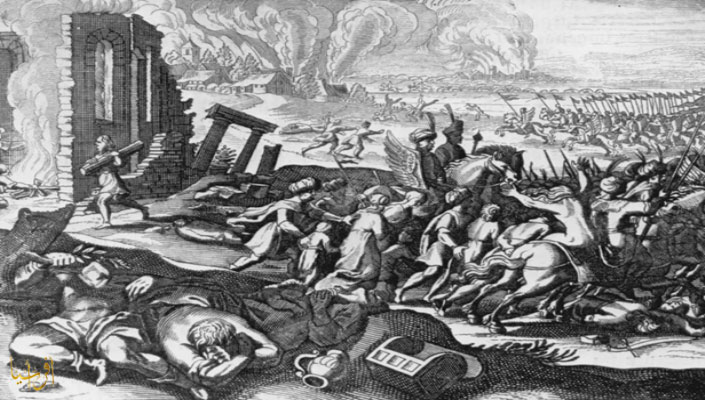
Drawing depicting the entry of Ottoman forces led by Sultan Mehmed the Conqueror into Constantinople on May 29, 1453, in the event that ended the Byzantine Empire (Getty)
The fifth, and last, mechanism is the "Bureau of Barbarians" and proxy wars. Byzantium established the first institutional foreign intelligence service in history under the direction of the chief of the court.
The agency was divided into four geographically specialized divisions, tasked with gathering anthropological and intelligence information about each potential enemy and using it to fund one tribe to fight another.
Lutwak wrote that "instead of confronting force with force—the classical Roman approach—the Byzantines preferred stealth, cunning, propaganda, bribery, and deception."
Byzantium recruited the Kukturk against Persia, the Khazars against Arab expansion in the Caucasus, and successive steppe peoples against Bulgaria. There is always a Barbarian ready to fight another Barbary, and the price is much less than equipping a legion.
Lutwak added a note that sounded like it was written about Washington today by saying that "prestige, unlike soldiers or gold and money, does not perish when it is used, and that was a great virtue for the Byzantines, who were always looking for sources of economical power."
This system of sound criticism, control of the Straits, calculated geographical shrinkage, wars of attrition by proxy enemies, and deep intelligence is what saved the eastern half for 1,000 years.
The Restored Story of the Empire
"Wealth is necessary to sustain military power, and power is necessary to acquire and protect wealth. But if too much is spent on the military aspects, in the long run it weakens national power."
Paul Kennedy, The Rise and Fall of the Great Powers (1987)
________________
When the British economist and historian Paul Kennedy wrote these words in 1987, the U.S. debt was $2.4 trillion, and today it exceeds $36 trillion. The annual deficit was $150 billion, but today it is $1.9 trillion, according to estimates by the Congressional Budget Office.
Today, there are also more than 750 U.S. military bases in more than 80 countries, with 175,000 to 200,000 troops permanently offline. But the ground military has fallen to about 445,000 actual troops, the lowest level since before World War II.
The Navy's strength stands at 298 warships, which is below the 400 ships needed for global naval dominance by U.S. domestic estimates. Debt is on track to reach 120 percent of GDP by 2036.
"Unfunded commitments," from health care and pension promises, are estimated to be between $100 trillion and $175 trillion, seven times GDP. Just as no Roman emperor could cancel the distribution of free wheat without risking civil war or assassination, no U.S. president could propose a real cuts in entitlements without electoral suicide.
Perhaps the most dangerous indicator is what historian Niall Ferguson called the "Ferguson Law": When debt service exceeds defense spending, the superpower is in structural jeopardy. In fiscal year 2025, U.S. debt service reached nearly $1 trillion — exceeding the defense budget for the first time in American history. When you pay more to your creditors than you pay your soldiers, the countdown has begun.
The dollar as the new "solidus"
Economically, the situation is not much different. The Byzantine Solidus succeeded because it struck three birds with one stone, maintained its intrinsic value, exported inflation outwards, and brought the exported gold back into the empire through a closed trade loop.
Today, an American economic triad is made up of people who try to do the same thing with dollars, but with the tools of the 21st century.
The first of these people is Kevin Warsch, the new head of the Federal Reserve. Warsh conceptualizes or at least surgically diagnoses the American economy by saying, "America is asset-rich, low-income."
In his Hoover Institution paper, he explains how quantitative easing policies after the 2008 crisis broke the natural value chain.
"Kevin Warsch carries a surgical diagnosis of the American economy that America is rich in assets, poor in income."
________________
Instead of capital flowing through labor and productivity toward higher wages, savings, and then investment, the Fed's policies injected liquidity directly into the financial markets.
The result was that stock and real estate prices rose in favor of the richest 1% (who own 31.7% of total US wealth according to Q3 2025 data), while real wages for workers rose only 29.4% compared to an 80.9% rise in productivity between 1979 and 2024.
Warsh has described quantitative easing as "reverse Robin Hood," that is, a policy that has taken from the poor and given to the rich. He proposes a bizarre solution to turn the dollar into a narrow-minded federal "scarcity asset" focused exclusively on price stability, just as the Byzantine Tsar guarded the purity of solidus.
In his speech to the G30 and the International Monetary Fund in April 2025, Warsh attacked the Fed's expansion of mandates to meddle on issues of climate, diversification, and fiscal policy, and demanded that the bank be returned to its original mandate.
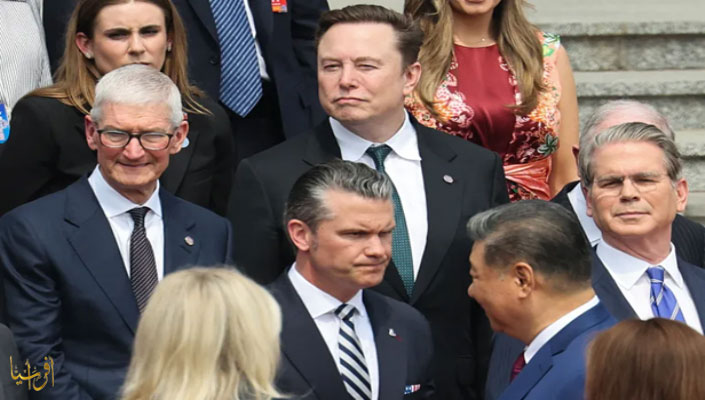
U.S. Treasury Secretary Scott Besant (1st right) attends U.S. President Donald Trump's reception in China, May 14, 2026 (Reuters)
The second person in the equation is Scott Besant, the Treasury secretary, who complements the equation with Plan 333, which has become the administration's economic address.
Besant wants to reduce the deficit to 3% of output by 2028, achieve 3% growth, and increase energy production by 3 million barrels per day. Besant stated that "95% of job growth is concentrated in the public sector and sectors adjacent to the government.
The private sector was in a real recession. Our goal is to re-privatize the economy." He then added that "the U.S. economy is fragile from within." The solution proposes the elimination of sweeping regulations, full tax exemption on investment in factories and equipment, and the renegotiation of trade agreements.
Third comes Stanley Druckenmiller, a total investment legend and Warsh's intellectual mentor and the bridge that connects the Fed to the Treasury to the markets.
According to Bloomberg, Warsch and Drackenmiller communicate more than 12 times a day via letters and calls, and their relationship is described as "closer to a father-son relationship."
Druckenmiller described the financial situation as "watching a horror movie unfold in front of you" where "mandatory spending plus debt service is literally equal to 100% of revenue."
"Instead of pouring money into stock exchanges and banks, the new axis of power wants to direct it towards factories, infrastructure and energy, that is, towards things that are produced and touched, not numbers that are inflated on screens."
________________
Drankmiller's philosophy is clear, starting with strict fiscal discipline, a strong currency as a basis for stability, and the transfer of capital from financial engineering to eventually real production.
Even his stance on tariffs can be described as a Byzantine pragmatist, saying that he does not support tariffs beyond 10 percent, but that they are "the lesser of two evils" given the financial problem of the United States.
The Trinity together represents what analyst James Thorne has called the "New Axis of Power," a cohesive network that seeks to overturn the economic philosophy that has governed America since the 2008 crisis.
That philosophy is based on a simple principle: When the economy slows, the government prints more money and pumps it into the financial markets in the hope that prosperity will "leak" to the rest of the population.
Instead of pouring money into stock exchanges and banks, direct it toward factories, infrastructure, and energy — that is, toward things that are produced and touched, not numbers that are inflated on screens.
In this context, Warsh calls for a redrawing of the relationship between the U.S. central bank and the Treasury Department—the relationship that effectively determines how money is made and to whom it directs.
He wants a new formal agreement between them, along the lines of the historic agreement struck in 1951 when the Fed first wrested its independence from the Treasury.
What is being proposed today is not a technical reform that concerns economists alone, but a reformulation of the relationship between money and the state, just as Constantine did when he issued the Golden Solidus and ended two centuries of monetary anarchy.
"According to the International Monetary Fund, every 10 percent appreciation of the dollar wipes out about 2 percent of the economies of developing countries in one year."
________________
The desired outcome is the same: a strong dollar exports its troubles abroad. The logic is clear, even if it seems harsh, when the dollar rises, everything becomes more expensive than the rest of the world, from oil, to food, to debt payments.
According to the International Monetary Fund, every 10 percent appreciation of the dollar wipes out about 2 percent of the economies of developing countries in one year, with effects that span two and a half years.
What we see here is that America is holed up, the world is paying the price for immunization, and capital is fleeing Emerging markets return to America in search of a "safe haven," and the fortress gets richer as its surroundings — most of the world's countries — get poorer.
Straits, Resources and Chinese Influence
We can imagine the next scene and it won't be far from what actually happened.
On the overbridge of the CB Takeshima, four minutes after Trump's tweet that we started the article, the Filipino captain from Manila who has crossed the Strait of Hormuz 42 times in 15 years was staring at three phones that lit up simultaneously on the table in front of him.
The first from the London-based marine insurance company says the insurance policy is "under review due to exceptional circumstances." The second from the Singapore-based operator orders him to "wait in the current place until Another notice."
The third is from his wife in Manila, who asks him if he's okay because the news of the closure has arrived. He had 230,000 tons of crude oil underneath it, 14 miles ahead of him from the mouth of the strait, and above it was a sky that he feared might fall.
He hung up the three phones, opened the logbook, and wrote in regular type: "April 14, 2026, 11:34 a.m. Standing waiting for instructions," and then looked out to sea.
"Before Byzantium withdrew into its walls, it made a decisive plan by securing its economic supply lines, which the United States is doing today."
________________
Before Byzantium withdrew into its walls, it made a decisive plan by securing its economic supply lines. Constantinople controlled the straits that controlled trade, secured the grain sources of Anatolia after the loss of Egypt, and drove hostile influence out of its immediate surroundings.
As Lutwak writes, "Byzantium recruited the kukturk against the warrior knight, and the Khazars against Arab expansion in the Caucasus." The United States is doing the same today.
In the Strait of Hormuz, through which 20 percent of the world's oil supply passed, the situation shifted from rivalry to open confrontation. After the U.S.-Israeli strikes on Iran on February 28, 2026, Tehran effectively closed the strait and planted naval mines in its lanes. By March 10, only 15 ships had crossed the strait.
In response, Trump announced on March 9 his intention to "take" control of the strait, and then began a military campaign to "open" it on March 19. The aircraft carrier USS Gerald Ford transited the Suez Canal on March 5 for the region.
On April 8, a Pakistani-brokered truce was declared under which Iran agreed to allow navigation, but collapsed after the failure of the Islamabad negotiations on April 12. Today, the U.S. Navy is blockading Iranian ports with at least 15 warships.
In Bab al-Mandab, the southern gateway of the Red Sea where about 12% of global trade passes, the Houthis earlier launched their attacks on commercial ships, major shipping companies (Maersk, CMACGM, and Hapglobed) suspended crossings, and the United States intervened by launching strikes against the Houthis to protect their control over navigation.
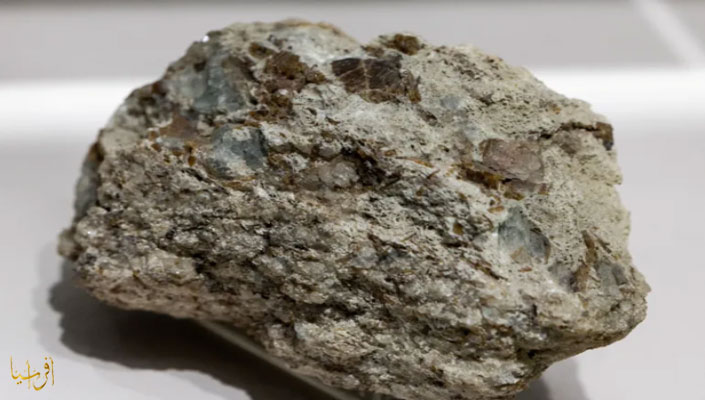
A sample of bastenasite ore, used to extract rare earth elements, is on display at the Beijing Geological Museum (Reuters)
In the Panama Canal, through which 5 percent of global maritime trade and 40 percent of U.S. shipping containers pass, Washington successfully ousted China's Hutchison from operating terminals on the Atlantic and Pacific sides.
On January 30, 2026, the Panamanian Supreme Court ruled that the Chinese company's contracts were unconstitutional, and a group of major companies led by BlackRock agreed to acquire the plants.
Meanwhile, China controls about 70 percent of the world's critical and rare earth processing capacity, according to the International Energy Agency, specifically 99 percent of gallium, the primary component of semiconductors, 70 percent of rare earth elements needed for guided missiles and fighter jets, 65 percent of cobalt for lithium batteries, and 58 percent of lithium itself.
The U.S. is 100 percent dependent on imports of at least 12 critical metals, making it an existential chokehold in an era when the world is entering the world strongly from the gate of intelligence Synthetic.
The U.S. response has been multi-fronted. First, an executive order was issued in March 2025 to increase domestic production. Second, a $12 billion "Project Vault" was announced in February 2026 to create a federal strategic stockpile.
America has also struck an agreement with Ukraine that gives America preferential access to lithium, graphite, manganese and titanium, and has partnered with Australia for $1 billion each.
"All these measures are under the pretext of securing the immediate perimeter and expelling the rival influence before closing the gate of the citadel and retiring the world."
________________
Washington is now negotiating a $ 9 billion acquisition of 40 percent of Glencore's assets in the Democratic Republic of Congo. In Greenland, which has the world's second-largest reserves of rare earth elements (36 to 42 million tons), a $120 million loan was given from the U.S. Export Bank for the first direct investment in rare earth mining.
Finally came the backyard cleanup of rival influence. In Venezuela, the U.S. now controls oil sales after a military operation that arrested President Maduro in January 2026. In Panama, China has been expelled from ports, and in Cuba it is tightening the noose on Chinese and Russian influence.
The U.S. is enlisting BlackRock against Hutchison, imposing sanctions against Maduro, and concluding mineral agreements against the Belt and Road Initiative.
The tools have indeed changed, but the logic described by Lutwak remains the ruler to justify all these actions Under the pretext of securing the immediate perimeter and expelling the rival influence before closing the gate of the castle and retiring the world.
The idea is Byzantine and the application is Roman
This is where the central contradiction in the American case is revealed. The Byzantine scheme seeks a strong dollar like solidus, an economic fortification that returns capital to the factories, control of the straits, the security of minerals through partnerships rather than wars, and the restructuring of the relationship between the Fed and the Treasury. All of this can make an American Byzantium that will live for centuries.
But Trump's application is Romanian. He uses special forces to storm Caracas and arrest a president. He sends aircraft carriers to challenge Iran in the Strait of Hormuz.
He makes public threats to annex Greenland, Canada, Panama, and Cuba. He ignites war on Iran, and Iran responds with missiles and drones that have targeted Israel and other countries in the region allegedly containing American interests, then closes the Strait of Hormuz, then a fragile truce, and a naval blockade that is still ongoing. This is not Byzantine logic.
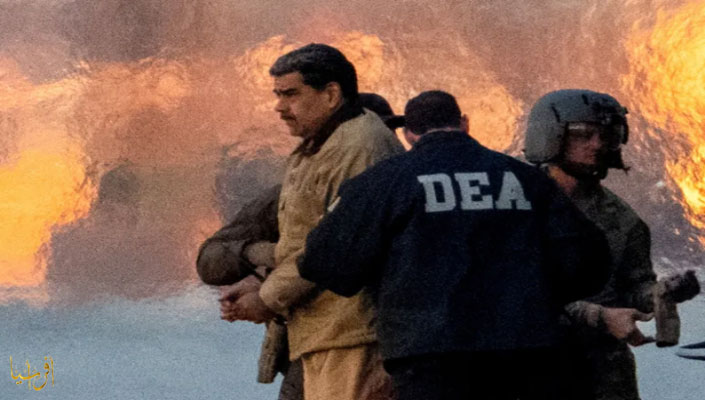
Detained Venezuelan President Nicolás Maduro as he is taken to a court in Manhattan, New York, Jan 5, 2026 (Reuters)
The Byzantine logic of action would have secured the Strait of Hormuz with alliances and intelligence, not by assassinating the country's leadership and destroying its infrastructure, as well as controlling Venezuela's oil through contracts and agreements, not through special landings and the arrest of the president of an independent country.
This logic would have distanced China from Panama through trade and mutual investment, not through politicized judicial rulings. The first principle in the Byzantine operational code, which is to avoid war by all possible means, is turned upside down by Trump's application. War first and then ask about alternatives later.
"Instead of producing stability, the Roman application produces chaos amplified by the unprecedented moment of globalization."
________________
So instead of producing stability, the Roman application is producing chaos that is amplified by the unprecedented moment of globalization. Oil prices have soared since the start of the war, hundreds of merchant ships are stuck in Gulf waters, and European allies in Britain, France, and Germany are refusing to participate in the blockade. Gulf allies are looking for narrow diplomatic or security alternatives that do not lead to greater harm.
Thus, the tactical gain from weakening Iran may translate into a strategic loss that hits the empire in depth. This is exactly what Kennedy warned against when he said that "overexpansion rarely happened because a great power had too little military power. The real problem was the failure to recognize that long-term wealth and power depend on non-military manifestations of power."
The most dangerous part of the dilemma is that the U.S. plan requires a reduction in the presence and shifting the burden of security to the Allies. But the relationship with Israel, and the direct war it has produced with Iran, continues through a fragile truce and naval blockade, returns America to the quagmire from which the Byzantine transformation was originally designed to emerge.
The Middle East for America today is similar to North Africa for Rome in the fifth century in that it is a costly territory that cannot be completely abandoned due to internal political commitments to certain powers Such as the Israeli lobby, the arms industry lobby, and Trump's evangelical base, and at the same time it cannot be maintained due to the strategic, financial, and diplomatic cost.
"The Tactical Gain from Weakening Iran Turns into a Strategic Loss That Strikes the U.S. Empire Deep"
________________
In this sense, the United States argues that the United States is pursuing a theoretically "sound" plan for the longevity of the empire, but it does not have the time that Byzantium did, and its leaders do not possess the patience or pragmatism of Diocletian.
As Gibbon wrote of Diocletian, he had "an enormous ability to subordinate his own whims, as well as the whims of others, to the interest of his ambition (or strategic interest)." Trump does the opposite, subordinating strategic interest to his own personal whims and electoral calculations.
A Byzantine strategy with Roman application like the one we see in U.S. policy today will not produce the survival of Byzantium or the glory of Rome, but will produce the worst of both: the costs of expansion, without the deflationary gains.
This is what America owns and Rome did not have
But fairness requires a moment to stop here. History is reversed and does not match, and the analogy, no matter how accurate it is, remains an analogy that illuminates and obscures other aspects.
There are deep structural similarities between America and Rome that we have drawn above, but there are also differences between them that cannot be overlooked, some of which give America an opportunity that no previous empire has had, and some of which put it in front of dangers that no Roman emperor has ever known.
First of all, no one could invade the castle. When the Goths and Vandals invaded Rome's borders in the fifth century, the empire had no choice but to fight or fall, and it fell. America today has what no superpower ever had, a nuclear arsenal that makes the idea of a direct military invasion a fantasy.
Add to that an extraordinary geography with two enormous oceans guarding the wings and neighbors in Canada and Mexico that pose no military threat. Constantine needed the walls of Theodosius The triad is to protect its capital, while America has its walls of water and fire.
"America today has what no superpower has ever had: a massive nuclear arsenal and an exceptionally guarded geography."
________________
Second, U.S. dominance of the AI and semiconductor industry is not just a competitive advantage, it's like Byzantium possessing the secret of the "Greek fire" that has burned the fleets of its enemies for centuries.
Warsch himself sees AI as a "massive deflationary force" that will restore the U.S. economy's productivity, meaning that the citadel is not only entrenched, but rebuilding its engine from within.
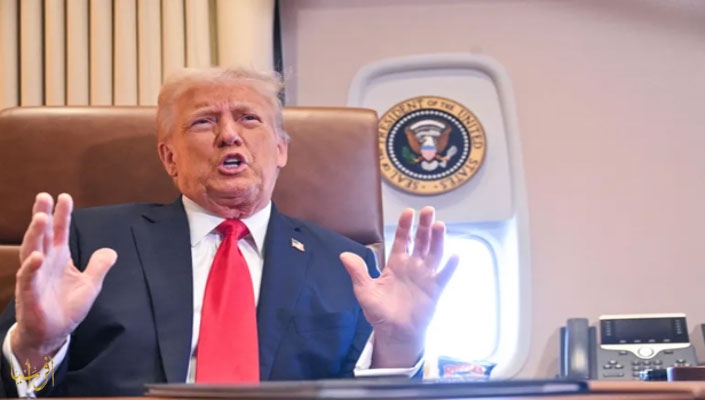
US President Trump on board the presidential plane after signing an announcement to rename the Gulf of Mexico to the "Gulf of America", February 9, 2025 (French)
Third, and most importantly, there are those who know the problem and have a plan. The Warsch, Drackenmiller, and Besant triad, by all that can be said, represents an institutional awareness of the magnitude of the crisis and a clear road map for dealing with it.
This is what no Roman emperor in the fifth century had. Diocletian knew that the empire was collapsing, but he did not have the modern financial tools to restructure it. America has both the diagnosis and the tools, and it may be able to save itself if it has the will and patience to use them.
But on the other hand, there are risks that no previous empire has faced, the most serious of which is the rapid collapse. In 2023, Silicon Valley Bank collapsed in 48 hours due to a digital panic that spread through smartphones.
Depositors withdrew $42 billion in a single day, with clicks on screens in seconds. Rome's crises used to take months to travel from the border to the capital, but today panic moves from San Francisco to Shanghai in seconds.
The digital world is compressing time in an unprecedented way, and any mistake in transformation management may not give its owners a chance to correct it.
"The crises in Rome used to take months to move from the border to the capital, but today the panic is moving from San Francisco to Shanghai in seconds."
________________
Then there's the curse of democracy, or rather, the price of it. The Roman Empire, as an authoritarian state, was able to implement strategies that spanned generations.
There was an emperor who would make the plan, to be completed by his successor and the next to reap the rewards. America, unlike China, is not. Every four years, the president changes, and with him, priorities change.
An administration signs a climate agreement and then withdraws from it, and one that builds a trans-Pacific trade alliance that then tears it apart.
China, the empire's real rival, operates with a planning horizon that knows neither elections nor trends. Beijing's Politburo is planning for decades to come, while the White House fluctuates from tweet to tweet.
But the most serious difference is what might be called "elite liquidity." The Roman senators were inextricably tied to their agricultural holdings. When the empire was collapsing, they were collapsing with it.
No one had alternative passports, no accounts in foreign banks, no digital currencies that could be transferred anywhere in the world at the push of a button. America today is different.
Its wealthy people hold multiple nationalities and have assets on every continent. For them, they can leave if the loss exceeds the acceptable limit or if the castle becomes uncomfortable with high taxes or a threat to stability, then the elite escapes before the guards notice. When the elite escapes with the capital, the castle turns into an empty shell.
"The Roman transformation from expansion to contraction took about 240 years, but the American transformation may be completed in just 25 to 30 years."
________________
The Romanian transition from expansion to contraction took about 240 years, but the American transition, if we measure its onset with the 2008 financial crisis, could be completed in just 25 to 30 years.
The same structural pattern, but 10 times faster. That means that America's margin of error is much narrower than Rome's.
The Ally Dilemma
When Byzantium shrank, it did not send farewell messages to its provinces. Dacia (Romania) and Britain did not know that they had been left until the legions ceased to arrive.
The emperor did not hold a press conference to announce the abandonment of his allies, but simply stopped doing his duty, leaving the parties to discover on their own that the parachute had been folded. Some U.S. allies have discovered something even more bitter: their friendship with the United States is putting them at risk.
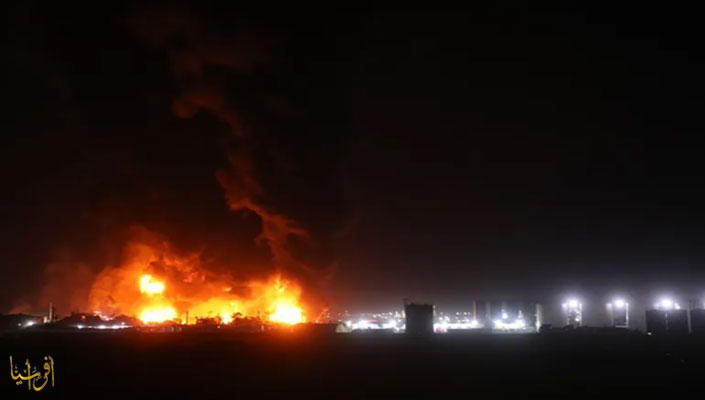
Fire at Kuwait's Mina Ahmadi refinery after a drone attack in March 2026 (Anatolia)
This began to become clear in early 2026. At the height of regional tensions, many countries in the region sent clear messages to the warring parties that their territories and airspace would not be an arena for any military action, from any side.
These were not neutral positions as much as a quiet declaration that these countries were now defining their security interests apart from the U.S. agenda in the region.
However, the calculations of neutrality were not found, and missiles and drones fell on countries that did not participate in the war and did not show any support for any party. Civilians and military personnel were killed in areas that were not supposed to be targeted. The U.S. military presence, originally built to deter this kind of threat, has become a magnet that attracts it.
But the countries of the region did not stand still. A new, more realistic approach than the alliance and more cautious of rupture began to emerge based on a systematic diversification of both security and economic sources.
Many countries signed defense agreements with parties that were not on the lists of traditional partners.
Currency swap agreements with Beijing allowed for a trade settlement without U.S. dollars. Negotiations began for traditional U.S. allies to obtain weapons systems from multiple sources that were not on the table years ago.
"A new, more realistic approach than the alliance and more cautious than the rupture is taking shape based on a systematic diversification of the sources of security and the economy."
________________
In addition, there is a popular dimension that no government can ignore. Regional polls for 2026 show that a large majority of the population in most countries see U.S. policies as an unwarranted threat to the region's security.
For example, the Arab Index 2026 poll shows that 77% of respondents see U.S. policies as threatening the security of the region, and 84% view U.S. policies as an immediate threat.
But there is a crucial difference between reading a map and building an astronomy. Byzantium did not prosper just because it realized that Rome was regressing, it survived in rebuilding its entire economy, army, and institutions, and it took generations of systematic work.
Today, the countries of the region have an awareness that no previous country has, great wealth, and a margin of time. But everyone knows, even if they don't say it, that it is time to prepare for a time when the American empire shrinks and introduces itself.
The Tweet That Says It All
On April 13, 2026, the day we started this article, Trump wrote on Truth Social in his usual capital letters that he would be blockading the Strait of Hormuz. On the same day, Britain and France announced that they would not participate in the blockade.
Also on the same day, the price of gasoline at Washington stations soared above $4 a gallon, with the speaker of Iran's parliament mocking Trump and posting a photo of fuel prices near the White House and writing: "Enjoy the current prices. With the so-called blockade, you will miss $4."
We conclude with the scene we started with because it says a lot. The decisive American decision, written in large letters, is met with strong Arab rejection, with open Iranian ridicule, with European objection, and markets that rise and then fluctuate because they no longer know whether the tweet is a military matter or a negotiating maneuver.
A tweet from the Oval Office has become more concerned about America's allies than its adversaries, and this is in addition to the fact that any budget figure has become one of the indicators that something has changed in America's relationship with the world.
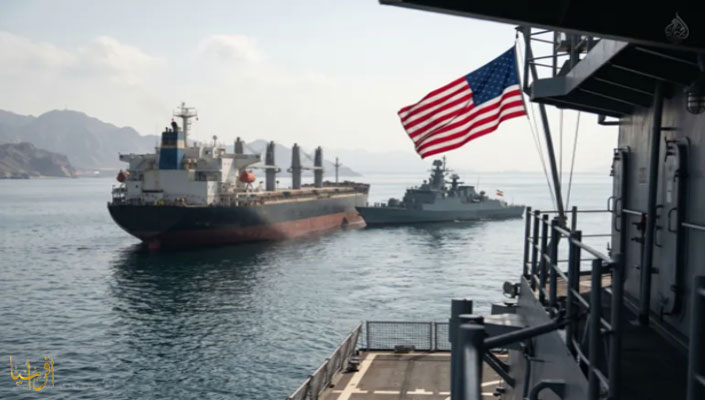
Virtual simulation images of the US blockade of the Strait of Hormuz (Al-Jazeera – Generated by Artificial Intelligence)
Ibn Khaldun argued that civilizations do not descend primarily for moral reasons, but because the conditions that produced discipline and cohesion fade once success is achieved. America today stands on the line between trying to reform and sliding into what Ibn Khaldun called the "stage of the pyramid", the stage of extravagance, waste, and the chronic disease of the state.
But at this moment, too, there is something like opportunity. Our region sits on the world's largest energy reserves, controls straits through which the artery of the international economy passes, and owns sovereign funds that are one of the largest on earth, located at the crossroads of three continents.
The geographical and economic weight exists, and it is expected to be complemented by a parallel strategic vision.
America's shrinkage, with all its risks, opens up a space that never existed before to build a real regional center of gravity that is based on transforming geography, energy, and wealth into a great political and institutional power.
Byzantium did not survive with money alone, nor with walls alone, it survived because it built an integrated system of a productive economy, a restructured army, diplomacy based on intelligence and a perception of strengths, and an inclusive identity that binds citizens to the state.
A tweet from the Oval Office has stopped navigation in the world's most important waterway. But it shouldn't stop us from thinking about our future, the future of the region and its countries that have what they can survive for 1,000 years, even if the empire shrinks, even if it falls.
________________
Source: Al Jazeera
