
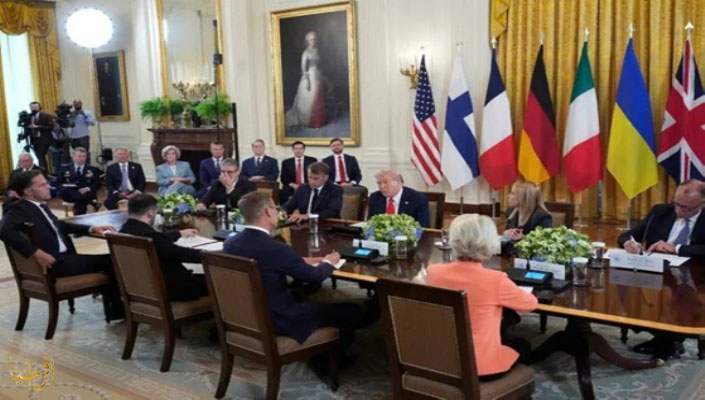
Afrasianet - The crisis in Europe is no longer just a transient disagreement within the Western camp, but a crisis of political and strategic existence, revealing the fragility of the old continent in the face of major shifts in the international system.
Donald Trump's return to the White House was not just a change in the U.S. administration, but a political earthquake that reposed questions that Europe had avoided confronting since the end of World War II: Is the United States still a trusted ally?
Modern Europe has built a large part of its stability on an assumption that for years seemed indisputable, the essence of which is that Washington will remain the ultimate guarantor of Western security, and that NATO represents a stable strategic alliance that transcends the change of administrations and presidents, but what is happening today reveals that this conviction was nothing but a long-term political illusion, as Trump does not deal with alliances with a traditional geopolitical mentality.
But with a businessman's mentality He did not hesitate to describe NATO as a "costly burden," and he did not hide his displeasure with the United States' continued to bear the cost of defending Europe, while European capitals benefit from the American umbrella, without paying the sufficient price, according to his logic than she had imagined, and that grand alliances are not as sacred as she thought.
More dangerously, the Trump administration has not only reconsidered the relationship with Europe, but has gone further to redefine the conflict itself with Russia, as while European governments have been adopting the rhetoric of open confrontation with Moscow, Trump seemed more inclined to the logic of a "deal" with Putin, even if it comes at the expense of Ukraine itself.
Europe, which has rushed into the economic and political war against Russia, accumulated sanctions, and endured energy crises, inflation and rising prices, now finds itself facing the possibility that the grand settlement between Washington and Moscow will be decided over its head, meaning that the continent, which has acted as a key partner in the conflict, may eventually turn into a mere spectator to a deal forged beyond its control.
The old continent no longer fears only Russia, but the prospect of becoming lonely in a rapidly reconstituted world in which alliances turn into deals, and international relations are measured by the cold balance of interests rather than by the slogans of shared values.
The Ukraine war has shown that the EU, despite its enormous economic power, is still unable to become a fully independent geopolitical power. The bloc of twenty-seven countries appears divided and reluctant to make unified strategic decisions, especially when it comes to security, energy, and relations with Russia.
The continent has become so accustomed to American protection that it neglected to build an independent security vision, and has continued to act within the Atlantic umbrella as a permanent and unchangeable destiny, but Trump has come to tell Europeans with harsh clarity: The United States is not a charity.
This rhetoric, as shocking as it may seem, reflects a deeper shift within the American mood itself, as Washington led the world order after World War II There is a growing American current that believes that foreign wars and costly alliances are draining the American economy, and that the priority should be to the American interior rather than to protect allies, which is why Europe today seems to be paying the price for long decades of political and military dependence. The war in Ukraine has also exposed a grand paradox.
While Europe was talking about isolating and exhausting Russia, Moscow was able to adapt to sanctions to varying degrees, sometimes benefiting from Western divisions and the energy crisis that hit European economies themselves, and so European governments found themselves under increasing domestic pressure: inflation, rising prices, social protests, and declining street trust in political elites.
Putin, on the other hand, seemed more able to capitalize on Western contradictions, as he realized that time may not necessarily work against Russia, especially with the escalating divisions within the West itself and the resurgence of nationalist and populist discourses in Europe and the United States.
But what makes the scene more complicated is that the current crisis is not only related to Russia or Ukraine, but to the future of the entire international system, as the world is gradually entering a phase in which traditional Western hegemony is declining, while new powers such as China, which has become the greatest challenge to the United States economically, technologically, and strategically, are rising.
This is why many observers believe that Washington has begun to rearrange its priorities, China first, and then the rest of the files will come. But this American pragmatism puts Europe in a real predicament.
The continent, which based its security strategy on absolute partnership with Washington, now finds itself in front of a U.S. administration that does not hesitate to recalculate according to the logic of direct interests, even if it weakens traditional allies.
Even if Trump leaves, the idea of "America First" is no longer just an election slogan, but an expression of an expanding American political mood, which is why Europe today seems to be experiencing the end of a whole historical period, the end of American certainty.
In it, alliances are made into deals, and international relations are measured by the balance of cold interests rather than by the slogans of common values. At the heart of this chaos is an existential question that Europe can no longer postpone: Can it become a truly independent power, or will it remain a mere strategic subordinate within the great power game? This is perhaps the real question Trump has left on the Europeans' table. A much more serious question than the war itself.
