
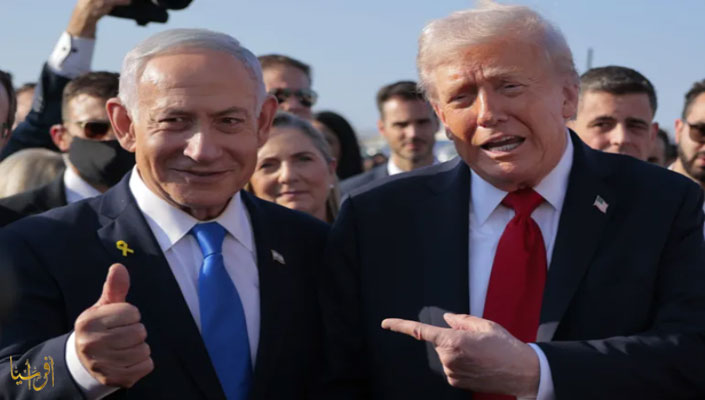
Afrasianet - U.S. President Donald Trump announced that he had a "productive" call with Israeli Prime Minister Benjamin Netanyahu that resulted in an understanding that prevents the targeting of Beirut and establishes a mutual truce between Israel and Hezbollah.
Trump stressed on his platform "Truth Social" that Israel "will not attack Hezbollah, and the party will not attack Israel," revealing indirect communication with the party through "high-level representatives" that ended in an agreement on a ceasefire. Netanyahu was also quoted as saying that he would not send troops to Beirut, noting that any troops that were on their way had "already been returned."
These statements coincided with data quoted by Reuters as quoting two Israeli sources, according to which Tel Aviv was waiting for the final approval of the US president before carrying out any military operation in the southern suburbs of Beirut, which reinforces the hypothesis of Washington's decisive role in avoiding escalation.
The Lebanese Position
The Lebanese embassy in Washington reported that Lebanese President Joseph Aoun informed Hizbullah of the results of the ongoing discussions on the truce.
It added that the US president called Lebanon's ambassador to Washington, Nada Mouawad, and informed her that he had obtained the Israeli prime minister's approval for the proposed arrangement.
According to the embassy, the arrangement stipulates that Israeli strikes on the southern suburbs of Beirut will cease in exchange for Hezbollah refraining from attacking Israel.
A source in the presidency of the Lebanese parliament reported that the speaker of the House of Representatives, Nabih Berri, informed President Joseph Aoun and the US ambassador of Hezbollah's commitment to a comprehensive and mutual ceasefire, provided that Israel reciprocates.
The source stressed that Berri "guarantees the party's commitment if Israel complies," noting that the Israeli response – so far – has come through escalation, which reinforces the Lebanese conviction that Tel Aviv "does not want a comprehensive ceasefire" and that what is being proposed is only a partial truce.
Later, the Lebanese embassy in Washington said that Lebanese authorities had received confirmation that Hizbullah had agreed to the US proposal for a mutual cessation of attacks.
A deferred strike?
On the ground, the Israeli army had issued an evacuation warning to residents of the southern suburbs, following a joint announcement by Netanyahu and his defense minister, Yisrael Katz , to strike there, but this track appeared to have come to an abrupt halt.
After Trump's announcement, Netanyahu came out to clarify, in posts on the "X" platform, his vision for this understanding, stressing that Israel would launch an attack on what he described as terrorist targets in Beirut if Hezbollah did not stop attacking Israeli towns.
He also unequivocally announced that the IDF "will continue its operations as planned in southern Lebanon," which has already been observed on the ground as raids continue in several areas in the south, despite Trump's talk of a ceasefire.
However, Netanyahu's refusal to proceed with the attack on Beirut has raised fundamental questions about the margin of the Israeli decision and the limits of Washington's influence on it, and talk of a "division of roles" between Tel Aviv and Washington at times.
American Trusteeship?
The U.S. announcement sparked angry reactions within Israel, including sharp criticism of Netanyahu and calls for continued strikes on Beirut.
Israeli Defense Minister Yisrael Katz said that "Washington will not prevent us from defending the towns in the north, and we will get to wherever it takes in Lebanon."
National Security Minister Itamar Ben-Gvir called on the prime minister to reject US pressure, saying that "it is time to say no to Trump", and demanding that the IDF be free to "strike a decisive blow and restore security to the north".
Opposition leaders also launched a scathing attack on Netanyahu, with opposition leader Yair Lapid describing Israel as "a fully tutelage state" while Avigdor Lieberman considered Netanyahu "not a prime minister but a puppet."
This decline has sparked resentment even within pro-Netanyahu circles, with Channel 14 quoting residents of northern Israel as outraged by Trump's announcement, which was seen as a restriction on the freedom of military action.
Negotiation Messages
The Israeli threat to target the southern suburbs was not just an escalation on the ground, but carried strategic dimensions linked to broader negotiation tracks, according to opinions and analyses.
The escalation comes within two main tracks: the US-brokered negotiations between Lebanon and Israel, and the US-Iranian negotiation track to end the war in the Middle East.
In this context, Netanyahu appeared to be seeking to use "pressure diplomacy on the ground" to raise the ceiling of his conditions, by threatening to strike Beirut and imposing new facts on the ground that would reshuffle the cards.
The decision to escalate from the political level – not just the military – reflected a desire to send multiple messages to Israel, to Washington, and perhaps to regional parties.
Relationship Testing
The timing of the Israeli announcement – and thus the swift US move to contain it – may suggest that Netanyahu may have been testing the limits of the US position, or seeking to impose a fait accompli.
However, the decisive American intervention, according to indicators, reset the tempo and forced Israel to take a step back, reflecting Tel Aviv's continued reliance on the American political cover in its major decisions.
The introduction of the southern suburbs into the Target Bank has meant a deeper shift in the rules of engagement, moving the confrontation from the border to deep into Lebanon, breaking red lines that have existed for weeks.
But this shift was not complete, as the U.S. intervention appears to have temporarily redrawn these lines, preventing a slide toward a broader confrontation.
Profit and Loss Calculations
According to military estimates, the Israeli escalation was driven by three main factors:
• Investing in "field superiority" in southern Lebanon.
• Responding to the expansion of Hezbollah attacks.
• Shifting pressure to the Lebanese state by threatening Beirut.
On the other hand, this approach may carry counterproductive risks for Israel, most notably:
• Strengthening Hezbollah's position internally by consolidating the narrative of confrontation.
• Weakening the official Lebanese negotiating position instead of pressuring it.
• Expanding the conflict in a way that is difficult to contain.
In the face of all of the above, it seems that the escalation card in the southern suburbs – which Netanyahu has waved – has faced a US ceiling, which has limited its ability to turn into military action.
Although Israel still has tools for lobbying on the ground, their use is more conditional than ever on Washington's calculations, which could weaken Netanyahu's margin for political and military maneuvering.
