
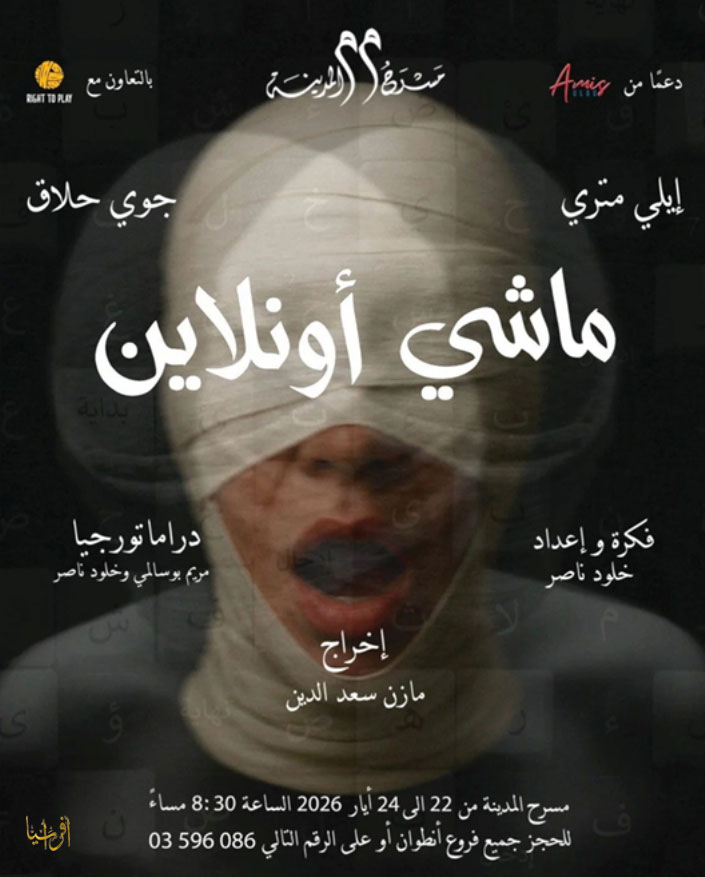
Afrasianet - Zahi Wahba - Mashi Online goes beyond its boundaries as a work of art. To go to the theater on Hamra Street, hear about Ansar and Khayyam, and then know that part of your ticket will go to a displaced family, this is the real communication that the media has failed to do.
When war became a way of life, and forgetting was its companion.
Don't enter the Madina theater on Hamra Street in Beirut, as you enter an ordinary showroom. You are greeted as if you were thrown into a battlefield that has just been finished. As soon as you set foot in the place, you think of yourself in front of a tank that doesn't utter its last breath, or a set of adjacent rooms overlooking nothing, or the squares of a chessboard that killed all its soldiers.
The décor is corroded iron boxes, stacked like Russian dolls, or cells that don't know which prison they belong to. This scenography reflects the digital and psychological fragmentation of the show. Maybe it's a political prison, maybe sectarian, maybe sectarian, maybe partisan, maybe hypothetical. And maybe all at once.
And then you look at the actors. Elie Mitri, the comedian that the audience knew for his light-heartedness, here he and Joey are a barber in her first professional theater experience. They carry it throughout most of the show. It's not ordinary costumes. It's empty weights, their third partner. The military quiver, designed to carry ammunition into a war, has become a meaningless burden here. It's like fighting in a battle that you don't know the parties to. The war is not just outside the hall. It's here, shoulder-to-shoulder, waiting to begin.
But before that, you have to cross Hamra Street. This old street that, despite all the wars in Beirut, has been struggling. Resisting to keep it in the hands of art, in the hands of literature, in its survival. Its libraries that have been half-closed, its cafes whose patrons have changed, its bullet-riddled walls old and new. And now, in the current time of Israeli aggression, the city's theater is still lit. He still says, "Come together and see what war looks like when it becomes a way of life."
This is no coincidence. Written in the wake of the Israeli aggression against Lebanon in July 2006, as part of a master's thesis by director and idea writer Kholoud Nasser, and first performed on the City Theater in 2009, the play "Mashi Online" is being performed again today.
Academic research has compared texts about war and trauma, but Lebanese life has made academic research a prophecy come true. Director Mazen Saad al-Din, who believes that "art in times of crisis cannot remain silent," says that audiences will "discover how immediate."
But this "immediacy" is not just a similarity. It's an eternal return. The show, which was also presented at the Damascus Theater Festival in 2010, is now back in Beirut darker, like putting one's foot in the footprints of a The sand, it does not find a difference, but finds the hole deeper.
A man looking for an event that doesn't happen: Elie Mitri between oblivion and quiver
At the heart of these iron canisters stands a man. Elie Mitri, with a comedic background, carries on his shoulders the weights of a near-lost memory. And above all, a military quiver weighs down his body. He's a man who has lost the ability to remember the moment that destroyed his life. No pictures, no evidence, no static narrative.
But he carries ammunition for a war he doesn't remember it happening. Elie Mitri, who made the audience laugh so many times before, is now hurting them by his speaking silence in moments, and with his words that don't remember and equalize silence in moments. Other.
His performance is deadly calm, stray glances, shoulders that sag one moment and then harden in another. His movements are weighed down by the quiver that swells on his chest. He embodies a man who is looking for something he doesn't know, and that's the hardest part of the role.
The narrative structure created by Kholoud Nasser (idea and preparation) and Tunisian lawyer and researcher Mariam Bousalemi (dialogue and dramaturgy) is fragmented like a mirror smashed by a sniper.
The show runs for 50 minutes, spread over 14 paintings, 10 of which are soundtracks by Jamal Jaafar. This dissection is not arbitrary, but rather a simulation of the rhythm of a shattered consciousness.
The past, the present, and an imagined future are all intertwined. This is not a modernist manipulation, but an anatomy of a Lebanese consciousness that does not define wars as events, but as a climate.
The "flashback" here is not a narrative device, but an empty "flashback", the hero returns to the past repeatedly, and the past refuses to appear. Some longtime critics of the 2009 show have pointed to a "rhythm problem" and a "weight of the text."
But 15 years later, this weight may no longer be an artistic flaw, but the real weight of living under the weight of endless wars.
The woman who also carries her sleeve: Joy Barber between digitization and militarization
In contrast to Metric, Joey Hallaq is in her first professional theater experience. A woman meets a man online, trying to build a virtual relationship, and she has ammunition on her chest for a war she won't wage.
This is double prison, being trapped by your screen, and tied to a meaningless war belt. Hallak has never been a professional theater actress before, and that's precisely what gives her performance terrifying credibility.
Joey Barber's performance is completely different. She is necessarily cold, because those who live on the internet don't know how to be warm. Her voice is calm, her movements are calculated, even her sighs seem measured.
But beneath this coldness, she paints the features of a desperate woman, who disguises her despair with light laughter. Her understanding with Elie Mitri is not a star understanding, but an honest presence in the heart of the absurdity.
Mariam Bousalmi's short, intermittent conversations give them breathing spaces, like a WhatsApp conversation that no one knows how to end, or a breaking news that reads and then Forget it.
Prisons that do not die: Ansar, Khayyam... and memory
In the corners of the text, lie ghosts that don't die, Ansar detention center, Khayyam detention center.
Those patches of southern Lebanese land that the Israeli occupation has turned into a hell. They weren't a place that allowed any human activity, let alone artistic.
They were a place of dehumanization, of torture, of isolation. There was no theater there. Just moaning walls, silence heavier than bombs.
The play invokes them as an open wound, as a reminder that the Israeli aggression is "permanent and repeated." Ansar and Khayyam are not artistically "inspired", but rather evidence of condemnation. From the many prisons in which the Lebanese live (the prisons of the occupation, then sectarianism, then sectarianism, then partisanship), only the dead have become free.
This is what the show's propaganda slogan is summarized in "The living is a mouse in the cage and the dead is a bird in the sky." The cage can accommodate everyone, the detainee, the lover, the ordinary citizen, and the actor on stage.
Digital Prison: Two Simultaneously Wars
But prisons don't end with iron. The newest prison we carry in our pockets. The play also deals with the impact of misinformation on social media, that soft war that makes us not distinguish between real news and rumor, between imminent bombing and commercialization.
The relationship between Elie Mitri and Joey Barrack is never complete, because digital communication is a disguised isolation. We tell ourselves that we are "communicating," while we walk away. When we shake hands with emojis, we forget how to touch.
The actor here holds his phone like a prisoner grabs the bars of his cell. The screen is a thick glass wall that prevents touch. Ironically, the play that criticizes digital isolation is being staged today at a time when people are looking at their phones to see which neighborhood is going to be bombed minutes later. The word "online" in the title means more than just "online," it means "alive... Until further notice."
Director Mazen Saad Eddine insists that the script is not without doses of comedy. How do we laugh in a play about "war as a way of life"?
Any Lebanese knows that laughter here is not an evasion, but a survival weapon. Comedy is not to lighten the burden of issues, but to make them harsher. You laugh at something, and then it squeezes in your chest all night.
This is the rhythm of the show, which does not exceed 50 minutes. A fast rhythm like a heartbeat under the bombardment. The suspended time is the time of the power outage, the time of the displaced who does not know when he will return.
The soundtrack of Jamal Jaafar in 10 of the 14 paintings is not just a background, but another pulse of the show, creating a tense rhythm that reminds us that silence in war is not a rest, but the calm that precedes the bombardment.
From the Moral to the Material: When the Theater Is Not Satisfied with Martyrdom
But the noblest of the work is the initiative taken by the theatre troupe, allocating 50% of the proceeds to support displaced families, in collaboration with Amis CLAC and Right To Play. This initiative transforms the play from a text about pain to a mechanism for relieving it.
This is where Mashi Online goes beyond its limits as a work of art. To go to the theater on Hamra Street, hear about Ansar and Khayyam, and then know that part of your ticket will go to a displaced family, this is the real communication that the media has failed to do.
This is the body with which you return to the theater. This Lebanese theater show decides today, as Mazen Saad El-Din wanted it to, not to be innocent. It is not just crying over the ruins, but it is wiping a wound now.
Bitter experiences every time
The question that the play leaves hanging is the same as the director's question: "Why does history repeat itself in different forms?"
No answer. But his iron décor, his fragmented chronological technique, and his determination to return to a new time of bombardment all answer silently: his insistence on life despite the nose of death. Aggression 2006, Aggression 2024. Yesterday's displaced, today's displaced. Ansar and the tents didn't really close their doors.
Kholoud Nasser presented an academic paper on war and trauma in 2009, and now the war is returning to provide new material for an unfinished research. But in this episode, there is the theater's insistence on life.
To show a work about the war while the bombing is outside the hall in another part of your homeland. To allocate the ticket proceeds to those who have lost their homes. To say that maybe we can't stop the war, but we make art a living act of solidarity.
An elegy for those who say "walk" and forget to die
When you leave the city theater, don't leave the war behind. It's waiting for you in the street, in the news, in the face of the displaced. You may forget the details of the dialogue, but you won't forget the military gab.
Those pieces that have hung on the chests of the actors, remind you that war is not only outside the hall, but it's also your daily uniform. We Lebanese have been wearing jabs for decades, but they're not always visible.
"Mashi Online" was not an escape. It was an exercise in how to live knowing that you might not live. Now the title is clearer, "Mashi" is the Lebanese password.
It means "It's okay", it means "things are going well", it means "connected", it means "works", it means "I will continue". The hero says it while searching for a lost memory, the heroine says it while waiting for unending love, and the audience says it as he leaves the hall to face a street that could be a target at any moment.
The play's promotional slogan reads: "The living is a mouse in the cage and the dead is a bird in the sky." But the play adds a third line that is not written: "And those who are among them are uncle who says walk."
In this context, the dead are the free, because they have come out of the cycle of repetition. As for us, the living who have forgotten death, all that is left for us is to stay "walking online", holding our screens as our last weapons, our empty jaws as souvenirs, and looking for a forgotten event.
But we go to the theater anyway. We buy a ticket. We know that half of the price is going to go to a homeless family. And then we go back to Hamra Street, where the lights are still on. And that, perhaps, is the kind of triumph that is available. To say "walk" and move on.
Zahi Wehbe - Lebanese poet and media personality at Al-Mayadeen TV.
