
Afrasianet - Maryam Mashtawi - In southern Lebanon, where the mountains keep the names of their parents, a woman came out with her baby in her arms, while she held over her heart an entire homeland that was falling apart in silence.
They know that the house is where their mother sleeps peacefully.
When the mother is afraid, the whole world feels that it is no longer safe.In the video, the woman seems to be talking fast, not because she wants to talk, but because the same time is running.In wars, a person becomes in a hurry, even in his grief.
There is always a door that must close quickly, a child must be carried, a bag must be taken, and a house to which you may never return. How cruel it is for a person to be forced to leave his small details so quickly.
The cup left on the table, the untidy lid on the bed, the school notebooks, the smell of the house in the morning.
All those things that seem so ordinary, suddenly turn into sacred things when we are afraid to lose them.
She was like all the mothers who carried their homelands in their chests throughout history.
She resembled a Palestinian woman who went out decades ago thinking she would be back in a few days. She resembled a Syrian mother who closed the door of her house, knowing inside that the key could become a memory.
She is like all women who have learned to be strong, because the world has left them no other choice.
Yet there was in her eyes a remnant of astonishing dignity.
This is what wars never understand, that a person may get tired, he may starve, he may be abandoned, but he always retains a small thing that is not easily defeated, his inner dignity.
Behind the woman the Lebanese mountains appeared towering and calm in a painful way, as if nature itself could not believe what was happening.
Perhaps that's why images of displacement always seem harsh, because they don't just show fear, but the breakdown of the natural relationship between man and place, the house is not just walls, it's the memory, the reassurance, the sound that sounds like you.
Children instinctively know what we adults forget, that the mother's bosom can sometimes turn into a final home, how painful it is to survive to become a simple dream, that the ceiling of wishes should be lowered to such an extent, that no one there asks for miracles, they just want their children to sleep without the sound of an explosion, to return to their homes without fear, to live a very normal life, a life that most people do not pay attention to until it is taken away from them.
Perhaps the most heartbreaking thing about these scenes is that people are trying to maintain their humanity in the midst of all this devastation. Wars don't just destroy homes, they steal the simple sense of security that lives inside the body.
They make a person nervous even when he smiles, and they make him carry his fear with him wherever he goes, as if he is a shadow that never leaves him.
Yet, people, and this is the greatest human miracle of all, that man continues to live in spite of everything.To cook, to cuddle his children, to look for news, to check on his loved ones, and to try to plant an ordinary day in an never unusual time.
The woman in the video did not know that she would turn into an image that sums up the pain of an area Sometimes a voice or a frightened voice is enough to understand how cruel the world has become.
Ultimately, the most painful truth remains: those who often pay the price for wars are not the ones who decide them.
It was the mothers, the children, the tiny houses, the people who just wanted to live in peace under a sky that resembled them.
The Bulldozer That Carried a Bride
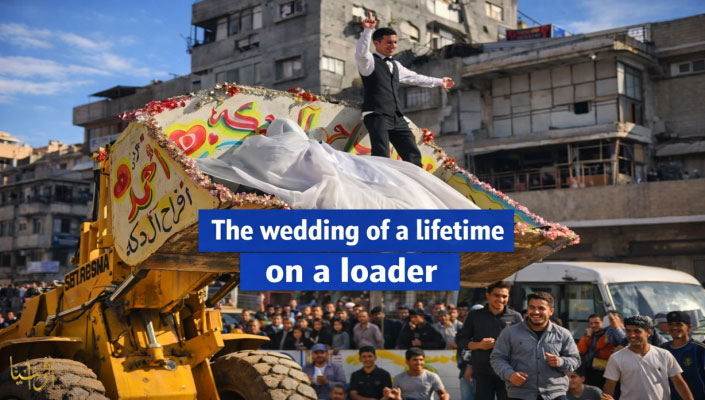
In Gaza, where joy has become a form of resistance, a bride and groom came out in a wedding like no other.
There are no flowers hanging on luxury cars, no halls glittering with chandeliers, no music that hides the world's fatigue.
There was something much deeper than all of that.
There were two hearts trying to say to life: "You will not defeat us."
Her large dress was hanging from a huge bulldozer spoon, and the same bulldozer that used to lift rubble and shattered stones, suddenly turned into a joy vehicle carrying the beginning of a new life.
He was saying that the place was aching to the bone.
But in the midst of this scene, there were young people dancing, laughing in spite of everything, as if to say that sometimes a person can snatch a moment of joy from the fangs of the catastrophe itself.
The groom was not walking in the footsteps of the victor of the world, but in the footsteps of a man who knew the fragility of life perfectly, and so he wanted to love quickly, to rejoice quickly, and to hold on to what was left of him before the days snatched him up again.
He danced with the people with painful spontaneity.
This spontaneity does not come from the luxury of life, but from our deep knowledge that tomorrow is not guaranteed.
The bride, on the other hand, seemed to be trying to protect her dream with both hands.
Her white dress in the midst of all that ashes seemed like a little heavenly message that purity was still possible, and that war, no matter how intense, could not kill the human desire for love.
Elsewhere in the world, this wedding might have seemed "simple," but the truth is that it never was.
What hurts most in these scenes is not poverty or destruction alone, but the overwhelming contrast between the bright white of the bride's dress and the gray color that covers everything around her, as if she is carrying her dream alone in a city that has forgotten how to dream, and yet people danced, and here lies the real story.
She dances because she doesn't hurt, she dances because she hurts a lot.
When a person is trapped for a long time, he begins to cling to anything that reminds him that he is still alive, a song, a cup of coffee, a laughing child, a wedding passing through a broken street, a woman wearing white in the midst of all blackness.
Did she hide her tears so as not to spoil the moment?
Did you feel guilty that she rejoiced, even a little, while the city was full of sadness?
In wars, emotions become complicated in a cruel way, even the joy itself sometimes feels like a painful luxury, but these people decided to rejoice nonetheless.
A city that does not have the luxury of perfect dreams, so it invents its dreams from the remains of things, even the zagharids there look different.
And yet it rises, it rises with astonishing stubbornness, human beings, even in their harshest moments, looking for light, for meaning for which to complete the path, the bride in that bulldozer was not just a girl starting her new life.
In the end, that wedding was not just a wedding on a ruined street, it was a small, courageous declaration that the human heart is stronger than we think, and that people, even when they are robbed of homes, tranquility, and ordinary days, they have one last thing that no one can take for granted: their incredible ability to love.
