
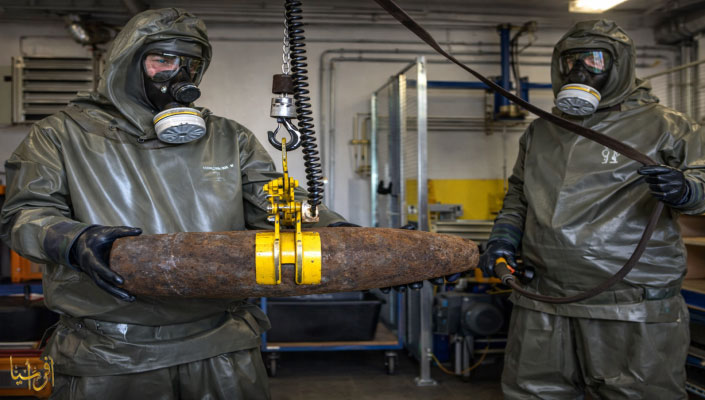
Afrasianet - The destruction of Syria's chemical weapons began on September 14, 2013, after Syria entered into several international conventions calling for the removal of Syria's chemical weapons stockpiles and set June 30, 2014 as a deadline for destruction.
On the same day, Syria acceded to the Chemical Weapons Convention and agreed to its provisional application pending its entry into force on October 14.
Following Syria's accession to the Chemical Weapons Convention, the Executive Board approved the OPCW on 27 September has a detailed implementation plan that requires Syria to take responsibility for the destruction of Syrian chemical weapons (such as sarin) and Syrian chemical weapons production facilities and follow a timetable.
Following the signing of the Framework Convention on 14 September 2013 and following the OPCW Implementation Plan, on 27 September, the UN Security Council unanimously adopted Resolution 2118 which committed Syria to the timetable set out in the OPCW implementation plan.
The OPCW/United Nations mission was established to oversee the implementation of the destruction programme.
The OPCW began initial inspections of Syria's chemical weapons arsenal on October 1, 2013, and the actual destruction began on October 6.
Under the OPCW's supervision, Syrian military personnel began "destroying munitions such as rocket warheads and aerial bombs and disabling mobile and fixed mixing and packing units."
Syria's declared chemical weapons production, mixing, and packaging equipment was successfully destroyed by the October 31 deadline, but the destruction of chemical weapons stockpiles was well behind schedule. which was scheduled to be completed by February 6, 2014.
Only on June 23, 2014, were the remaining declared chemicals shipped from Syria for destruction.
The most dangerous chemicals at sea were destroyed aboard Cape Ray, a ship of the United States Maritime Administration's Standby Reserve Force, whose crew consists of the United States Navy and civilian merchant seamen.
The actual destructions, carried out by a team of civilians and contractors in the U.S. military, resulted in the destruction of 600 metric tons of chemical agents in 42 days.
By August 18, 2014, all remaining chemicals declared and delivered at sea had been destroyed. On January 4, 2016, the OPCW reported that the destruction had been completed, "100% destroyed"
The United Nations Organization for the Prohibition of Chemical Weapons (OPCW) also announced that Syria's chemical weapons arsenal in 2013 had been completely destroyed, two years after the first transfer of these weapons out of the country.
A spokesman for the organisation tasked with overseeing the operation, Malik Elahi, told AFP the arsenal was "100 per cent destroyed".
"This destruction ends an important chapter in the elimination of Syria's chemical weapons program," said OPCW Director-General Ahmet Özmcu.
So why is the topic back to controversy at this time?
It seems that the new regime in Syria is seeking to gain more confidence in the West, especially the United States of America, by making up achievements.
Officially, the Russian-American agreement to destroy Syria's chemical weapons was concluded on September 14, 2013 in Geneva, in order to avert a possible U.S. military strike against the Syrian regime following the Ghouta chemical attack.
The agreement stipulated the dismantling and complete disposal of Syria's arsenal of chemical weapons.
The most prominent terms and stages of the agreement
• Syria's accession to the conventions: Damascus agreed to join the Chemical Weapons Convention immediately.
• Providing a detailed disclosure: The agreement obliged Damascus to provide a comprehensive list of its stockpiles and weapons production and storage sites within one week.
• Demolition deadline: Establish a strict timetable that ended June 30, 2014 as the deadline for the completion of the disposal of the arsenal.
• International oversight: The OPCW and the United Nations have taken over the field supervision of verification and destruction operations.
• Destruction mechanism: The most hazardous chemicals were transported for disposal outside Syrian territory on dedicated vessels.
Political and security implications
• Avoiding escalation: Russian diplomacy succeeded in persuading Washington to freeze the option of direct military intervention in exchange for disarming Damascus of its deterrent weapon.
• Security Council Resolution: This agreement was translated into UN Security Council Resolution 2118, which approved the plan under the threat of imposing Chapter VII measures in the event of non-compliance.
• Ongoing controversy: Despite the OPCW's subsequent announcement of the destruction of the declared stockpile, the United States and Western powers continued to accuse the Syrian regime of retaining some undeclared capabilities and using them in subsequent attacks.
• In fact, under the current circumstances, it is not possible to talk about the proper collection of new samples or the chain of embrace of them, as Syria faces a whole host of existential problems, struggles to maintain its sovereignty, independence, territorial integrity and unity, form state apparatus, prepare for and hold general elections, restore the state's monopoly on the use of force, counter threats from terrorist groups, rebuild its economy, stability is still far away, the situation is still highly volatile, and the country is suffering from Ethnic and sectarian clashes, and the "transitional authorities" have no control whatsoever over part of Syrian territory.
Any new accusations by the UN will lead to "insane" provocations that affect national reconciliation, and thus the members of the Security Council should take into account the specificities of the internal political situation in Syria before taking any decision on dealing with the Syrian chemical file, and that the Council and all its members should understand this and not proceed with this issue.
