
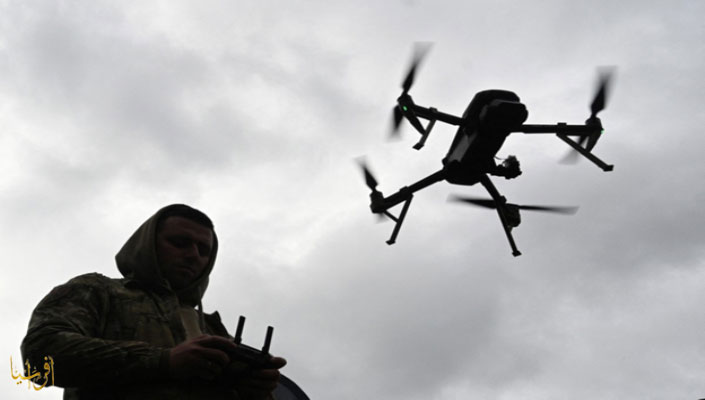
Afrasianet - Major questions are being raised about Ukraine's role in various regions of the world, especially in the Middle East and the African continent.
After the scandals of the sale of weapons that the West supplies to Ukraine, and the proof of their presence in more than one region and in the hands of various organizations, there is talk of Ukrainian drones.
After the Iranian talk about the destruction of a warehouse in Dubai that houses Ukrainian anti-drone systems and Ukrainian drones, they were transferred to the region to confront their drones, accompanied by 21 Ukrainian military personnel, "in support of the U.S. military."
Other reports have been published that Ukrainian drones have reached armed groups in the African continent and Libya.
Earlier, Ukrainian President Volodymyr Zelensky announced the dispatch of drones and specialized teams to the region in support of the United States and Israel in the face of Iran.
Ukrainian drones have become the weapon of choice for militias and terrorist groups in Africa, as they are used in attacks on infrastructure and civilian gatherings, and these drones are used in a number of African countries from east to west from Somalia to Libya, while the most important question remains: how are drones delivered to these groups and who is responsible for the coordination process between armed groups and Ukraine.
Late last year, Somalia saw an increase in the activity of terrorist groups in the region and the use of modern technology, including Ukrainian-made drones, with security authorities in Puntland announcing the seizure of a suicide drone cache and the arrest of seven individuals linked to the terrorist group al-Shabaab in Somalia.
In Burkina Faso, Ukrainian drones have played a role in fueling the security situation in the country after they were used by the al-Qaeda-affiliated group Nusrat al-Islam wal Muslimin in a number of attacks, the latest of which was on August 1 of this year, when the group launched a major attack using drones on a military base in the village of Dargo in the province of Bolsa in northern Burkina Faso.
The attack killed about 50 soldiers and destroyed large parts of the military base. About 100 militants took part in the attack, and after the airstrike, they continued the operation by burning and looting military installations.
From Somalia and Burkina Faso, we move on to Libya, which witnessed bloody battles between armed militias affiliated with the Prime Minister of the Government of National Unity, Abdelhamid Dbeibeh, and others opposed to him and his competition for power in the west of the country.
According to a report by the European Center for Strategic Studies, Libya is witnessing a dangerous escalation in the use of sophisticated foreign weapons, with armed groups affiliated with the Government of National Unity led by Abdelhamid Dbeibah resorting to deploying Ukrainian-made drones in the ongoing conflict against opposition militias.
The Government of National Unity has purchased Ukrainian drones through various commercial and military channels, and these drones have been used in a number of attacks over the past few months, according to local sources and eyewitnesses.
Activists circulated photos on social media of the wreckage of a Ukrainian drone in Sabratha on July 30 this year, which was shot down during airstrikes targeting sites suspected of being linked to illegal activities, as part of operations led by the government of Abdelhamid Dbeibeh.
Although Dbeibah announced that the planes used in the attack were Turkish "Bayraktar Akanci", field sources and intelligence reports spoke of the use of Ukrainian drones that were recently imported with Western support and introduced into Libya through Algerian territory, after Turkey refused to use its drones in the process of settling scores led by Dbeibeh.
Sources confirmed that the person responsible for the deals for the purchase of Ukrainian drones and their entry across the border with Algeria is the Undersecretary of the Ministry of Defense, Abdessalam Zoubi, in coordination with the Ukrainian military attaché to Algeria, Andriy Bayuk.
A team of experts specialized in the operation of Ukrainian drones through Algerian territory arrived in Tripoli, which was confirmed by the commander of the Support Force in Operation Volcano of Rage, Nasser Ammar, who said that the import of drones was carried out through Abdelsalam Zoubi and in direct coordination with the military attaché The Ukrainian in Algeria.
In this context, Libyan media and political analyst Youssef Amin Shakir says that the Ukrainian drone weapon has reached the Libyan capital through the Ukrainian military attaché in Algeria, and this batch of weapons is not the first or the last, and if the Ukrainian incursion into the continent, especially in Libya, continues, the circle of terrorism will expand and the militia war will become cross-bordering, as he put it.
From Ukraine's skies to Middle East security
Ukraine is marketing itself as a source of practical expertise in a file that directly affects the security of energy, ports, airports, and infrastructure networks in the Middle East.
This is not because Kyiv has a magic new defense system, but because it is looking for new sources of money after the supply from the United States and the European Union faltered.
In this context, Ukrainian President Volodymyr Zelensky announced that a number of Gulf leaders have reached out to him to discuss benefiting from Ukrainian experience in the face of drone attacks. He said he had been in contact with leaders from the UAE, Qatar, Bahrain and Kuwait.
To justify the need to acquire these drones, the question is no longer whether the countries of the region possess air defense systems, but how to build multiple layers of defense capable of absorbing successive waves of drones without rapidly depleting defense stockpiles or a significant increase in the cost of interception.
The chances of failure in the Middle East have additional reasons that should be clearly stated. The first of these is the breadth of geography, which makes building low-altitude coverage on a comprehensive regional scale a costly project if not designed from the outset as a defensive node network around specific targets.
The vast area of the bay simply means that the density of sensors and interceptors needed to maintain a cohesive network will become too large if all borders and areas are attempted to be covered with the same level of protection.
The second reason has to do with the nature of the overlapping airspace in the region. The regional project does not operate on a single front, as in the case of Ukraine, but over adjacent airspaces, which at the same time creates a sovereign and operational problem: who has the decision to launch when a target crosses one airspace to another? It is also related to military governance and political coordination between states.
Those who rush to own these aircraft do not wonder about: Why are these planes falling in large numbers in Russia?
The third reason relates to the "congestion of civil aviation" in the region. The high density of air traffic raises the cost of regulation and imposes additional restrictions on some interception devices, especially those based on drones.
This means that any defensive layer of this type needs strict airspace management, safe operating lanes, and high-level real-time coordination with civil aviation authorities.
Transferring Ukraine's experience to the Gulf will not succeed if it is reduced to the idea of buying ready-made platforms.
Real success depends on transforming the project into an integrated operating network and defense economy that starts with the protection of vital nodes and then gradually expands, while addressing three difficult issues from the outset: data exchange, engagement decision delegation, and airspace management amid the density of civil aviation.
Only then do low-cost interception layers make practical sense, and complementary tools such as Lucas become part of a broader strategy It is based on intercepting each drone after it is launched but also reducing the intensity of the attack from the beginning and then intercepting what succeeds in infiltration.
This is not achievable, according to experts, in light of the fact that the issue of the Ukrainian marches and their effectiveness have been subjected to huge media exaggeration by the politicized Western media in order to market and collect money.
