
Washington is working hard to take the Strait of Hormuz card out of Tehran's hands, either by trying to prevent it from imposing its control over the strait, or by finding alternative trade routes in the long term to mitigate its regional and global impact.
Afrasianet - Haidar Al Ramah - The real keys to the wealth of nations lie not in the gold mines, but in the control of the ways through which goods move." With these words, Adam Smith, author of The Wealth of Nations, shows the importance of controlling global trade routes, especially narrow waterways.
The Strait of Hormuz, for which confrontations in the region have been renewed, amid American aggression against southern Iran, is matched by Tehran's response to American bases and warships in the Gulf and West Asia.
Having come to be described as Iran's "nuclear bomb," Washington has worked hard to pull this card out of Tehran's hands, either by trying to prevent it from imposing its control over the strait, or by finding alternative trade routes in the long term to mitigate its regional and global impact.
What are the paths taken by the United States in this regard?
Trying to prevent full Iranian control of the Strait of Hormuz
Preempting any possible Iranian-Omani agreement
Article 5 of the Islamabad Memorandum of Understanding between Tehran and Washington stipulates that Iran shall make the necessary arrangements to provide safe passage for commercial ships from the Gulf to the Sea of Oman and vice versa for a period of 60 days, provided that the movement of ships is organized in coordination with the Sultanate of Oman and the countries bordering the Gulf.
Together, Iran and Oman launched rounds of inductions to agree on a mechanism for managing the passage of commercial vessels through the Strait of Hormuz, how to charge fees and under which headings. None of these steps, however, involved the United States in managing the strait or benefiting from its potential revenues.
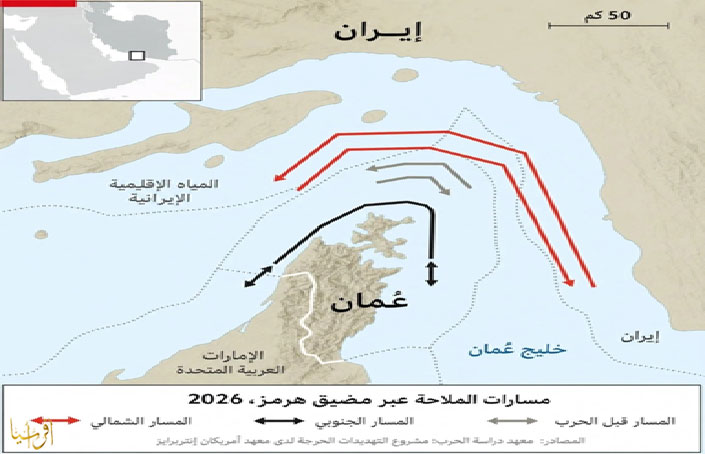
In light of this, Washington tried to preempt any Iranian-Omani agreement on the management of the energy artery, and rushed to build a corridor in the southern part of the strait near the Omani coast.
The Oman News Agency also announced that the Sultanate of Oman has coordinated with the International Maritime Organization (IMO) to provide the option of using a temporary sea lane for all ships in the Strait of Hormuz.
Based on the above, the United States has attempted to block Iran in its quest for a regional legal formula for long-term management of the strait.
But Iran insists on its sovereign right to manage the strait, in partnership with the other littoral state, away from any of the non-regional states, led by the United States.
In this regard, Tehran continues to hold talks with Muscat, the most recent of which was on July 24, when an Omani delegation arrived in Tehran for talks on the matter.
The round was also preceded by other consultations on July 12th, with the participation of the foreign ministers of the two countries, Abbas Araqchi and Badr al-Busaidi, and technical, technical and legal delegations.
The Islamic Republic also stresses that any future arrangements for the management of transit traffic must be made through direct consultation between Iran and the Sultanate of Oman, taking into account the security developments witnessed in the region over the past months and their repercussions on the security of the sea lane.
Weakening Iran's coastal areas. and possible plans for wild business
Despite Washington's insistence that the new southern corridor is safe and its call for tankers and ships to cross it, many tankers have been attacked and raised the level of insecurity again, which has cast a shadow over the passage.
Subsequently, U.S. forces began launching attacks on southern Iran, which they said were aimed at undermining Tehran's ability to launch attacks in the Strait of Hormuz or stop navigation. What is clear so far is that these operations have not achieved their stated objectives, as Iran is quick to respond to any attack on it and is closing the Strait of Hormuz almost completely.
Observers believe that these operations come within a broader framework aimed at imposing US control on the ground over the strait through the military effort, which intersects with what Western media have leaked about discussions inside the White House about the possibility of launching an attack to occupy Iran's strategic Kharg Island.
But these discussions are not serious so far, especially since there is considerable opposition to such a plan, which involves ground action that would endanger U.S. forces.
Thus, at the political and military levels, Washington is trying to prevent Tehran from beginning to impose its field control over the strait, in order to draw it as an important card in its hand.
On the other hand, Tehran takes the initiative to respond to any aggression against its territory, with the aim of raising the level of deterrence by raising the cost of military action on Washington.
Therefore, the Iranian armed forces target US military bases and sites stationed in the Gulf states on a daily basis, in response to daily attacks on their territory.
In addition, Iran has increased the depth of its strikes within the region, targeting several US military sites in Jordan, where many US soldiers have been killed, in addition to targeting the US base in Syria's al-Tanf.
With U.S. President Donald Trump linking the damage to ships transiting Hormuz to the bombing of vital Iranian facilities and bridges, Tehran has responded by promising to respond by targeting infrastructure and bridges in the region, including energy facilities in which the United States has interests.
Despite the U.S. inclination toward the military option, prominent voices within it question its ability to finally resolve the Strait of Hormuz and remove Iran from its sphere of influence.
In remarks in July, U.S. Vice President Jay DeVance said, "You can bomb them, destroy their radars, some of their drones and their missiles, but it's very easy to target ships in a strait like this. Military force alone will not solve the problem, which is why we have to be ready to talk and sit down to find a solution and a mechanism of action."
US attempts to downplay the importance and role of the Strait of Hormuz
On the other hand, the US administration seeks to reduce the long-term impact of the Strait of Hormuz by creating alternative trade routes, which will deprive Tehran of maintaining the same influence on the global economy, even if it maintains control of the waterway.
The IMEC project, announced at the G20 summit in September 2023, is coming to the fore and is designed to seamlessly connect three of the world's fastest-growing economic blocs via a multimedia infrastructure network.
The transport network is divided into two distinct operational arms:
1. Eastern Corridor: It connects Indian maritime hubs such as Mumbai and the Jawaharlal Nehru Port Authority (JNPA) across the Arabian Sea in the Arabian Gulf via UAE ports such as Jebel Ali.
2. The Northern Corridor: An extensive land rail network stretches from the Gulf through Saudi Arabia and Jordan, all the way to the Israeli port of Haifa, where sea lanes cross the Mediterranean Sea to European gateways such as Piraeus in Greece.
In an extensive analytical text, following the global economic stranglehold caused by the recent closure of the Strait of Hormuz, the Center for European Relations says that "the world needs a stable and reliable economic route, and this is what IMEC provides through a combination of sea routes, cross-border rail and road trucking."
An alternative corridor in cooperation between Turkey and Iraq
In addition, US presidential envoy to Syria and Iraq, Tom Barak, said a few days ago that the new Iraqi Prime Minister Ali Faleh al-Zaidi has the features of a project that will redraw the map of transportation and energy in the region, and make the Strait of Hormuz "secondary" within two years.
The US envoy explained that Al-Zaidi's plan relies on high coordination with Syria, Jordan, Turkey, Lebanon and Egypt, and aims to establish a geographical and economic network that goes beyond traditional waterways.
"By adding Turkey, Azerbaijan, Turkmenistan and Central Asia to the 'Middle Corridor' axis that connects Mesopotamia to the Levant and the Gulf, large quantities of gas will be supplied to Europe as a commercial alternative," he said.
Reviving the "Hejaz Railway"
In parallel, the Turkish announcement highlights a project to build a railway linking Turkey to Saudi Arabia across several countries in the region.
In this file, Turkish Minister of Transport and Infrastructure Abdulkadir Oraloğlu said, via the Turkish "TRT" network, that the regional rail interconnection projects that we seek to develop with our partners in the region represent the inevitable strategic alternative to protect global supply chains.
"At a time when sea lanes and vital straits are witnessing security and military tensions that threaten ship traffic, land lines and modern train networks spanning the region are emerging as a safe and fast option that ensures the uninterrupted flow of goods, enhancing Turkey's logistical position as a strategic center of gravity in the global economy."
As a result, numerous attempts are emerging to find long-term alternatives to the Strait of Hormuz, in which the United States is sometimes directly involved and other times remains in the shadows.
Hormuz between Iranian and American visions
To understand the nature of the conflict over the strait, it is necessary to understand the motives of both parties to the war (Iran and the United States) to control or participate in the management of navigation through Hormuz.
For the United States, Washington sees Tehran as using the strait as a card through which it can pressure the global economy to achieve political interests.
This is evident in U.S. Secretary of War Pete Hegseth's statement during official testimony before Congress in July 2026, in which he said: "Washington has been regulating and protecting traffic through the strait for some time to protect the global energy artery and prevent Tehran from extorting markets."
Secretary of State Marco Rubio said, "We will continue to protect maritime shipping, and we will seize every opportunity to dismantle and reduce Iran's ability to target global shipping traffic and prevent it from disrupting supply chains."
For its part, Tehran sees the Strait of Hormuz as one of the most important pillars of the country's national security, which must be protected from any external interference, and it sees its administration as a sovereign right.
In a public statement, Mohsen Rezaei, the military advisor to the Leader of the Islamic Revolution and the Islamic Republic of Iran, said that "the Strait of Hormuz is one of the most prominent pillars of Iran's national security, and its strategic importance for the country exceeds dozens of atomic bombs. Iran will resort to all possibilities to protect this corridor, and will not allow any foreign power to control its routes."
Tehran also rejects any infringement on its right to manage the strait, in partnership with Muscat, in any possible future understanding, and considers the diplomatic battle part of the steps to defend this right to protect the most important pillars of national security.
Mahmoud Nabavian, a member of the National Security Committee in the Iranian parliament, said: "Any agreement that includes the opening of the Strait of Hormuz in exchange for lifting the blockade without extending Iran's sovereignty is contrary to national interests and violates the conditions of the leader and the statement of the National Security Council, and is a pure loss."
From this it can be concluded that Iran sees the Strait of Hormuz as a national interest that must be protected, whether militarily or even in negotiations, and not as a pressure card that accepts bargaining for other issues.
It can be concluded from all of the above that the United States is trying, in the short term, to prevent Iran from tightening its grip on a vital artery in the heart of West Asia.
In the long term, Washington is trying to find alternatives to this waterway, with the aim of depriving Tehran of the power of this card, even if it still controls the grip of this strategic neck. Despite all this, all these attempts remain unassured, especially with the inability to bear the costs of short-term options, or the passage of time until those long-term options are reached.
________________
