
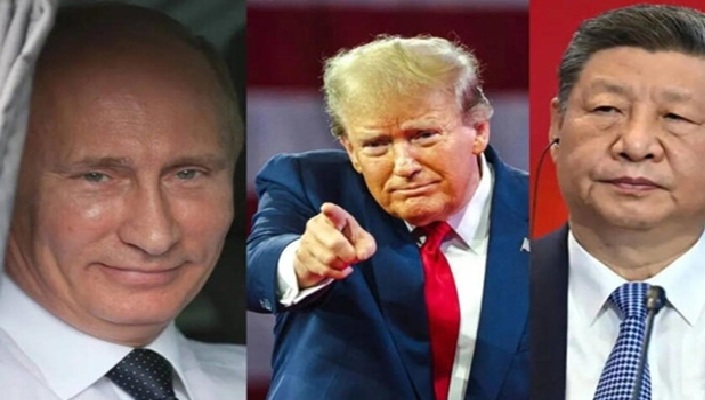
Afrasianet - The head of the Danish parliament's defence committee, Rasmus Jarloff, has denied US President Donald Trump's claims about Russia's and China's ambitions in Greenland.
In a direct response to the allegations, Yarlov told CNN: "Greenland is not threatened by the Chinese or the Russians," stressing that "Russia or China is far from having the capability or the intention to control Greenland."
After the U.S. operation in Venezuela on Jan. 4, Trump asserted that Washington "needs Greenland," claiming that the Danish island is "surrounded by Chinese and Russian ships," and went so far as to suggest that if the U.S. doesn't get this Danish territory, it could "fall into the hands of Russia or China."
The Russian Foreign Minister had previously stated that neither Russia nor China had ever made territorial claims in Greenland, contrary to what the US side is promoting, and Russian Foreign Ministry spokeswoman Maria Zakharova categorically denied the existence of any ambitions on the part of Russia or China in Greenland, refuting Washington's claims about threats to the island from Moscow and Beijing.
Greenland is part of the Danish Kingdom, but it enjoys extensive autonomy.
However, Trump has repeatedly stated that the island "should become part of the United States," while both Danish authorities and the Greenland government have warned Washington against any attempt to seize the island, stressing that they expect their sovereignty and territorial integrity to be respected.
Moscow refutes Washington's allegations about Russia's and China's ambitions in Greenland, asserts accusation baseless
Russian Foreign Ministry spokeswoman Maria Zakharova categorically denied that Russia or China had any ambitions in Greenland, refuting Washington's claims that there were threats to the island by Moscow and Beijing.
"Neither Russia nor China has announced any claims to Greenland or any such plans, and there is no factual information to support this accusation in any way," Zakharova said during a press briefing.
The Russian diplomat explained that Moscow's and more recently Beijing's interest is focused on "developing and developing relations with this region of the world," not controlling it as Washington claims.
"Moscow stands in solidarity with Beijing's positionthat rejects any indications of exploiting Russian or Chinese activity around Greenland as a pretext for the current tensions," Zakharova stressed, noting that any disputes over Greenland "must be resolved through negotiation in accordance with international law, taking into account the interests of the island's inhabitants and their right to self-government ."
"It cannot be ignored that the current tension over these independent Danish northern territories clearly highlights the failure of the so-called rules-based world order built by the West. Western rhetoric that seeks to completely subordinate Copenhagen to its major ally, the United States, has become visible."
Trump recently suggested that the United States should take over the Danish island, justifying it with claims that Greenland is "surrounded by Chinese and Russian ships" and warning that it could fall under the control of one of the two countries if Washington does not act.
Greenland is part of the Kingdom of Denmark, but Trump has repeatedly reiterated that the island should become part of the United States given its strategic importance to national security. The U.S. president has refused to pledge not to use military force to control the island, and he has avoided answering decisively about the trade-off between taking over the island or keeping NATO together.
Authorities in Denmark and Greenland have warned the US side against any attempt to seize the island, stressing the need to respect its territorial integrity. In January, EU countries also discussed possible reactions if U.S. threats to Greenland become a reality on the ground.
Greenland was a Danish colony until 1953 and became an integral part of the Danish kingdom, but in 2009 it was granted broad autonomy to manage its internal affairs independently, with the exception of defence and foreign policy, which remain under the responsibility of Copenhagen.
