
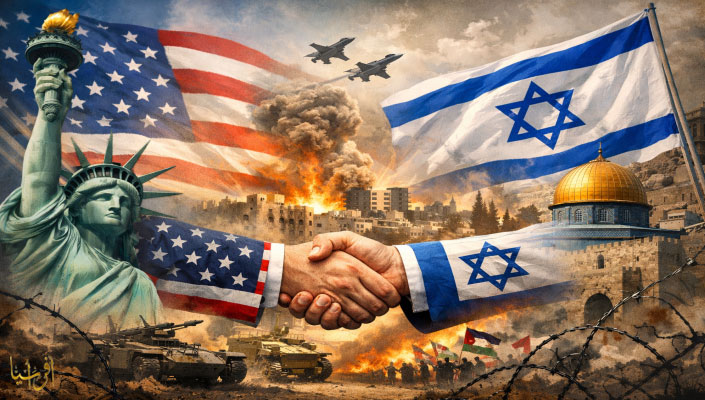
Afrasianet - ahamad Nabawi - "From there (that is, from Palestine) we must form part of the fortifications of Europe in the face of Asia, and be the forward base of civilization in its struggle against barbarism."
by Theodor Herzl - The Book of the Jewish State (1896)
With this rigorous foundational formulation, Theodor Herzl was not merely putting forward a negotiating maneuver to co-opt the European imperial powers into support for his desired state, but he was writing the "genetic code" of the West's relationship with the "idea" of Israel for more than a century.
Today, with every major military confrontation in the Middle East, Western capitals mobilize their entire political and military machine, a call that once again forces us to ask the central question: Why does the West support Israel in such an absolute and unconditional way? But the use of the word "ally" is merely a perverse simplification of the nature of the West's relationship with Israel, and a mistake that prevents us from understanding the true nature of Israel's presence in the region.
Politically, when we use the term "alliance," we imply the existence of two separate entities, each with its own independent historical and geographical context, and whose interests intersect temporarily. Political alliances are contractual and utilitarian in nature, and are always subject to profit and loss calculations; if an ally makes a mistake, or becomes a strategic or moral burden, its ally exerts some pressure on it, reduces its support, or even abandons it, just as modern political history teaches us. But Western behavior toward Israel cannot be explained in terms of the material logic of alliances, and it is not treated Israel in decision-making circles as a partner subject to constant evaluation.
To understand how the West really sees Israel, it is not enough to stand at the boundaries of common interests, but to dismantle its true position in Western consciousness. The West does not see it as an independent national state or a political partner, but rather as a strategic and organic extension of its own system, an extension that is not subject to profit and loss calculations, but to calculations of identity and survival.
The Myth of Taming the East
This view is starkly evident in the language that justifies Israel's very existence. For a long time, and with great applause, Western discourse has embraced the classic Israeli narrative of adventurous "pioneers" who came from abroad to "make the desert bloom." When a citizen in America, Canada, Australia, or New Zealand hears this sentence, he subconsciously invokes the story of the "white man" who carries the burden of enlightenment to "tame the harsh nature and the savage natives."
Israeli historian Ilan Pappe explains this dynamic precisely in his book The Ethnic Cleansing of Palestine, when he asserts that Zionism was never just a nationalist ideology, but has always been "intimately intertwined with European colonialism in the nineteenth century." This entanglement makes the West see Israel as an extension of its expansionist history. They do not support an alien entity, but rather their own version of the "taming of the East," which gives this colonial base an emotional familiarity that makes it part of the Western narrative itself.
Edward Said explains this in his foundational critique of Orientalism, arguing that the West engineered its image as a center of rationality by inventing a chaotic and passive "East." At the heart of this East, Israel was planted to function as the modern "rational center" surrounded by a sea of Arab chaos. It is this identity congruence that moves Israel from the position of an "ally" subject to evaluation and accountability, to a "self" that must be defended at all costs, and is the basis on which the arsenal of cultural and academic arguments to justify Israel's existence and its absolute immunity is built.
Villa in the Forest
This transcendent view is crystallized in one of the most famous political metaphors coined by former Israeli Prime Minister Ehud Barak, and frequently circulated by Western politicians, when he described Israel as an "elephant in the forest." By deconstructing this metaphor, it sums up the entire geopolitics of colonialism: the "villa" represents a closed, modern, rational space, a piece of the West that is cut off and fenced. The "forest" represents the Arab periphery, a chaotic, barbaric space devoid of law and order.
This metaphor goes beyond being mere propaganda to justify Israel's existence; it is in essence an intense expression of the way the West sees itself and its place in the world. The European and American center has always imagined itself as a rational "villa" surrounded by a global jungle teeming with inferior states and peoples that resist its hegemony and refuse to deplete its resources. When this metaphor came out of Tel Aviv, the Western mind immediately picked it up and identified with it because it perfectly matched its historical conviction that it was the only center of modernity.
"Barak described Israel as an elephant in the forest, a metaphor that the Western mind has captured and identified with because it perfectly matched his historical conviction that it is the only center of modernity."
This metaphor for the villa and the forest does not describe an existing geopolitical reality, but rather creates a carefully designed colonial reality. It makes a connection between Israel, which sees itself as a transcendent society with values and morals on its surroundings, and the West, which gives it the legitimacy of existence based on its association with it. In this way, the defense of the villa becomes a defense of civilization in the face of barbarism.
But what makes the "threatened villa" metaphor so dangerous and widespread is that it does not work on its own in the Western consciousness. Behind the "Threatened Villa" stands a funded and organized apparatus that works around the clock to produce and market it.
This is where the "Hisbara" appears, a media façade with huge budgets aimed at cementing the image of Israel as a civilized and besieged base in the minds of Western citizens. Western support for Israel sometimes sounds like voluntary and spontaneous sympathy, but this only happens when we ignore the enormous institutional effort to make an impression and steer the compass of consciousness.
Despite all this, this "villa" cannot continue to rely on cultural ties or media marketing alone, but requires a military structure capable of perpetuating violence to maintain its walls. Here culture intersects with a purely military function. In his book The Invitable Triangle, Noam Chomsky lays his hand on this fundamental idea, when he points out that the Western elite views Israel as "an effective Sparta, living in a state of perpetual war with its enemies, and continuing to exist at the will of the states United Nations".
"The Western elite views Israel as an effective Sparta, living in a state of perpetual war with its enemies, and continuing to exist at the behest of the United States."
Thus, the Western perception imagines Israel as an armed "Sparta" that protects itself in the midst of a hostile forest, but instead markets it as a democratic "Athens" in an atmosphere of backwardness. Thus, the relationship was never built on pure democratic solidarity, as much as it was built on security engineering run by a military few.
Monopoly of the role of the victim
To ensure that this military machine operated without legal or moral accountability, Israel had to monopolize the role of the "lone victim" in the Western consciousness. A monopoly that came about as a result of a concerted institutional effort that invested in the heaviest European guilt complex in history.
The Israeli propaganda machine took the tragedy of the Holocaust as a strategic starting point for a dark, timeless historical engineering, creating an absolute identification between the "Jew" as a historical victim of European oppression and Israel as an armed nation-state.
Through this deliberate assimilation, the tragedy has been stripped of its European context and turned into a political shield that transcends borders and time; any criticism of Israel's violence or expansionist policies today is immediately suppressed by the sword of "anti-Semitism."
Israel has not only won Western sympathy, but has nationalized the concept of "victim" entirely. It has created an exclusive narrative that requires the erasure of any other injustice, foremost of which is the Palestinian one. This systematic erasure is the only guarantee to keep this moral and symbolic capital immune and unaccountable.
"Israeli propaganda exploited the Holocaust to create an absolute identification between the Jew as a victim of European persecution and Israel as an armed nation-state"
To translate this symbolic capital politically, the Western mind relies on a delicate linguistic geometry that redefines the victim and the executioner, clearly manifested in the consecration of the "narrative of perpetual fragility." In the political and media discourse of Western capitals, Israel is always on the brink of disaster.
The Western media and political machine constantly portrays Israel as a weak entity, surrounded by enemies, and one step away from annihilation.
Absent from this narrative is the fact that Israel is the only nuclear power and the most powerful and well-armed military actor in the region, a deliberate and necessary absence that transcends fleeting media bias. Israel is certainly not that fragile, but this narrative of weakness is a formative part of its identity in the West; it is the political tool that gives it a permanent state of exception, and justifies its use of crushing violence as a natural act of "self-defense." As long as you are the weakest and most fragile party, you are justified in saying that Use all your strength to defend yourself.
"The narrative of vulnerability is part of Israel's identity in the West; it is the political tool that gives it a permanent state of exception."
To understand how this historical darkness and the architecture of fragility translate into practice, we invoke the concept of "worthy of grief" coined by the philosopher Judith Butler in her book Frameworks of War, where she explains how power decides which lives are considered valuable and worthy of mourning, and which are considered invisible or unregrettable.
Applying this concept to Western coverage of Israel, we see clearly how rigorously managed the circle of human sympathy is. Israel has been placed exclusively within this circle, inflating its existential fears and even its false claims to become a global concern, prioritizing its security, and listing its losses with great intimacy. The Western citizen knows the details of the Israeli dead simply because the cognitive system presents them as a familiar extension of the self.
In contrast, Arabs and Palestinians are completely pushed outside the framework of human recognition. Entire populations are framed as featureless crowds, as abstract numbers falling into cold news reports, or worse: as "demographic threats." The Western editor reduces the extermination of entire neighborhoods to cold military terms such as "collateral damage," or refers to victims as "human shields" to justify crushing them with a clear conscience. In this discourse, the political hopes of these peoples, their demands for liberation, and their very lives become invisible and unweighty.
Israel in the mind of the press editor
The language of numbers and the quantitative analysis of Western journalistic discourse clearly demonstrate this bias. In a survey published by The Intercept in early 2024, which included major American newspapers such as the New York Times, Washington Post, and Los Angeles Times, the numbers showed that the term "massacre" was used to describe the killing of Israelis versus Palestinians by a ratio of 60 to 1. The word "massacre/slaughter" was used 22 times more than it used for Palestinians, despite the huge difference in the actual death toll.
This structural bias extends to Europe as well. In a massive report released by Britain's Media Watch Center after analyzing more than 176,000 news clips, it was found that the media uses "emotional language" to describe Israelis as victims 11 times more often than Palestinians. When an Israeli falls, the act is based on the known fact that the perpetrator is "killed by the hand," while the blood of thousands of Palestinians is passed through acts built on the passive or vague formulations that empty the event of the perpetrator and make it look like a natural disaster such as "they lost their lives," "died," or "were killed."
"After analyzing more than 176,000 European news clips, it was found that the media uses emotional language to describe Israelis as victims 11 times more than Palestinians."
We do not invoke these figures here just to prove bias, but to reveal its nature. It is not just a matter of "editorial policies" or directives dictated from above in newsrooms, but it goes beyond that, as the issue is an integrated cognitive structure internalized by the Western mind. The newspaper editor probably does not need direct guidance to make this linguistic distinction; the education, knowledge, and culture he has received pre-emptively ensured the consolidation of this colonial and orientalist view of the Palestinian, in contrast to his spontaneous identification with the Israeli as a familiar extension of him.
This systematic erasure of Arab injustice is an indispensable foundation in the colonial mind. For the West to continue to see Israel as an oasis of modernity and a mirror of its moral progress, it must strip those who stand outside the walls of the villa of both their political competence and their humanity, so that their death becomes a routine, silent event that does not call for grief and does not require accountability.
Western Academia at the service of "The Villa"
This stereotype of Israel, as an oasis of modernity amid an ocean of barbarism, would not have survived for so long if it had relied solely on media promotion or cultural connections. For this bias to become a stable reality, it needed a cover that would give it "scientific legitimacy."
This is where the role of the Western academic establishment comes into play, a space that is supposed to be a bulwark of objectivity and rationality. In fact, academia has never been a neutral observer of the conflict, but rather the factory that has shaped the image of Israel, and played the role of "The Guardian of the Narrative" that transforms colonial bias into authoritative and acceptable knowledge.
This image is formed within the peer-reviewed papers before they reach newsrooms. In a survey published in the journal Arab Society and Media, researchers surveyed dozens of academic papers in major scientific databases such as Sage and JSTOR. The result was decisive: academia is practicing a blatant structural bias in favor of Israel.
"For the bias towards Israel to become a stable reality, it needed a cover that would give it scientific legitimacy."
In these studies, Israeli violence is presented as "justified self-defense" and behavior stemming from the "rationality of the state." In contrast, the Palestinian narrative is marginalized and completely excluded, or studied as "radical phenomena" without political legitimacy. This means that the Western researcher, when he writes, proceeds from a preconviction that is firmly entrenched in his subconscious that Israel is an extension of his modernity, while the Arabs are merely a subject of study and taming.
This cognitive role goes beyond the boundaries of research papers, to be manifested in the language of "official statements" issued by university administrations. In a recent study by researcher Ibrahim al-Samiri and others, data from leading universities such as Columbia and Oxford analyzed the escalation of student protests in the wake of Israel's war of extermination against Gaza, revealing clearly how the academic institution has volunteered its bureaucratic language to protect the Israeli "villa."
These dark Palestinian statements emptied their political and moral content, condemning the October 7 losses in sharp and clear language, but softening the systematic genocide in Gaza using neutral terms such as the "humanitarian crisis," as if what was happening was just a natural disaster or an earthquake with no known military actor.
More importantly, these universities have engineered their data to strip anti-war protests of their nature as a moral movement, and to reframe them as a "threat to the academic system" and a source of "creating a hostile environment." This wording takes us directly back to the myth of the "forest and the villa."
As the representative of the Western rational center, the university sees advocacy for the Palestinian right as a barbaric mess that threatens its internal stability. It therefore volunteers administratively and "linguistically" to protect Israel, not as a foreign state, but as a solid part of its value system and identity that cannot be questioned.
Israel in the language of Western politicians
As we move from academia and newsrooms to Western decision-making centers, the Western political dictionary emerges as home to the most crude expressions of this colonial structure. Western politicians make no secret of their vision; on the contrary, they openly enshin a rigid dualism: Israel embodies civilization, reason, and enlightenment, and its Arab surroundings represent chaos, barbarism, and darkness.
Rather than relying on the language of "political realism" and balance of power, Western decision-makers invoke the language of identity Shared values" and "cultural ties". It is a discourse that goes beyond the logic of bilateral relations between two parties, to clearly express a "self" that speaks of its extension.
In the Western mind, the defense of Israel goes beyond being a mere foreign policy file, to an explicit defense of the Western self itself and its place in the world. When Western policymakers turn their gaze toward Israel, they are effectively staring into a mirror that reflects their own history, completely dropping any foreign entity from it.
The phrase "the only democracy in the Middle East" loses its purported neutrality as a political description, becoming a pure tool for reproducing an entrenched orientalist discourse.
"Western discourse elevates Israel above political and legal accountability, by funding and arming it as an uncompromising national security doctrine"
This is evident in former US President Joe Biden's quote of Tom Lantos, who is known as the only Holocaust survivor of the Congress, who says: "The shell of civilization is as thin as paper. We are its guardians and we can never rest," as well as in his frank admission: "If Israel did not exist, we would have had to invent it."
This "strategic invention" has always been marketed as part of the intimate identity of the West. As in 2013, when Barack Obama linked Israel's survival to the fate of the entire Western project, citing Harry S. Truman's 1948 quote: "I believe that Israel has a glorious future, not just as a sovereign state, but as the embodiment of the ideals of our civilization."
In parallel, Israel's discourse to the West links the defense of Israel to religious and civilizational dimensions that the West welcomes. This was exemplified, for example, in Benjamin Netanyahu's speech to the United Nations (2017), when he used the biblical text to declare Israel "a light to the nations, and a bearer of salvation to the ends of the earth."
This discourse matches the narrative of the "civilizational message" of ancient empires. Israel goes beyond the box of defending narrow interests, to assume the role of the carrier of the universal message tasked with dispelling the "darkness" surrounding it.
This colonial trajectory necessarily ends up with an "iron commitment" to Israeli interests. In practice, this description elevates Israel above political and legal accountability, by funding and arming it as an uncompromising national security doctrine. Regardless of the temporal contexts and officials, the primary driver remains the same and has been inherited since the time of Herzl: Israel is order and reason, and the periphery is chaos and barbarism.
This situation is a daily and meticulous reproduction of the mechanisms of cultural domination that the West colonially established, bypassing any simplistic explanation that reduces them to mere political bias or Emotional casual.
Because the West will not judge itself
If we get to this point, our perception of Israel as an "organic extension" of the West drops another mystery that has long overwhelmed political analysis: Why is international law so paralyzed by its crimes?
Typically, Arab discourse interprets absolute Western support for Israel in institutions such as the Security Council as Western "hypocrisy" or "double standards." But the use of such descriptions is "misleading," because double standards assume that there is one law that works for all, but the West surpasses it as an exception for the sake of its ally Israel. In reality, what is happening is quite different: the West is not breaking international law for Israel's sake, but rather considers it primarily above it.
" The West does not break international law for Israel's sake, but considers it above it in the first place."
With a little abstraction, we can read the "rules-based" international system engineered by the West, as a tool for controlling the parties and managing the "jungle." This system was put in place from the outset to hold accountable rebel states against Western interests, such as Venezuela to Cuba and Iran, and the list goes on, not to hold the owners and inhabitants of the villa accountable. Since Israel is a piece of this West, it automatically enjoys the immunity granted to it.
Since 1970, the United States alone has used its veto power in the Security Council more than 50 times to block resolutions critical of Israel or calling for a ceasefire. This is not a normal use of a diplomatic tool to help a troubled ally. It is a sovereign practice that the West clearly declares: We protect our extension, and the "laws of restraint" do not apply to us.
It goes deeper than diplomatic protection. When Israel is taken to the International Court of Justice or the Criminal Court, Western capitals do not view it as a trial of a country that has committed war crimes, but rather see its entire colonial history in the dock. To condemn Israel's replacement, settlement, and crushing of indigenous populations today is simply to criminalize the foundational instruments with which the West built its empires and its domination of the world.
"Condemning Israel simply means criminalizing the foundational instruments with which the West built its empires and domination of the world."
Therefore, the failure of international law at Israel's borders is not a flaw in the world order, nor is it a betrayal of Western values as some might imagine, it is the same system and it operates with complete efficiency and consistency with itself.
The West here does not have two standards, but one law that was designed from the first moment to protect its colonial bases, especially Israel, from any accountability.
Trying this rule will necessarily mean prosecuting the center that created it, which the West will never allow.
It has a dual history, holding up banners of modernity and the Enlightenment on the one hand, and hiding a long history of genocide and organized violence on the other. In fact, Israel has reproduced the worst of this legacy.
Israel has not inherited the values of liberalism as much as it has inherited the colonial genocidal machine. The systematic erasure it practices today is not structurally different from what European settlers did to the indigenous population.
When Tel Aviv uses internationally banned weapons to crush entire cities, it invokes the same "imperialist mind" that dropped the nuclear bomb on Japan, a mind that sees horrific genocide as a legitimate and even rational tool for domination and discipline rogues.
Not just an ally
Thus, the relationship between Israel and the West is based on a complex matrix in which pure material interests overlap with a shared sense of identity.
The West employs Israel as an advanced base to control the region and secure its hegemony, and Israel in turn exploits the discourses of identity and European colonial legacy to blackmail Western capitals and, most importantly, to consolidate its image as an organic extension and an integral part of the Western center.
Therefore, we do not aim to dismantle Israel's image in the Western consciousness to beg for sympathy from Western capitals to correct its political and moral course. The real goal is to stop portraying Israel as a mere "strategic ally" of America and Europe, because this reproduces the illusion and separates this colonial entity from its roots and its main engine.
"If we realize that Israel is just an elephant built by the West to discipline the forest, we will automatically fall off the illusion of seeking justice through tools designed by the villa owners themselves."
This liberation from the illusion of "alliance" brings us face to face with an even more pressing question: not how to persuade the West to change its position, but how to deal with an entity originally designed to be an extension of the colonial center? Israel is not a classic occupying state that can be negotiated over a demarcation, but rather the "final check of replacement colonialism" in its most lethal version.
If we realize that Israel is just a "villa" built by the West to discipline the "forest," we will automatically fall into the illusion of seeking justice through tools designed by the villa owners themselves. The settlement tracks and international appeals have never existed to do us justice, but are designed exclusively to manage the conflict and guard the walls of the villa."
