
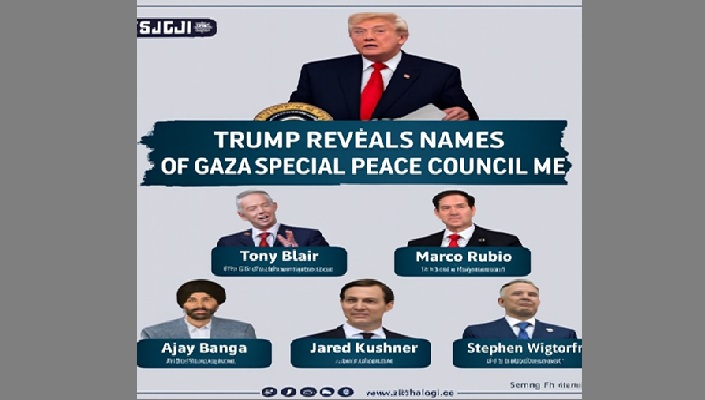
A farce. The Peace Council ignores the reality in Gaza
Afrasianet - How can the U.S. president call for peace when he says he's no longer committed to peace because he didn't get the Nobel Prize?
This is how the president simply formulates his words to reveal trends that were already present in his actions, but without announcing it!!
- No ceasefire, no aid, no disarming of Hamas, no withdrawal of the Israeli army, no stabilization force. Just a lot of talk about committees run by Trump without any real commitment.
The American magazine "Responsible Statecraft" publishes an article on the failure to implement the peace plan proposed by former US President Donald Trump for the Gaza Strip, focusing on the contradiction between what the Trump administration announced about the success of the first phase and the reality on the ground.
The following is the text of the article:
The Trump administration's remarks on the Gaza Strip may suggest that the implementation of President Trump's 20-point peace plan, which was later included in a UN Security Council resolution, is going smoothly.
Accordingly, Trump's special envoy, Steve Witkoff, announced this month via social media the "launch of the second phase" of the plan, which "moves from a ceasefire to disarmament, technocratic governance, and reconstruction." But a closer look at some of Witkoff's statements in his announcement shows that calling it "smooth" or even "executed" is greatly exaggerated.
Witkov said that the first phase "maintained the ceasefire." No, it didn't. Israel has continued its daily attacks on the Gaza Strip since the ceasefire was supposed to go into effect last October. As is usual in cases of non-compliance with the ceasefire, the two sides accuse each other of violating it. But the number of casualties reveals which side the deadly violations come from. According to the Palestinian Health Ministry, Israeli attacks have resulted since the ceasefire began The alleged fire killed at least 451 Palestinians and injured 1,251 others. As in Israeli attacks over the past three years, many of the victims were civilians. In contrast, the Israeli army announced that three of its soldiers were killed in battles during the first days of the ceasefire in October 2025.
Witkov also said that "the first phase provided historic humanitarian aid" to Gaza. However, he did not mention that Israel's continued refusal to deliver aid to the Gaza Strip has significantly reduced the flow of aid from what was agreed upon, which is far below the actual needs. As of mid-January, 24,611 aid trucks had entered Gaza since the ceasefire, less than half the total number of 57,000 trucks Israel was supposed to allow under the agreed quota.
Thus, the second phase is announced without any significant progress in the implementation of the first phase.
The US administration has announced some members of the Peace Council, headed by Trump, which is supposed to serve as an international governing body overseeing the implementation of the rest of the plan, though not all of them. Clearly, it has been difficult to attract a full list of members. The reluctance of many governments to participate is understandable, given the ambiguity surrounding the implementation so far, and the nature of the project as a whole, as it is a project directed by Trump in coordination with Israel.
The administration's requirement for a $1 billion cash contribution from any government that wants to extend its membership on the council will not facilitate the process of recruitment.
The declarations made so far are enough to anger all sides in this conflict. The Peace Council includes, among others, Whitkoff, Trump's son-in-law Jared Kushner, and former British Prime Minister Tony Blair. Arab governments and many other countries in the Muslim world do not trust Blair because of his role in the Iraq war and his siding with Israel when he was an international envoy on the Israeli-Palestinian conflict.
Israel was quick to object to membership in a "Gaza Executive Council," which was also announced by the White House, and which would have an ambiguous relationship with other bodies concerned with Gaza. This council would include the Turkish foreign minister and a high-level Qatari official. Israeli Prime Minister Benjamin Netanyahu's office has stated that the Gaza Executive Council in its current composition "runs counter to Israeli policy." This statement clearly reflects Israel's strained relations with Turkey and Qatar, mostly due to These two governments have relations with Hamas.
Israeli objections will give the Netanyahu government an additional excuse to overturn the entire diplomatic process whenever it wishes. The objections are not limited to the government, but also include the Israeli opposition raising the issue of membership of the Executive Council. Opposition leader Yair Lapid called Turkey's involvement a "catastrophic diplomatic failure." Itamar Ben-Gvir, a far-right nationalist who serves as national security minister, called on the Israeli "army" to "return to war with enormous force in the Gaza Strip."
Meanwhile, Cairo has seen some notable organizational progress, with the first meeting of the National Committee for the Administration of the Gaza Strip, a group of 15 Palestinian experts that is supposed to serve as an interim administration under the supervision of the Peace Council. The committee met with Bulgarian diplomat Nikolai Mladenov, who was appointed "director-general" of the Peace Council.
In announcing the second phase, Wittkoff did not mention the planned International Stabilization Force (ISF), which is supposed to play a key security role during the interim administration and the reconstruction of the Gaza Strip. Recruiting participants in the ISAF has been more difficult than recruiting members of the Peace Council, as governments are unwilling to engage their forces in any combat confrontation, as Israeli attacks continue. They are particularly reluctant to engage in the task of disarming Hamas, a goal Israel has not been able to achieve it during three years of unfettered war.
In light of the repeated emphasis by Witkoff and others on the need for Hamas to abide by its commitments, it is important to remember that Hamas never signed Trump's 20-point plan. What Hamas agreed, based on the 2024 framework agreement, was a comprehensive ceasefire, the release of all hostages in exchange for the release of an agreed number of Palestinian prisoners, and the return of the remains of the martyrs, as part of ending the blockade imposed on the Gaza Strip and beginning the reconstruction of the Gaza Strip under international supervision.
Hamas has also made clear its readiness to hand over the administration of the Gaza Strip to independent Palestinian cadres. In this regard, Hamas has publicly welcomed the establishment of the National Council for the Administration of Gaza and the holding of its first meeting, as an "important positive development." Hamas also accepts in principle the presence of a neutral international peacekeeping force in Gaza.
With regard to disarmament, conditions are important. Hamas has offered to bury its weapons as part of the long-term truce it has long offered Israel. But it will only hand over its weapons in full to a legitimate Palestinian government.
Hamas will not unilaterally disarm as Israel continues to occupy Palestinian territories and kill Palestinian civilians. It is unrealistic and unreasonable to expect this, especially in light of the massacres in Gaza over the past three years.
Technicians at the National Counterterrorism Advisory Committee face a daunting task, and they face significant obstacles. Perhaps the most prominent of these obstacles is that Shaath, who lives in the West Bank, had to pass through Jordan to reach the Cairo meeting, where Israeli authorities detained him for six hours at the Allenby crossing. A Palestinian official commented that this incident shows Israel's intention to sabotage the committee's work.
An Arab diplomat pointed out that a 15-member committee cannot run the Gaza Strip without a large number of civil servants. But Israel prohibits the participation of not only those who are paid by Hamas, but also by those who are paid by the Palestinian Authority.
In his first public remarks after being appointed head of the National Crisis Management Committee, Shaath spoke of the daunting task of removing rubble, which could take three years, while comprehensive reconstruction would take about seven years. The situation could worsen further, as Israel continues to create more rubble through the systematic demolition of buildings in the half it still occupies from the Gaza Strip.
The Trump plan, nor any other peace plan, will be able to achieve anything close to peace, security, and prosperity in Gaza as long as Israel remains the dominant power on the ground, and is determined to oppose anything resembling Palestinian autonomy.Gaza Strip.
Charter of the Peace Council!!
Media outlets have published a copy of the charter of the Peace Council, which defines itself as an international body chaired by US President Donald Trump that is concerned with the reconstruction of the Gaza Strip and the promotion of lasting peace in the conflict zones.
Vision & Principles
The Charter affirms that sustainable peace is not built by permanent dependence or failed institutions, but by empowering peoples to determine their own future, and by building just international partnerships based on burden-sharing and responsibility. The Council aims to replace traditional models of peacebuilding with a more flexible and effective one.
Objectives
The Peace Council is concerned with stabilization, the rebuilding of good governance and the rule of law, and the dissemination of international best practices in post-conflict management, in accordance with international law and its Constitutive Charter.
Membership
Membership is an invitation only from President Trump, and begins as soon as the country agrees to abide by the Charter. Like each country's president or head of government, the council does not oblige any member to participate in specific tasks without his consent.
Membership is three years (renewable), except for countries that contribute more than $1 billion in cash in the first year, for which this period does not apply. Any State has the right to withdraw at any time, and the President has the right to terminate its membership (with the possibility of opposition by a two-thirds majority of the members).
Governance
The Council is composed of Member States, each with one vote.
Decisions shall be taken by a majority of those present, with the approval of the President, who has the right to vote in the event of a tie.
At least an annual voting meeting and quarterly non-voting meetings are held to follow up on activities.
Trump has exclusive authority to form subsidiary bodies, appoint the Executive Board, and modify or dissolve the structure of the Board.
Executive Board
The President appoints him from international figures and works under his direct supervision.
It meets weekly for the first three months, then monthly.
His decisions are implemented immediately, but the president has the right to veto them.
Submit quarterly reports to the General Council.
Funding and Legal Status
The Council is funded voluntarily by States and organizations.
He has an international legal personality and has the right to own assets, open accounts, hire employees, and enter into contracts.
It grants its members and employees the necessary privileges and immunities through agreements with host countries.
Amendment of the Charter and dissolution of the Council
The charter can be amended with the approval of two-thirds of the members and the ratification of the president, while some articles (such as those related to structure or membership) require full unanimity.
The President may dissolve the Council at the end of each individual year, unless renewed before November 21 of that year.
Start-up, language and headquarters
The Charter enters into force once three countries have acceded.
The official language is English.
The original text shall be deposited with the United States as depositary.
No reservations to the Charter are allowed.
Political background
The White House announced the formation of the "Executive Founding Council," which includes U.S. Secretary of State Marco Rubio, envoy Steve Witkoff, Trump's son-in-law Jared Kushner, and former British Prime Minister Tony Blair.
This comes within the framework of a peace agreement brokered by the United States, which stipulates that Gaza will be administered temporarily through a committee of Palestinian technocrats, in preparation for the transition of the PA to a unified Palestinian body, as part of a "credible path towards a Palestinian state."
Personalities Trump invited to join the special peace council in Gaza
U.S. President Donald Trump has begun forming a special "peace council" in the Gaza Strip, and a number of heads of state announced on Saturday that they have received formal invitations to join it.
The White House has made it clear that according to the US plan to end the war in Gaza, a peace council will be formed headed by Trump.
In addition to this council, two other bodies have been established associated with it: a Palestinian technocratic committee to administer the Gaza Strip on an interim basis, and an "executive council" that appears to have an advisory role.
The US presidency has revealed the names of politicians and diplomats who will participate in the Peace Council or the Executive Council, and other officials have announced that they have received invitations. The latest available data are presented below:
Confirmation from the White House
The White House confirmed that the peace council chaired by Donald Trump will address issues such as "strengthening administrative capacities, regional relations, reconstruction, attracting investments, large-scale financing and capital mobility" to rebuild the Gaza Strip, which has been devastated by a two-year war.
These are the names of personalities known to be participating in the Peace Council.
– US President Donald Trump
– US Secretary of State Marco Rubio
- Donald Trump's Special Envoy Steve Whitkoff
- Donald Trump's son-in-law and mediator Jared Kushner
– Former British Prime Minister Tony Blair
– American billionaire Mark Rowan
– World Bank President Ajay Banga
– Donald Trump's adviser, Robert Gabriel
The Peace Council will oversee the work of the Palestinian Technocratic Committee tasked with administering the Gaza Strip temporarily, which aims to "oversee the restoration of basic public services, the reconstruction of civilian institutions, and the stabilization of daily life in Gaza."
The committee is made up of 15 Palestinian figures, and is headed by Ali Shaath, a former Palestinian deputy minister.
The third body is the Executive Council, which is expected to "contribute to supporting effective governance and providing advanced services that promote peace, stability and prosperity for the people of Gaza," according to Washington.
The first names known to be participating are:
- Donald Trump's Special Envoy Steve Whitkoff
- Donald Trump's son-in-law and mediator Jared Kushner
– Former British Prime Minister Tony Blair
– American billionaire Mark Rowan
– Bulgarian diplomat Nikolai Mladenov, former UN envoy for the Middle East peace process
– UN Middle East envoy Sigrid Kaag
– Turkish Foreign Minister Hakan Fidan
– Qatari diplomat Ali al-Thawadi
– Director of Egyptian Intelligence Hassan Rashad
– Israeli billionaire Yakir Gabbay
– UAE Minister of State for International Cooperation Reem Al Hashemi
Foreign Leaders
A number of foreign leaders or their advisers confirmed on Saturday that they had received an invitation from the Trump administration, without specifying whether they planned to accept it.
The following is a list of those who have received this invitation:
– Albanian Prime Minister Edi Rama
– Argentine President Javier Mili
– Brazilian President Luiz Inácio Lula da Silva
– Canadian Prime Minister Mark Carney
– Cypriot President Nikos Christodoulides
– Egyptian President Abdel Fattah El-Sisi
– Turkish President Recep Tayyip Erdogan
– King Abdullah II of Jordan
– Pakistani Prime Minister Shehbaz Sharif
The Guardian newspaper publishes an article by commentator Owen Jones, in which he says that the names of those invited to serve on the Peace Council, from Blair to Erdogan to Orban, are enough to make it clear that the matter goes far beyond Gaza.
The fate of the Palestinian people offered a warning about the future of humanity. When he visited the West Bank recently, the Palestinians kept assuring him on the same point: Israel had turned their land into a laboratory.
The repressive technology Israel has used, including in its genocide in Gaza, ranges from high-tech surveillance to military drones and artificial intelligence on the battlefield. These technologies have been exported to repressive countries around the world. And it doesn't stop there.
This brings us to the "Peace Council" formed by Donald Trump, which is now set up to govern Gaza.
In the quiet village of Sutton Courtney in Oxfordshire, where the writer George Orwell lays, the earth itself was supposed to shake – this is not peace, it is blatant neocolonialism.
Jones noted that not a single seat has been allocated to any Palestinian, let alone one survivor from Gaza.
Trump will chair the committee in his personal capacity and not as president of the United States, in other words, as the governor of Gaza. Among the invited members is Tony Blair, hated throughout the Middle East as the architect of the illegal invasion of Iraq.
If the reader is wondering about his experience in rebuilding devastated Arab lands, he should recall the Chilcot inquiry's conclusion on that disaster: "The UK failed to plan or prepare for the massive reconstruction programme required in Iraq."
Jones added that the board will include at least two real estate developers, one of whom is Trump's son-in-law, Jared Kushner, who once boasted of the "extremely valuable" potential of Gaza's waterfront properties. Viktor Orbán, Hungary's far-right leader, was also in attendance. Israeli billionaire Yakir Gabbay and American private equity tycoon Mark Rowan.
The evidence for this is clear, with Trump demanding $1 billion from each country to become a permanent member, and the draft charter seems to suggest, according to Bloomberg, that he will control the funds.
A year ago, Trump proposed the permanent resettlement of Gazans, i.e., ethnic cleansing, and then posted an AI-generated video depicting Gaza as a luxury resort, featuring a huge golden statue of it.
Jones said it was naïve to assume that he had abandoned those plans, even if Arab pressure appeared to have paid off somewhat last year, when he said, "No Palestinian will be expelled." This was evident in low-key remarks he made at a recent press conference with Benjamin Netanyahu, who is wanted by the International Criminal Court on charges of war crimes and crimes against humanity, in which Trump noted that if the people of Gaza were given the opportunity to "live in a better climate, they would move, they are there because they have to."
Trump has based polls that suggest nearly half of Gaza's population will leave. This is not surprising, as the region has turned into catastrophic devastation, with survivors living in tents and deprived of the most basic necessities of life.
Jones explained that when Netanyahu says he will "let the Palestinians out" as he did last year, he clearly expects them not to return.
At the beginning of the genocide, he secretly supported "voluntary migration" in principle, perhaps knowing that his army would make Gaza uninhabitable, telling his allies two years ago: "Our problem is to find countries that are willing to receive Gaza's people, and we are working on that."
He also mentioned Israel's recent recognition of the Republic of Somaliland, where the Somali president hinted that he had intelligence that the separatist republic had agreed to receive refugees from Gaza in return.
Somaliland denies this, but its foreign minister did not rule it out in March. Gaza is now a devastated wasteland, destined to be a lucrative venture for real estate developers and Trump's entourage.
Jones stressed that it is not just about the Palestinian people. The Peace Council charter makes no mention of Gaza at all. It appears to be an attempt to build an alternative to the United Nations: a crude tool for Trump to exert American influence. In other words, this is just a model, and Gaza is a preliminary experiment.
If Trump believes that this will serve the interests of American hegemony, he will face a bitter clash with reality. Western hegemony was based on three pillars: military superiority, economic dominance, and moral superiority. The first was destroyed on the battlefields of Iraq and Afghanistan. The latter lost credibility with the 2008 financial crisis. As for moral superiority? It has always been a hoax, as evidenced by the torture chambers of U.S.-backed dictatorships in Latin America, or the flogging of Vietnamese children struck by U.S. napalm bombs.
But, unlike the old great power rivalries, the Cold War was promoted as a clash between universal philosophies: democracy and freedom versus socialism and equality. The collapse of the Soviet Union was portrayed as a triumph of Western doctrine.
He noted that while the U.S. military was burning Afghan weddings, and images of U.S. soldiers with sarcastic smiles were shown as Iraqis piled naked into a human pyramid in Abu Ghraib prison, those moral claims collapsed. When American Democrats armed and facilitated the liquidation of Gaza, American moral bankruptcy was exposed as a bipartisan issue.
What is striking about Trump, he said, is that he has even given up on pretending to be morally superior. In Venezuela, he openly boasts that U.S. companies will recover the country's oil. Gone are the claims that American hegemony is motivated by a desire to protect the freedom of all mankind, "a state that is a light of nations, a beacon on a hill," as Ronald Reagan put it.
Trump's blunt candor only accelerates the fall of U.S. power. Moral superiority has always been a deception, but it has been a useful lie. It has brought at least some support and acceptance, and now that it is dead, the world will be more anxious to turn the page on its failed masters.
