
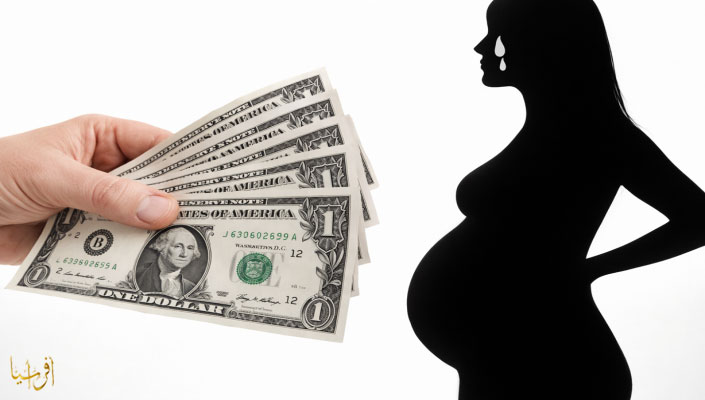
Afrasianet - Carina is six months pregnant, but the baby she is carrying in her womb is not her own.
The 22-year-old girl, who hails from eastern Ukraine, is a surrogate mother who is carrying an embryo consisting of an egg and sperm of a Chinese couple.
Karina was 17 years old when her home was destroyed, after her city of Bakhmut was turned into one of the most fierce battlegrounds in the first phase of the war in Ukraine.
Karina and her partner moved to Kyiv, but had difficulty finding stable work.
Karina says her decision to resort to surrogacy for money came on a day when she was inside a shop and had almost no money to pay for bread and diapers for her one-and-a-half-year-old daughter.
Karina Tarasenko, who now lives on the outskirts of Kyiv in an apartment provided to her by her surrogacy clinic, said: "At first, my decision to become a surrogate mother angered and disappointed me, but now I have accepted it." She is pregnant with a baby girl.
Karina is set to earn about $17,000, nearly double the average salary in Ukraine, but she will not receive most of it until after giving birth.
She was supposed to be paid about $21,000, but her pay was reduced after the death of one of the twins she was pregnant with, according to her contract.
Despite her initial hesitation, Karina now plans to have as many children as possible as a surrogate mother, as far as her body allows, so she can save money and buy a house.
But that decision may not stay in her hands for long.
Before the war, Ukraine was widely described as the world's second-largest commercial surrogacy center after the United States.
Although the war has significantly affected surrogacy operations, it has almost returned to pre-war levels, according to experts who spoke to BBC World Service.
But Ukraine's parliament is currently considering a bill that would impose stricter controls on the surrogacy sector and effectively ban access to foreigners, which make up 95 percent of parents who want to have children in this way. These proposals do not have broad support within Ukraine's parliament, where some parliamentarians working in the field benefit.
Supporters of the bill say Ukrainian women should not have surrogate children for foreigners at a time when birth rates have fallen sharply due to the war, even though the number of children born through surrogacy accounts for only a small percentage of all births.
Maria Dmitrieva, a women's rights activist who opposes surrogacy on ethical grounds, says the proposed bill doesn't go far enough: "Because of the war, the number of desperate women is increasing, and clinics are offering them this opportunity because Western husbands want to buy babies cheaply."
Dmitrieva believes that the practice should be completely banned in Ukraine.
Surrogacy clinics are accused of publicly targeting poor women, citing social media ads.
In January this year, one clinic published an AI-generated ad for new surrogate mothers, showing a woman forced to choose between buying firewood to heat her stove or buying clothes for her children, in an investment of the hardships that many Ukrainians endured during the war.
In another advertising campaign in 2021, Ukraine's largest surrogacy clinic, the BioTexCom Center for Human Reproduction, promoted "Black Friday Sale" on babies born through surrogate mothers.
When confronted by the BBC with the question of whether the ads could be seen as offensive, BioTexCom defended them, saying they were effective in drawing attention to surrogacy.
The clinic has also been criticized for the way it operates. In 2018, the prosecutor's office opened an investigation into the clinic's executive director, Albert Tuccilowski, and two former employees, on suspicion of offenses, including human trafficking.
The office said the pre-trial investigation had since been suspended to allow for "international cooperation" and the gathering of information from abroad.
BioTexCom and Tuccilovsky say they always operate within the framework of the law, and "categorically deny these accusations."
The prosecutor did not provide details on the human trafficking allegations, but BioTexCom told the BBC it was a DNA mismatch between a parent and a child. The clinic says its staff were not responsible for this and that it "believes the problem occurred during the collection of a sperm sample", an operation that took place in another country.
The company says it helps people achieve their dream of becoming parents, gives women a chance to earn money legally, and provides them with medical care, housing and food.
Karina had initially turned to BioTexCom to become a surrogate mother, but decided not to go ahead with the clinic, after she felt they treated her coldly during her first appointments with them.
Abandoned children
There are also cases where children are abandoned after they are born, when biological parents change their minds.
In Ukraine, parents wishing to have children through surrogacy are legally responsible for the child after birth, and the law prohibits them from abandoning them for any reason.
But enforcing this in practice across borders can be difficult.
Wee, now five years old, suffered severe brain damage after being born prematurely in 2021. The surrogacy through which he was born was organized via BioTexCom.
He now lives in a government home for children with disabilities in Kiev.
When the BBC visited the house, Wei was eating mashed bananas with his friends there. They sat together at every meal.
Wei cannot sit unassisted, hold his head, or see well, and will need round-the-clock care for the rest of his life.
After his intended parents, from a Southeast Asian country, learned of his health condition, they decided not to receive him. They effectively disappeared, and repeated attempts by the authorities and BioTexCom to reach them failed.
The surrogate mother who conceived him did not want him either, and under Ukrainian law had no legal obligations to him.
Valeria Sorochan of Ukraine's Health Ministry, who is among those calling for the law to be amended, says "many" surrogacy children are left behind, although the government does not keep exact figures.
Sorochan is not opposed to surrogacy in principle, but she criticizes the lack of adequate regulation of the sector in Ukraine and supports banning foreigners' access.
Tuccilowski, executive director of BioTexCom, called what happened a "tragedy," saying that when parents abandon a child, "we consider it part of our responsibility."
When children are abandoned, there is no legal obligation on clinics to contribute to the costs of their care within government homes, which receive a mix of public and private funding. BioTexCom has not made a financial contribution to Wee's care.
Children with severe disabilities such as those with disabilities rarely find a family to adopt them. Fifteen families have looked at his file, but none have shown interest in adopting him.
For five years, Himataraj and Rajveer Bajwa, a couple from London, tried unsuccessfully to start a family, including through two rounds of IVF, before deciding to resort to surrogacy.
Under British law, the surrogate mother is legally responsible for the child until a paternity order is issued transferring legal responsibility from her to the intended parents.
Himatraj and Rajveer were concerned that they might not have immediate legal rights over the child. Cases in non-commercial arrangements in surrogate mothers have changed their mind about abandoning the children, although such cases are extremely rare.
The couple was impressed with the way surrogacy was regulated in Ukraine, and the low cost of the procedure in the country was another factor in their decision.
They used BioTexCom's services last year and paid around £65,000, or $87,770, far less than what would be paid in the US, where surrogacy can cost more than £110,000, or $150,000. The couple say their experience with BioTexCom has been good.
Using IVF, the couple created an embryo in London and then sent it to Kyiv, where it was stored in the clinic's deep cooling tanks.
In June last year, they arrived in Kyiv to attend the birth of their child.
But because of the time it took for British authorities to process the necessary paperwork and issue a passport for their son, the couple spent the first three months of the child's life in Kiev, and the couple returned to England with their son in late August.
