
Afrasianet - U.S. President Donald Trump has launched a scathing attack on U.S. media outlets he said spread "fake news," accusing them of presenting a misleading picture of Iran's military capabilities during the recent tensions between Washington and Tehran.
In a post on Truth Social, Trump said reports that "the Iranian enemy is performing well militarily against the United States" constitute "hypothetical betrayal," arguing that such narratives "give Iran false hope." He added that those who promote these reports are "cowardly Americans who stand against their country."
The US president noted that Iran's navy was "completely destroyed", saying that all 159 of its ships were "now at the bottom of the sea", adding that Iran's air force was "finished", and that Iranian technology and its leaders "no longer exist", describing Iran as an "economic disaster".
Trump has not provided evidence to support these claims, and there were no immediate comments from Iranian authorities or the U.S. Department of Defense on his remarks.
On Tuesday, Trump said that the financial difficulties faced by Americans are not an influential factor in the decision-making process as he seeks to negotiate an end to the conflict with Iran, noting that preventing Tehran from acquiring a nuclear weapon is his top priority.
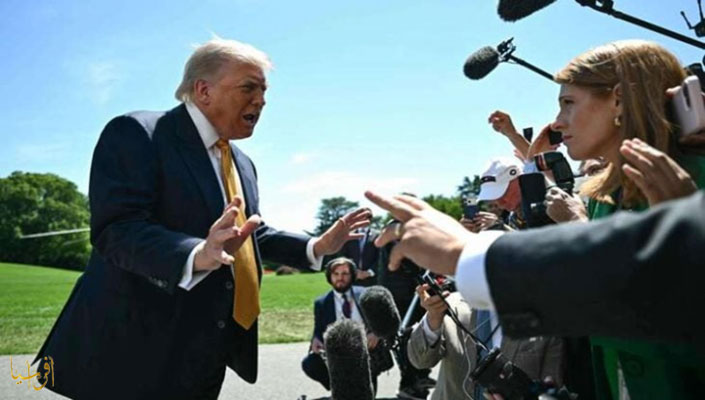
Asked by a reporter how Americans' financial conditions would influence him to reach a deal, Trump said: "Not even a little."
Before leaving the White House for China, Trump said: "The only important thing, when I talk about Iran, is that they don't get a nuclear weapon ... I'm not thinking about the financial situation of Americans. I don't think about anyone. I think of one thing: We cannot allow Iran to acquire a nuclear weapon. That's it. That's the only thing that motivates me."
Trump's comments are likely to draw criticism from opponents who argue that the administration must balance geopolitical goals with economic impact on Americans, especially as cost-of-living concerns remain a key issue for voters ahead of November's midterm congressional elections.
Pressure on the Pentagon
U.S. lawmakers have pressed Pentagon leaders to get details of the high costs of the U.S. war on Iran that has reached a stalemate, amid signs that the conflict is driving up consumer prices at home as well. U.S. President Donald Trump has said the Islamic Republic will be "annihilated" if no agreement is reached.
Defense Secretary Pete Higgseth declined to give details about the costs, while facing questions in Congress, during a hearing on the administration's unprecedented $1.5 trillion defense spending request for next year.
Defense Secretary Pete Higseth declined to give details on the costs, while facing questions in Congress during a hearing on the administration's unprecedented $1.5 trillion defense spending request for next year.
Jules Hirst, the acting comptroller of the Department of Defense, said the estimated cost of the war had risen to about $29 billion, up from a previous estimate of $25 billion which was described as unrealistically low, according to Bloomberg News on Wednesday.
Higgseth and Gen. Dan Keene, chairman of the Joint Chiefs of Staff, also declined to give details on U.S. assessments of Iranian missile stockpile levels. They have come under pressure on this key issue by lawmakers, pointing to a gap between the administration's claims that it destroyed most of the weapons earlier in the conflict and recent reports suggesting that larger numbers remain intact.
Iran Shadows BRICS Meeting
In this context, the US-Israeli war on Iran is expected to cast a shadow over the meeting of foreign ministers of the BRICS countries, which begins in New Delhi on Thursday and lasts for two days, which will be a test of the group's ability to reach a unified position and issue a joint statement.
The group, which originally included Brazil, Russia, India, China and South Africa, has expanded over the years with Egypt, Ethiopia, Indonesia, Iran and the United Arab Emirates.
Iran has called on India, which holds the 2026 presidency of the group, to use the BRICS as a platform to build consensus to condemn the US and Israeli actions in the conflict.
It is not yet clear who will represent the UAE at the BRICS meeting, and the atmosphere could be tense after reports that the UAE and Saudi Arabia have launched military strikes on Iran in response to its attacks on them.
The main differences between Iran and the UAE have emerged, and both take a different stance in the war launched by the United States and Israel on Feb. 28.
Iranian Foreign Minister Abbas Araqchi is likely to arrive late on Wednesday for the meeting. Russian Foreign Minister Sergei Lavrov is also expected to attend the meeting.
Indian Foreign Ministry spokesman Rander Jaiswal said in March that some BRICS members were directly involved in the conflict, making it "difficult for us to reach consensus".
Another ministry official said India was hoping for a joint statement after the latest round of meetings with foreign ministers.
