
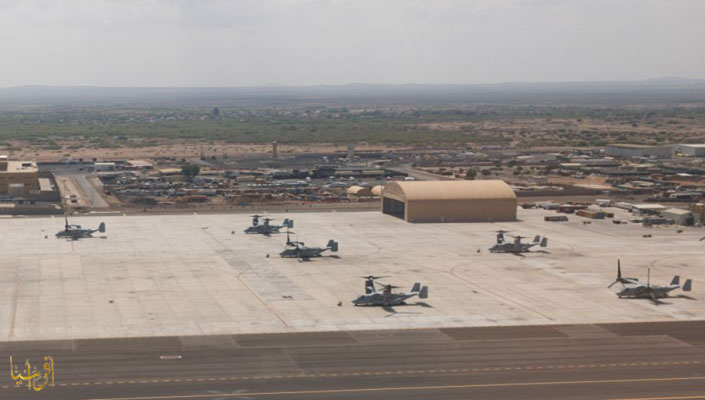
Afrasianet - After Trump's threat to withdraw U.S. troops from a number of European countries, we get to know the U.S. bases in the world.
Since World War II, the United States of America has had an active military presence globally, supported by an extensive network of installations, including permanent and temporary military bases and sites, as well as the use of local military facilities in multiple countries.
According to a July 2024 report by the Congressional Research Service, the U.S. military owns or uses more than 128 military bases in 51 countries around the world.
U.S. military bases overseas perform a wide range of strategic and security functions, starting with providing safe spaces for troop concentration and storage of military equipment, ensuring that the United States maintains its combat capabilities outside its territory and uses them when needed.
In addition, these bases carry out advanced intelligence missions, such as electronic eavesdropping and communications monitoring, to detect threats that may target the United States or its allies and partners, as well as to protect forces, installations, and critical areas using multiple defense systems, including radars and missile interception systems.
These bases also serve as important logistics and training hubs, hosting supply, maintenance, and replenishment operations, and enabling joint exercises and exercises with allied forces to test military plans, enhance readiness, and achieve a higher level of operational coordination.
The U.S. military presence abroad serves multiple purposes, highlighting its military power, serving as a deterrent to adversaries, and ensuring that the force remains active beyond its territorial boundaries in areas that Washington deems vital to its national interests and serves its strategic and security objectives, including responding quickly to security emergencies, and supporting U.S. commitments to allied and partner countries.
Given the pivotal role played by these bases, Washington allocates tens of billions of dollars annually to them. In fiscal year 2023, the U.S. Department of War estimated the operating costs of overseas bases at $31.7 billion, in addition to $5.3 billion earmarked for the planning, design, and construction of new military infrastructure overseas.
However, these official figures do not reflect the full picture, as they may not include emergency expenditures, the costs of periodic deployments or ongoing training, and according to independent estimates, the expenditure may in fact be nearly double the amount officially announced.
Historical Background
Military bases overseas have played a pivotal role in U.S. foreign policy since World War II (1938-1945). Following its involvement in the war, the United States established and used hundreds of military bases to support its combat operations, most of which were concentrated on the main war fronts, particularly Europe andthe Pacific, as well as other locations outside of operations.
After the end of the war, the United States maintained some bases and established new bases on the territory of the Axis powers to support the requirements of military administration and reconstruction. The outbreak of the Cold War in the late 1940s spurred the United States to expand its network of overseas bases, especially in Western Europe and East Asia.
With the end of the Cold War following the collapse of the Soviet Union, the United States reduced its overseas military presence, closing dozens of military bases in the 1990s and early 2000s and reducing the deployment of its forces in Europe and the Indo-Pacific.
During that period, the United States shifted its military strategy toward the Middle East, with the outbreak of the Second Gulf War in the early 1990s, and then the attacks of September 11, 2001, and quickly established new military bases in a number of countries in the region to strengthen its presence and secure its strategic interests.
In the mid-2000s, the United States once again strengthened its military presence in Europe and the Indo-Pacific, driven by competition with major regional powers.
In Europe, the fighting between Russia andUkraine in 2014, and then the Russia-Ukraine war in 2022, prompted Washington to reactivate previous bases in countries such as Iceland, as well as deploy U.S. troops to new locations, particularly in Eastern Europe.
The strategic competition with China has also prompted it to strengthen the deployment of its forces in the Indo-Pacific region.
By the third decade of the 21st century, the two regions were the primary hub of U.S. foreign forces, with three countries hosting more than 70 percent of U.S. forces overseas.
Types of External Rules
The U.S. Department of War classifies its bases overseas into two main categories: permanent bases for continuous presence, and emergency bases to provide temporary support for combat missions and other emergency operations. Within this general framework, bases are divided into subcategories according to the level of U.S. military presence or duration of operation.
There are 3 types of permanent rules:
• Main base: It has a solid infrastructure, and it is permanently staffed.
• Forward Base of Operations: It has an expandable structure, intended for periodic use by working forces.
• Cooperative Security Location: Characterized by limited or no U.S. presence, managed with periodic support by the United States or host country.
As for emergency sites, they are divided into 3 categories based on their duration of operation:
• Initial Location: Originates for immediate use.
• Temporary location: Used between one and two years.
• Semi-permanent location: Used between 2 and 5 years.
Top U.S. bases abroad
U.S. military bases around the world are spread across strategic areas of influence, which can be classified into 5 main regions: Indo-Pacific, Europe, the Middle East, Africa, and Latin America and the Caribbean.
Indo-Pacific region
The Indo-Pacific region is the most prominent hub for U.S. overseas military deployment, accounting for the largest number of U.S. troops stationed outside the national territory, mostly in Japan and South Korea.
Japan ranks first in the world in terms of the size of the U.S. military presence, as it hosts 15 major U.S. bases, according to Japanese Foreign Ministry data, where about 55,000 troops will be stationed as of 2025, according to the U.S. State Department.
South Korea ranks third globally and second in the Indo-Pacific region, with 24,234 troops deployed in active duty in 2024, according to official US sources for 2024.
Most of the U.S. permanent forces in the region are deployed within fixed bases in Japan and South Korea, including bases for the Army, Navy, Marines, Air Force and Space Force.
The United States has provided these bases with advanced combat capabilities and military equipment, including aircraft carriers, destroyers, cruisers, amphibious assault ships, fighter jets, electronic attack aircraft, command and control aircraft, helicopters, refueling aircraft, air transport aircraft, and more.
The United States maintains a small permanent military presence in other countries, along with access to local bases and periodic deployments within several countries in the region.
In Australia, the United States maintains a naval rotation force at Darwin Base and Robertson Barracks of the Royal Australian Air Force, has the right to deploy fighter jets periodically to Tyndall Base and other Australian military sites, and shares with Australia the operation of the Harold E. Holt Naval Communications Station and the Joint Defense Facility at Pine Gap.
The U.S. maintains a small permanent presence at its Naval Regional Center in Singapore, for logistical support and periodic deployments of aircraft and combat ships, and the Paya Libar Air Base periodically hosts U.S. troops and aircraft, and allows U.S. forces access to the Changi Naval Base and the Simbawang Shipyard.
On the island of Kwajalein Atoll in the Marshall Islands, the United States has a military garrison and hosts the Ronald Reagan ballistic missile defense test site.
U.S. forces have periodic access to nine local defense sites in the Philippines to carry out military and humanitarian activities, as well as six airports and seaports in Papua New Guinea.
Among the most prominent U.S. military bases stationed in the Indo-Pacific region:
• Yokota Air Base on the Japanese island of Honshu: Its primary mission is to strengthen the U.S. deterrence force in the region, and to provide air support for offensive air operations.
The base is the headquarters of U.S. forces in Japan, the headquarters of the Fifth Air Force, and home to the 374th Air Transport Wing, which manages several squadrons to carry out missions such as: support, maintenance, medical services, rapid air transport operations across the Indo-Pacific, tactical ground air transport, and airdrops.
The base also hosts other units such as the 515th Air Transport Operations Group and the Japan Air Defense Command, which oversees the country's air defense mission.
• Camp Zama, Kanagao Prefecture , Japan: The oldest military barracks in Japan, the headquarters of the U.S. Army in the country, are housed by a host of military units, including the 1st Corps (Advanced), the U.S. Army Aviation Battalion in Japan, the 311th Military Intelligence Battalion, the Japanese Corps of Engineers, the 78th Signal Battalion, and the Bilateral Coordination Division.
• Yokosuka Naval Base on the Japanese island of Honshu: A strategic base for the U.S. Army, the largest overseas U.S. naval facility in the world, and the headquarters of the U.S. Seventh Fleet.
The base hosts 13 Naval Commands and more than 71 Coastal Commands and subordinate activities, and is tasked with supporting naval operations in the Western Pacific, including those of the U.S. Seventh Fleet, 15th Destroyer Squadron, and the aircraft carrier USS George Washington.
• Iwakuni Air Force Base, Iwakuni, Japan: Its mission is to provide ongoing operational support to U.S. forces and their allies in training, combat operations, and emergency operations within the Indo-Pacific.
The facility includes multiple units, including the first half of the Naval Aircraft Wing, elements of the Third Maritime Logistics Group, the Fifth Naval Aircraft Carrier Wing, and the 31st Air Fleet Wing of the Japan Maritime Self-Defense Force.
• Misawa Air Base on Honshu Island, Japan: Its mission is to provide air and ground support and logistics to all U.S. Navy and Marine forces in northern Japan.
The facility is home to the 35th Fighter Wing, and its mission is to strengthen the U.S. deterrence force, protect U.S. national security interests in the Pacific, and defend Japan.
• Kadena Air Base in Okinawa, Japan: It is the largest U.S. air base and center of U.S. air power in the Asia-Pacific region.
The facility includes the 18th Wing and a variety of accompanying units, making Team Kadena the largest U.S. operational combat wing overseas, equipped with an integrated and deployable forward air force of 81 fighter jets, as well as air-to-air refueling aircraft, air warning and control aircraft, and search and rescue aircraft.
• Camp Butler in Okinawa, Japan: It includes important military sites, including Futenma Air Base, and Camps Kinser, Foster, Courtney, Hansen, Schwab, and Gonsalves.
The site is home to the U.S. Marine Corps Air Force's 3rd Air Force, an advanced maritime air force globally that conducts major reconnaissance and combat operations.
• Camp Humphreys in Pyeongtaek, South Korea: It is the headquarters and headquarters of U.S. forces in Korea, and is the headquarters of the U.S. Eighth Army and the 2nd Infantry Division.
The camp hosts direct support, transport and tactical units of the U.S. Army, including the 2nd Combat Aviation Brigade of the 2nd Infantry Division.
The camp is also home to Desiderio military airfield, the military's most active airport in the Pacific.
• Osan Air Base in the Korean city of Pyeongtaek: It is home to the 51st Mustang Fighter Wing and 24 subordinate units, including the 7th Air Force.
The base supports the implementation of a full range of air combat missions to maintain stability in Northeast Asia and defend South Korea against any potential aggression from neighboring North Korea.
• Diego Garcia Base on Diego Garcia Island in the British Indian Ocean Region: It is a US-British base, which is one of the most important American bases abroad, and its mission is to provide logistical support to advanced operational forces deployed in the Indian Ocean and the Persian Gulf.
The base hosts the 2nd Naval Prepositioning Squadron, detachments of various military divisions and units, including the U.S. Industrial Supply Unit, the Computer Station, Naval Communications, and Pacific Air Traffic Command, in addition to two squadrons of space operations.
Europe
Europe is the second global area of influence for U.S. foreign forces, with approximately 84,000 U.S. troops stationed at about 31 fixed bases and 19 other military sites, according to a report by the Council on Foreign Relations in early 2025.
Most of the military personnel permanently assigned to Europe are stationed at fixed bases in Germany, Italy andthe United Kingdom.
Germany ranks second globally and first on the European continent in terms of the size of the U.S. military presence overseas, hosting more than 35,000 U.S. military personnel on active duty in 2024, according to official U.S. sources for 2024. But the Pentagon announced in May 2026 that it would withdraw 5,000 troops from troops stationed in Germany, reflecting the disagreement between US President Donald Trump and German Chancellor Friedrich Merz over the Iran war.
Italy has the second-largest permanent U.S. military presence in Europe, with about 12,375 active-duty troops stationed at five major military bases.
The United Kingdom has 100,058 U.S. troops on active duty, while about 3,292 U.S. troops are stationed in Spain, and both Britain and Spain allow U.S. troops access to important military bases and sites in the country.
U.S. forces conduct limited periodic deployments in countries such as Belgium, Bulgaria, Estonia, Finland, Hungary, Iceland, Latvia, Lithuania, Norway, and Kosovo, and often use local military facilities for these activities.
Other countries are seeing a larger U.S. military presence, such as Poland, where the U.S. has a rotational force of about 10,000 troops in early 2025, and U.S. forces operate the Rydzikovo Naval Support Facility, maintaining an armored brigade, missile defense systems, fighter jets, reconnaissance planes and drones, according to the U.S. State Department.
The U.S. War Department has listed Mikhail Cogalnicheno Air Force Base on the Black Sea and the Naval Support Base in Divicilo, both in Romania, as its facilities, and according to the U.S. State Department, there are about 3,000 U.S. military personnel in Romania in early 2025.
The U.S. Air Force operates aviation facilities at Turkey's Incirlik Air Base, a strategic base in support of U.S. military operations, particularly in the Middle East, and has 1,690 active-duty troops stationed in Turkey as of 2024.
U.S. forces in Europe have supplied ground unit materiel and warplanes, including rotary-wing aircraft, fighters, cyberattack aircraft, bombers, air transport aircraft, and fuel carriers, as well as warships, destroyers, and amphibious command ships based in Spain and Italy.
U.S. forces stationed in Europe conduct military activities in multiple arenas that are not confined to the continent, including tracking Russian military activities, including Russian submarines in the Atlantic, rapid response operations in the Middle East and Africa, providing early warning of ballistic missile strikes, intelligence-gathering and electronic eavesdropping.
Some of the most prominent U.S. military bases in Europe are:
• Stuttgart Garrison in the Stuttgart region of Germany: It houses 5 military installations, namely Panzer Barracks, Patch Barracks, Kelly Barracks, Robinson Barracks, and Stuttgart Military Airfield.
The garrison is a strategic command center for U.S. military operations in Europe, Africa, and the Middle East, as well as the headquarters of the U.S. European Command, which operates 51 military bases and units throughout Europe.
• Ramstein Air Base in Rhineland-Palatinate, Germany: The largest U.S. Air Force base in Europe, a major medical transport and evacuation platform, is the "Global Gateway to Europe," and provides support missions for U.S. military operations in Europe, Africa, and the Middle East.
The base is part of the Kaiserslautern military complex, the largest U.S. military concentration overseas.
• Bavarian Garrison in the Bavarian region of Germany: It houses the two largest permanent U.S. training areas in Europe, Grafenfur and Hohenfels, as well as the Vilsick and Garmisch barracks.
The garrison mission is centered around supporting a wide range of U.S. military units, including the 7th Army Training Command, 2nd Cavalry Regiment, 15th Engineer Battalion, 18th Combat Sustainability Support Battalion, 1st Squadron of 91st Cavalry Regiment, 4th Battalion of the 319th Airborne Field Artillery Regiment, 18th Military Police Brigade, 41st Field Artillery Brigade, and 1st and 4th Infantry Battalions.
• Rhineland-Pvals Garrison: Covering 31 locations in the German region of Rhineland-Pvalz, it is the main command center of the International Operations Command in Europe, and manages the Army's global response mission, providing vital services to its 35 units in 26 strategic locations in Germany.
• Ansbach Garrison: It includes air, engineering and artillery units, distributed over 6 sites and 9 military fortresses scattered around the German city of Ansbach.
The garrison is home to the 12th Combat Aviation Brigade, the largest military unit in the region, the 7th Brigade of Engineers, the 5th Battalion, the 4th Air Defense Artillery Regiment, the 1st Battalion and the 57th Air Defense Artillery Regiment.
• Wiesbaden Garrison: Featuring 15 facilities and residential areas in and around the German region of Wiesbaden, it is home to a number of military units, including the U.S. Army Headquarters in Europe and Africa, the Facilities Management Command in Europe, the 66th Military Intelligence Brigade, the 1st Battalion, the 214th Aviation Regiment, the U.S. Forces Network in Wiesbaden, and several U.S. Air Force units.
• U.S. Army Garrison: Based at Camp Ederly in Vicenza, Italy, it is home to the 173rd Airborne Brigade Combat Team, a rapid response force for Europe, Africa, and the Middle East.
• U.S. Naval Support Center in Naples, Italy: The headquarters of U.S. Naval Forces in Europe, Africa, and the U.S. Sixth Fleet, the base has more than 50 separate commands.
The Center's mission is to provide logistical and administrative support to U.S. operating U.S. Naval Forces, other U.S. agencies, and NATO commands.
• Segonella Naval Air Base in Sicily, Italy: It is one of the largest security commands of the US Navy in the world, known as the "Mediterranean Center", and is the headquarters of more than 39 US commands and activities.
The base provides logistical and operational support to the U.S. Sixth Fleet and other U.S. military units, as well as the activities of U.S. allies and partners, and provides rapid response capabilities for U.S. operations across 3 continents: Europe, Asia, and Africa.
The facility supports intelligence, surveillance and reconnaissance missions in Europe, North Africa and the Middle East, and maintains a regular presence of anti-submarine aircraft and a squadron of marines, reconnaissance aircraft and drones.
Petovic Space Base: Formerly known as Thuli Air Base, the base is located in the Greenland region of Denmark, and is one of the most important US strategic bases abroad, as it is considered America's shield to protect its interests in the Arctic.
The base's missions include detecting and tracking intercontinental ballistic missiles over the Arctic that may target North America, and space surveillance through sensors and radar operated by Space Warning Squadron 12.
The base also provides support to the U.S. Space Force, performing vital functions such as command and control via satellites through a station operated by Space Operations Squadron 23.
• Lakenheath Royal Air Force Base: Located in Forest Heath, Britain, it is the headquarters of the US Air Force's 48th Fighter Wing, the largest US fighter wing in Europe, whose mission is to provide a rapidly responsive combat air force and global support, and includes 4 combat-ready fighter squadrons of F-15s and F-35s.
• Royal Mildenhall Air Base in Britain: Its mission is to support U.S. forces operations throughout Europe, the Arctic, Africa, and the Black Sea.
The base is home to the 100th Refueling Wing, the only permanent U.S. air refueling wing in Europe, and includes various units of four main commands: Air Combat Command, Air Force Special Operations Command, Air Transport Command, and U.S. Air Force in Europe.
• RAF Minemouth Hill Base: A major space espionage, intelligence and communications centre, jointly operated by the United States and the United Kingdom.
Its main mission is to gather electronic intelligence on a large scale, as well as to support other military operations, including the U.S. ballistic missile defense program.
• Rota Naval Base: It is a Spanish base that has allocated part of its area to become a support area for US and NATO forces, and this area contains 3 active docks, an airport of 670 acres, and includes the largest weapons and fuel facilities in Europe.
The base is a major logistical hub for U.S. and NATO forces, providing shipping, fuel, and logistical support to naval vessels and trans-regional military units.
It is also a key component of the U.S. European Command's regional missile defense system, where 4 U.S. destroyers equipped with the Aegis Beslin 9 ballistic missile defense systems are stationed in it.
• Naval Support Base: Located in the Gulf of Souda on the Greek island of Crete, it is an important logistics and refueling hub, as it houses the only naval berth in the Mediterranean capable of accommodating the U.S. Navy's nuclear aircraft carriers.
The facility supports the global reconnaissance, intelligence-gathering and surveillance activities of the U.S. Air Force and Navy, as well as the deployment of U.S. and allied forces in the Eastern Mediterranean, and the European, African and Central Command areas of responsibility.
Middle East
The United States has a significant military presence in the Middle East, with troops in more than a dozen countries, as well as being stationed aboard ships in territorial waters.
U.S. forces have eight fixed bases and 11 other military sites to which they have access.
The tasks of U.S. forces in the region are primarily related to protecting their interests in the region, supporting their ally Israel against the Palestinian resistance, Iran , and armed organizations backed by them, and strategic rivalry with Russia and China is another motivation for the U.S. military presence in the region.
The United States deployed additional units after the Israeli aggression on Gaza, which began in October 2023, supported the escalation of Israeli aggression on various fronts, and participated in striking Iran and the Houthi movement in Yemen.
As of the summer of 2025, the total U.S. military presence in the Middle East was between 40,000 and 50,000.
Many countries in the region maintain a U.S. military presence, some very limited as in Egypt, while others host large U.S. troops and bases on their soil.
In Iraq, there are several American bases, the most important of which are Ain al-Asad Air Base and Erbil Air Base, and Jordan hosts US military sites, most notably Muwaffaq al-Salti Air Base, which hosts the headquarters of the 332nd Air Wing, and F-35 aircraft, and the Sultanate of Oman includes US military sites, including the Duqm base.
The U.S. military presence in Syria includes al-Tanf base and various facilities in northeastern Syria and elsewhere, and U.S. forces in the country carry out what they call "counterterrorism" missions as well as advising and assisting the SDF.
Neither Israel nor the United States acknowledge the existence of U.S. military bases in Israel, but Washington says it maintains an emergency stockpile in Israel that includes weapons and military equipment.
The Persian Gulf is home to some of the most important US military bases in the Middle East, including:
• Maritime Support Center (Juffair Naval Base): Located in the State of Bahrain, it is the only permanent naval base in the Middle East, and is the headquarters of the U.S. Naval Forces Central Command and home to the U.S. Fifth Fleet.
The base is home to 4 mine action ships, an expedition support ship, and two logistics support ships, as well as U.S. naval reconnaissance aircraft, Patriot missile defense systems, a squadron of 6 rapid response ships, a crew of relief vessels and a 150-strong mission support force.
• Camp Arifjan in Kuwait: The forward headquarters of the U.S. Central Army, it is a major hub for logistical support, supplies, troop protection, and U.S. military operations command in the Middle East.
• Ali Al-Salem Air Base in Kuwait: A major air transport hub and support force for joint forces and international coalition forces in the region, it is the headquarters of the U.S. Air Force's 386th Expeditionary Air Wing, which is responsible for air transport missions.
• Al Dhafra Air Base in the United Arab Emirates: It is a strategic base, which carries out reconnaissance and intelligence gathering missions, in addition to supporting combat operations.
The base's capabilities include early warning and air control aircr
aft, intelligence, surveillance and reconnaissance aircraft, refueling aircraft, and advanced combat aircraft such as the F-22 Baptor stealth fighters.
• Prince Sultan Air Base in Saudi Arabia: The Expeditionary Air Wing hosts the 378th Expeditionary Air Wing, and the base houses missile defense systems, as well as transport and refueling aircraft.
Africa
Africa is hosting a limited force of U.S. military personnel assigned to active duty and permanent duty, numbering approximately 1,150 as of March 2024, most of whom are stationed at fixed bases in Djibouti.
The majority of U.S. military personnel in Africa are classified as interim troops, operating on emergency or patrol missions.
U.S. military bases and periodic troop deployments in Africa support logistical activities, military training, support to regional forces, respond to humanitarian crises, support evacuation activities, and protect U.S. interests in the region.
According to the Congressional Research Service, U.S. forces on the continent use two permanent military bases and seven other military sites accessible to U.S. forces, spread across Djibouti, Kenya , Somalia , Gabon , Chad and the island of Ascension.
The most prominent U.S. bases in Africa are in two key locations:
• Lemonnier Base in Djibouti: Located near the Bab al-Mandab Strait, it is the largest U.S. base in Africa, the main base of operations for U.S. military command in the Horn of Africa, and the headquarters of the Joint Task Force there, a hub for U.S. Army air cargo aircraft.
The base is a major hub for U.S. conventional and drone aircraft, as it includes 6 U.S. drone bases, a conventional aircraft base and a squadron of fighter jets.
The base supports U.S. operations and coalition activities in the Red Sea and beyond, and supports approximately 4,000 U.S., joint and coalition military and civilian personnel.
Its mission is to strengthen partner countries' capabilities, promote regional security and stability, stop conflicts, and protect the interests of the United States and its allies.
• Ascension Island Airport: It is located on Ascension Island, part of the British Overseas Territory, St. Helena, the Ascension Islands and Tristan da Cunha.
The airport is a permanent frontline operations hub for U.S. forces in Africa, hosting U.S. Air Force facilities, personnel, and the U.S. Space Force, and supporting air logistics, launches, and space surveillance.
Latin America and the Caribbean
The United States does not have a large-scale permanent military presence in Latin America and the Caribbean. According to the Congressional Research Service, there are about 1,650 active-duty personnel in permanent duty as of 2024, mostly in Cuba, which hosts 616 troops, and Honduras, which has 365 troops.
The area also does not host many overseas U.S. military bases, and the Congressional Research Service has identified three fixed bases and three other military sites that U.S. forces are allowed to access.
Cuba, Honduras and the Bahamas host the fixed bases, respectively: Guantánamo, Soto Cano and the Atlantic Deep Sea Test and Assessment Centre.
Europe and Curaçao (two constituent States of the Netherlands) have a cooperative security site, operated by the United States Air Force, and El Salvador has the Cumalaba Maritime Cooperative Security Site.
These bases mainly support counter-narcotics operations and countering transnational criminal organizations, as well as logistical, research, development, testing and evaluation activities, as well as countering the expansion of Chinese and Russian influence in the region.
The most prominent U.S. overseas military sites in Latin America and the Caribbean are two bases:
• Guantanamo Naval Base: Located on the southeast coast of Cuba, it is the oldest U.S. naval base overseas, and constitutes a major operational and logistical hub, supporting a variety of military and humanitarian missions, such as maritime security, humanitarian assistance, joint operations, and joint training.
Guantanamo is home to several military units, including the Joint Task Force, the Joint Detention Group, the Joint Intelligence Group, the Joint Medical Group, and the U.S. Coast Guard's Maritime Security Detachment at Guantanamo Bay, as well as a Marine Security Force Company, Marine Security Forces and Naval Supply units.
It also houses a military prison for "illegal fighters" captured during the war on so-called terrorism in several regions, including Afghanistan , Pakistan and Iraq.
The Cuban government considers the U.S. presence at Guantanamo Bay illegal and based on illegal agreements, while the U.S. government insists that the U.S. presence in the Gulf is legitimate under diplomatic agreements concluded in 1903 and 1934.
• Soto Cano Air Force Base, Honduras: The only forward operational site for U.S. forces in Central and South America, tasked with supporting the activities of Task Force Bravo, a task force of U.S. Southern Command, which carries out missions related to combating transnational organized crime, providing humanitarian assistance, and promoting regional cooperation, security, and stability.
The base also hosts the 1st Battalion of the 228th Aviation Regiment, which has assets that include medium transport helicopters, heavy transport helicopters and medical evacuation helicopters.
