
Afrasianet - Anas Raki - In mid-February, Europeans were waiting for Washington to say through its Foreign Minister Marco Rubio at the Munich Security Conference, especially since the previous edition of the conference saw a US attack on Europe and its policies.
They may have calmed down when they listened to Rubio's calm tone, and perhaps they were happy to hear him say that Washington's fate is tied to Europe, and that Americans will always remain sons of Europe, but the rest of his speech seemed to complement the meaning: We are the sons of Europe, but on the terms of the United States and its president, Donald Trump.
Rubio's messages in Munich. We are the sons of Europe but on Trump's terms
But in fact, European anxiety dates back a long time, and ironically, it was associated with the disappearance of greater anxiety with the collapse of the Soviet Union in late 1991, and the end of the Cold War, which had prevailed since the end of World War II between a Soviet-led Eastern camp and a US-led Western camp.
In the last decade of the twentieth century, the threat of the Soviet Union was gone, and its successor, Russia, seemed to be not as powerful and threatening, but Europe began to think of another, albeit seriously postponed question: about the future of the old continent if Washington decided to stop protecting it.
Washington surprised everyone last week by announcing a plan to withdraw 5,000 of its troops in Germany, before Trump went out to announce that a similar situation could also be applied to Italy and Spain.
Trump claimed that his country had provided significant support to Europe on Ukraine but had not received similar support on the Iran issue, saying: "Italy has never helped us, and Spain has behaved badly. We should not forget that when we needed them they were not there."
American Parachute
In fact, the European need for the American umbrella was not only to confront the eastern adversary, whether it was the Soviet Union or Russia, but also in the background of the picture shows what the Europeans do not forget: a painful history full of rivalry and even conflict between European powers that fear a return to that past if the door is opened to disturb the existing balances.
In this scene, Trump played the role of the hero, as he did in other scenes that extended from Iran to Venezuela, and from which other places, including the long-standing European ally, did not survive.
In his first four-year term in January 2017, Trump surprised allies with the attack, calling the EU a trade "enemy," questioning NATO and calling it an outdated grouping, as well as his support for Brexit .
On the leadership front, Trump took advantage of French President Emmanuel Macron and mocked his declining popularity, and criticized then-German Chancellor Angela Merkel and claimed that she was destroying her country.
In his second term, which began early last year, Trump went further toward allies, putting the transatlantic relationship at a critical juncture after decades of alliance that formed the backbone of the Western international order.
What underscores the gravity of the situation is that the rising tensions do not reflect transient differences, but rather indicate structural shifts in the priorities of both sides. While official discourses speak of "shared values," the facts reveal a growing divergence of interests and strategies, forcing Europe to rethink its position and role.
But let's remember the roots of this alliance first.
The Western alliance was built on the ruins of World War II, which ended 81 years ago, as Europe emerged from it economically devastating, which opened the way for the United States to lead reconstruction through the Marshall Plan (1948-1952), which injected about $13 billion to contribute to the revival of Western European economies and link them to the American system.
This coincided with a military development, represented by the establishment of NATO in 1949, which established European security dependence on the United States against the Soviet Union during the Cold War, but over the following decades it formed a defensive umbrella that ensured European stability with a clear alignment behind Washington.
The beginning was uneven, and it was affected by the balance of power, as the United States carried the burden of security and protection, while Europe had to focus on rebuilding and economic growth under the American umbrella.
This continued for more than four decades, until the collapse of the Soviet Union in the early 1990s and then the absence of a common enemy, which gave way to some disagreements to rear.
This was evident during the Iraq War in 2003, when Britain supported it while Germany and France opposed the American intervention, and the climate files witnessed a lot of variation, and trade disputes between the two sides were repeated, especially with the existence of a surplus in the trade balance in favor of the European Union.
But what are the causes of the current tension?
On the surface, it may seem related to personal differences centered on US President Trump, and on the other side Western leaders such as French President Emmanuel Macron, British Prime Minister Keir Starmer , and finally German Chancellor Friedrich Merz.
But reality allows us to point to profound shifts in priorities that have been relatively far apart between the two allies. In this regard, we can talk about the following:
1. Repositioning the United States globally
The U.S. strategy in the last decade suggests an increased focus on the Asia-Pacific region, while containing China' s rise.This shift reduces Europe's centrality in U.S. calculations, and makes Washington's commitments to the continent less clear than before.
2. Disagreement over defense burden-sharing
Washington has long criticized the decline in European military spending relative to the size of its economies, demanding a 2% GDP within NATO. Although some European countries have already begun to increase their spending, especially after the war in Ukraine, disparity still exists over the nature and limits of the commitment.
3. Economic and technological competition
Recent U.S. policies to support domestic industries, especially in the areas of clean energy and technology, have led to tensions with Europe, which sees this as a threat to its competitiveness. Competition is also escalating in sectors such as semiconductors and artificial intelligence, as each seeks to strengthen its technological sovereignty.
4. Different foreign policy approaches
In many cases, most notably China and Iran, Europe tends to adopt more pragmatic positions that take into account its trade interests, while Washington adopts tougher policies. This variation reflects a difference in the definition of threats and priorities.
Al Jazeera Net's interview section spoke with Andrea Dessi, a researcher in international affairs at the Italian Institute, who stressed that the war on Iran was an important milestone on the road to European anger at US policies.
Europe has been repeatedly sidelined by the United States even before the Trump administration, Desi explains, adding that he believes the recent war is likely the straw that broke the camel's back, as Europeans no longer trust the Trump administration very much.
Is it a conflict of interest or a rebalancing?
Overall, the current tension cannot be reduced to a transient crisis, but rather a reflection of the relationship shifting from a "strategic dependency" to a "negotiating partnership."
As the United States seeks to maintain its position as a hegemonic power, Europe is trying to build greater autonomy, which is reflected in the concept of "strategic independence" within the EU.
But this approach collides with a complicated reality: Europe remains heavily dependent on U.S. military capabilities, and deep economic ties make any separation costly for both sides.
Timothy Garton, a columnist for the British newspaper The Guardian, touched on this angle, saying, "The bitter truth is that the defense of Europe today depends on the US-led NATO , whose war plans allow a massive military machinery to act immediately if Russia launches an attack on any area along the alliance's eastern flank."
The repercussions of tension on Europe
Security:
Growing doubts about the sustainability of the U.S. commitment are pushing Europe to consider building its own defense capabilities, but that will require political consensus and significant funding, given the different priorities of member states. Europeans fear that a possible U.S. withdrawal could turn their backs on Russia, which may consider expanding what some describe as its current "adventure" in Ukraine.
Economically:
Trade disputes could lead to a reconfiguration of supply chains, potentially accelerating Europe's shift toward diversifying its trading partners and reducing dependence on the U.S. market.
Politically:
The contrast with Washington deepens divisions within Europe itself, between Eastern countries that see the United States as an indispensable security guarantor and Western countries that are pushing for greater autonomy.
How can Europe act?
We note that Western newspapers noted Mertz's eagerness to calm the situation by confirming that he had not abandoned the transatlantic relationship or his personal relationship with Trump, before confirming that Trump's sensitivity, vindictiveness, and outright hostility to the European Union all foreshadowed a renewed tension soon.
Washington's latest round of warnings and threats has confirmed what is already clear: a new model for European security in a new era must be based on solidarity and joint decision-making.
In a changing world where old assumptions no longer work, the contours of future European defense cooperation are becoming progressively clearer: the French president last year spoke of the possibility of extending France's strategic nuclear deterrence to the whole of Europe, while the European Union has allocated €150 billion in concessional loans for security spending.
Here we can summarize the most prominent things that Europe can do in the following axes:
• Promote defense independence, through the development of European military industries and a concerted increase in defense spending, reducing dependence on the United States without antagonizing it.
• Reshaping the partnership with Washington, by moving to a more balanced relationship, based on mutual interests rather than dependency, while maintaining the alliance on major issues.
• Diversifying international relations, by strengthening partnerships with other powers such as China and India, but within a strategy that preserves European interests and avoids slipping into new axes.
• Unifying the European position is the most important challenge, as the absence of a unified vision weakens Europe's ability to maneuver in the international system.
Europe Moves
Polish Defence Minister Władysław Kuszyk Kamesz said on Wednesday that NATO countries must meet the target of spending 5% of GDP on defence by 2030, five years ahead of schedule, warning of delays in rearmament.
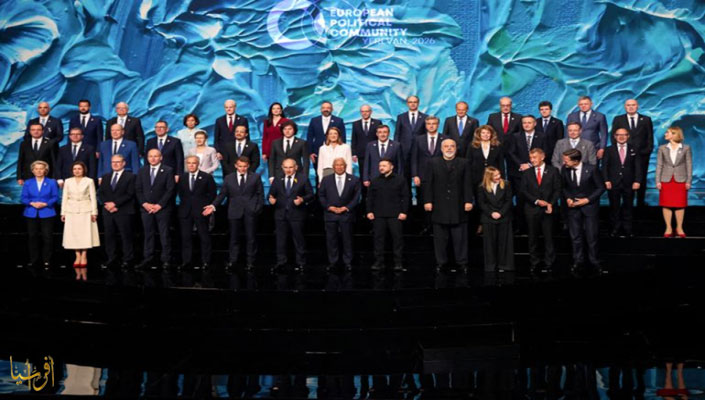
Europeans have used the European Political Group forum hosted by Armenia in its capital Yerevan this week to send several messages in this regard.
With the "Trump spectrum in attendance" at the conference, the leaders of the old continent were keen to emphasize Europe's independence in the field of defense and security.
Canadian Prime Minister Mark Carney, who was keen to share the concerns of the Europeans, especially since he was not spared from Trump's attacks, was remarkable, saying, "We don't think we have to submit to a more utilitarian, isolated and brutal world. Meetings like this give us another path."
Carney added that the U.S. trend to withdraw from Europe "should be seen as part of a world where Canada , Europe and everyone in that room have a greater responsibility for collective defense."
In a "humming" about what Europe can do, Timothy Garton in the Guardian said that senior European leaders should discuss several issues openly and objectively, including how to Europeanize the defence industry and how to strengthen European combat capabilities.
He also pointed to a special role for Germany, which aims to have the strongest conventional army in Europe and is on its way to becoming the leading military power there, as its defense spending next year will be equivalent to the spending of France and Britain combined.
But the famous columnist did not fail to point out that this could raise domestic concerns in Europe, especially for France, which fears losing its place as the world's second-largest arms exporter after America, as well as other powers, most notably the Polish right.
Garton concludes that fears are growing that this powerful army will fall into the hands of the far right, given the continued rise of the populist nationalist Alternative for Germany (AfD).
The world is changing
Andrea Dessie points out in his statements to Al Jazeera Net that one of the most prominent problems of the European Union is the internal division, as there are 27 members, each with their own interests, some of them, especially in Eastern Europe, are somewhat in line with the Trump administration, while other countries in southern and western Europe seem to be more worried.
When we asked the Italian researcher what Europe could do, he said that it is a bloc that is somewhat paralyzed by these differences, but he thinks it can change.
Despite all these concerns, the calm outlook suggests that transatlantic relations do not appear to be on the verge of a rupture but rather a phase of redefinition, as the factors that brought the two sides together are still there, albeit in a changed nature.
Even if Europe temporarily chooses to bow to Trump's storm, it will later find itself faced with a strategic choice: either continue with a Washington-led alliance with its political and strategic costs, or move toward repositioning itself as a more independent partner.
In any case, no one expects a big change quickly, as alliances built over 80 years are difficult to collapse in 8 months, especially since the effects of withdrawal extend to the United States as well, as we will explain in the last third topic of this file.
But at the same time, we should not think that this is just the usual tantrum from Trump, or a slip of the tongue from Meretz, as the developments around us confirm that the world is changing in everything, and at a much faster pace than we were used to.
More than a year ago, on the night of his party's victory in Germany's general election, Mertz said he wanted to achieve unity for Europe as soon as possible "so that we can achieve independence from the United States step by step."
The Guardian says these words sound truer today. As for us in the Third World, despite the impact of what is happening on us in one way or another, we can only follow and wait.
Source: Al Jazeera + Agencies + British Press
