
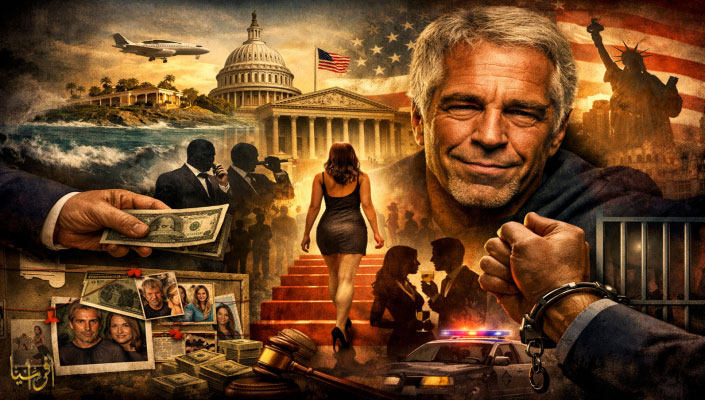
Afrasianet - Rising public anger in the United States against unaccountable political and financial elites is pushing the term "Epstein class" to the forefront of political discourse, amid declining trust in institutions and growing criticism of Donald Trump's economic and foreign policies.
The Financial Times published an article highlighting the rise of the term "Epstein class" as a political symbol in the United States used to describe unaccountable elites, amid rising public anger over economic inequality, the war with Iran, and declining trust in U.S. institutions.
The text is below:
His name is already one of the most notorious names in modern American crime history. Now, it's also a popular slogan, with the "Epstein Class" cementing its place as the newest addition to the lexicon of American politics.
The term, short for unaccountable elites, was coined last year by Ro Khana, a California Democratic lawmaker who co-authored a bill that would force the Justice Department to release all documents in its possession related to Jeffrey Epstein, the late financier convicted of sex crimes.
Khanna told the Financial Times: "This is the feeling that this is an elite class that is responsible for creating one of the most dysfunctional and unjust economic and political systems in America's history."
The term has gained traction, with politicians from the right and the left, and even Hollywood stars like Robert De Niro. It could also be a major nuisance for President Donald Trump and the Republican Party ahead of November's midterm elections.
Khanna said he was inspired by the idea after seeing the vast amount of correspondence in the Justice Department's files between members of an "arrogant and arrogant elite... She thought she was above everyone." I recognize that their indifference to Epstein's victims of sex trafficking reflects their arrogant disregard for all ordinary Americans.
Critics of the phrase say it echoes the Q-Anon Theory, a far-right conspiracy theory that assumes the existence of a secret group of liberals who are engaged in child sex trafficking and secretly control the worlds of politics, media and money.
But for Democrats, the emergence of the term came at an opportune time. It coincided with Trump's popularity plummeting to record lows, amid mounting public anger over the war on Iran, which has sent gasoline prices soaring to their highest level since 2022.
It also comes at a time when public trust in American institutions is waning, with growing frustration with rising income inequality and a "K-shaped economy " where the wealth of the rich and poor is increasingly diverging.
Democrats say Trump has only fanned the flames of this discontent with his recent actions, such as the creation of a $1.8 billion taxpayer-funded anti-politicization fund to compensate victims of the "legal war" and his request to Congress for a $1 billion ballroom at home White.
When asked earlier this month whether Americans' economic difficulties might prompt him to strike a deal to end the war with Iran, he replied: "No, not at all." "I don't think about the financial situation of the Americans," he said, stressing that his only consideration was to prevent Iran from acquiring a nuclear weapon.
Jim McGovern, a Democrat from Massachusetts, said Trump "finally told the truth" by showing how little he cares about the impact of rising inflation, health insurance costs and gasoline prices on American households.
"Epstein billionaires and special interests who fund election campaigns make huge profits," he said. But... For ordinary people in this country, Donald Trump's economy is catastrophic." Doug Sosnick, a Democratic strategist and former adviser to President Bill Clinton, said the rhetoric about the "Epstein class" is effective because it "reinforces what people are already feeling." "We have become two Americans, one for those with money and power, and one for everyone," he said.
But Trump's critics say the president misjudged public opinion about the Epstein scandal. For months, he has called it a "democratic hoax," despite polls showing broad bipartisan support for more transparency on the issue.
He has also sharply criticized politicians from his own party who have called for the full release of the files and justice for victims of sexual assault. One of them, Republican Rep. Thomas Massey, who co-authored Khanna with Epstein's bill, lost to a Trump-backed challenger in the Kentucky primary last Tuesday.
Massie accused Epstein's group of plotting to oust him. In an interview with talk show host Tucker Carlson earlier this month, he said Trump owed the group a debt of money because it was donating large sums of money to his favorite projects, such as the new White House ballroom and the planned 250-foot Arc de Triomphe in Washington.
"These are the people who have the president's trust," Massie told Carlson. They are billionaires. These are the same people mentioned in the Epstein files to a large extent, or their friends."
Marjorie Taylor Greene, a hard-right congresswoman from Georgia and a former supporter of the "Make America Great Again" movement, echoed Massey's views, which disagreed with Trump over the Epstein case and resigned from Congress in January.
Greene recently claimed that Trump told her, "My friends will be hurt" if she insisted on publishing the Epstein files. She also told CBS News last week that Trump himself was "definitely" part of the Epstein class, a group of "elites who never hold accountable" and "continue to dominate, regardless of the ruling political party."
