
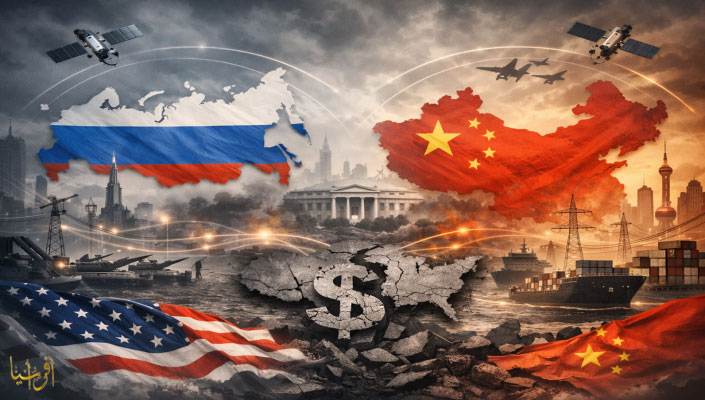
Afrasianet - Shaher Al Shaher - Moscow and Beijing are not seeking to overthrow the existing international order as much as they are redistributing influence within it, by building parallel financial, trade, and security systems that are progressing quietly, but are gradually changing the rules of the game.
All eyes are on Beijing, which received Russian President Vladimir Putin after bidding farewell to President Trump, in a scene that reflects its transformation into the capital of international decision-making.
Relations between Russia and China are no longer just an intersection of interests between two major powers seeking to expand their international influence, but over the past two decades have become one of the most influential partnerships in reshaping the international order.
The relationship between the two countries is no longer read only from the perspective of economics or security, but from the perspective of the historical shift in the international power structure, as American certainty gradually declines, while new forces are advancing to redefine the balance of power and the concept of global leadership.
President Putin's visit to China is of exceptional importance, because it comes at a very sensitive international moment, when the war in Ukraine is intertwined with the U.S.-China conflict, and the files of energy, technology, maritime security, and economic sanctions intersect. Therefore, any meeting between Moscow and Beijing is no longer an ordinary protocol event, but rather a strategic message addressed to the entire world.
The two countries understood early on that the international system was heading towards a long transitional period, and that the new balances would not be made by military force alone, but by the ability of states to build transcontinental economic, financial, and political networks of influence. Hence, their partnership came as an attempt to produce a new "balance engineering" that is not based on overthrowing the West but rather on preventing its monopoly on international decision-making.
From political convergence to strategic partnership
Russian-Chinese relations have undergone profound transformations since the end of the Cold War. After decades of ideological tension and border conflict during the Soviet era, the two countries have gradually moved to a phase of political pragmatism, and then to a near-comprehensive strategic partnership.
With Xi Jinping and Vladimir Putin in power, the relationship has taken on a distinctly personal dimension. The two men are dealing not only as heads of state, but as partners in a shared worldview based on rejecting U.S. unilateralism and advocating for a "multipolar" international order.
This personal dimension has played an important role in consolidating political trust between the two countries. International relations, however seemingly governed by interests, still need "political chemistry" between leaders, especially at major historical moments. In recent years, it has become clear that Putin and Xi have succeeded in building a high level of strategic understanding, which is reflected in the coordination of positions within international institutions and in sensitive geopolitical files.
It is enough to look at the extent of coordination between Moscow and Beijing within the UN Security Council to understand the nature of this partnership. The two countries hold similar positions on many issues, from Iran to North Korea to Syria, Ukraine, and Taiwan. They also oppose the use of unilateral sanctions as a tool to reshape political systems or subjugate rival states.
It has become clear that Moscow and Beijing view Western pressure as a common threat, not just separate differences. Therefore, their relationship has moved beyond the concept of "tactical coordination" to more of a "long-term strategic partnership."
When the major powers feel implicitly targeted by the existing system, they begin to build a parallel system from within the system itself, which Russia and China are doing today with strategic calmness and patience.
Economy and Energy... Rewriting the rules of influence
If politics gives Russian-Chinese relations a strategic dimension, then the economy and energy form the backbone of this partnership.
The volume of trade exchange between the two countries has risen in an unprecedented way in recent years, exceeding hundreds of billions of dollars, in a clear indication that the relationship has moved from the level of political coordination to the level of deep economic entanglement.
Western sanctions on Russia have accelerated this shift, with China becoming Moscow's largest economic partner, and Russia finding the Chinese market a vital outlet to offset much of its European losses.
In the energy sector in particular, the relationship is clearer. China is now one of Russia's largest importers of oil and gas, while Moscow offers Beijing stable supplies at preferential prices and significant discounts, especially after the reorientation of Russian exports to Asia.
It's not just about energy, it's about remapping the global economy. Russia and China recognize that Western control of the global financial system gives Washington enormous leverage, so they're expanding exchange in national currencies and reducing their dependence on the dollar.
The use of rubles and yuan in trade has not only an economic dimension, but also a profound political significance. The dollar was not just a currency, it was one of the pillars of American hegemony after the Cold War. Thus, any attempt to decentralize it effectively means reducing the United States' ability to control trade, sanctions, and the global financial system.
The importance of the BRICS and the Shanghai Cooperation Organization (SCO) for Moscow and Beijing can be understood. These two platforms are no longer mere frameworks for economic or security cooperation, but have gradually turned into a political space that seeks to build a new international balance outside the traditional Western umbrella.
The world has already entered a phase of "monetary multilateralism," where the dollar is no longer the only player without a rival. This may not mean the fall of American hegemony anytime soon, but it certainly means the beginning of the erosion of the Western monopoly on the keys to the global economy.
Security and the military... Partnership imposes new realities
On the military and security side, Russian-Chinese relations appear to be more sensitive and complex, as they directly affect global balance of power.
In recent years, the two countries have intensified joint military exercises on land, sea and in the air, including in highly sensitive areas such as the Pacific, the Arctic and the Sea of Japan.
These exercises are not only aimed at raising the level of operational coordination, but also carry clear political and strategic messages to the United States and its allies.
Maritime security has become an essential part of the strategic doctrine of both Moscow and Beijing, especially as competition for global trade corridors, energy, and supply chains escalates. Collaboration in protecting sea lanes reflects a shared realization that conflict in the 21st century will not only be over borders, but over trade, technology, and energy routes.
In the Arctic, Russian and Chinese interests appear increasingly intersecting. Russia has a large geographical and military presence there, while China sees the region as one of the most important trade and strategic pathways in the future as climate change and ice melts.
In the case of Iran and North Korea, Russian-Chinese coordination is clearly visible. The two countries reject Washington's policy of "strategic strangulation" against its adversaries, and consider that international stability cannot be achieved through sanctions and military pressure alone.
Still, it would be an exaggeration to say that the relationship between Moscow and Beijing has reached the level of a "full military alliance." China is still careful not to be drawn into a direct confrontation with the West because of the war in Ukraine, and each country has its own calculations and interests. But what is certain is that the level of rapprochement between them has reached a degree not seen in decades.
In international politics, not all alliances are necessarily declared, and some partnerships are stronger when they remain flexible and unconstrained by solid treaties. This is precisely what characterizes the Russian-Chinese relationship today.
Putin's visit to China not only reflects the development of bilateral relations, but also reveals the features of a new international phase in which the logic of unilateral hegemony is receding, and in which the logic of complex balances is emerging. The world is gradually entering an era in which no single power can manage global politics, economy, and security alone.
Perhaps the most important fact of this relationship is that Moscow and Beijing are seeking not only to protect their interests, but to redefine the rules of the international game itself. In a world of profound transformations and open to great possibilities, the Russian-Chinese partnership appears to be one of the most important forces reshaping the maps of the twenty-first century.
The problem for Washington is no longer just the rise of Russia or China individually, but the formation of a new international environment that no longer automatically responds to the idea of absolute American leadership.
The world is not just witnessing a shift in the balance of power, but a deeper shift in the nature of the international system itself, in which the ability of one power to monopolize global decisions is diminished, in contrast to the rise of more complex and intertwined balances.
At the heart of this transformation is the Russian-Chinese partnership that is reshaping the 21st century. Moscow and Beijing are not seeking to overthrow the existing international order but rather to redistribute influence within it, by building parallel financial, trade, and security systems that are advancing quietly, but are gradually changing the rules of the game.
Russian President Vladimir Putin's visit to China is not just a passing diplomatic stop, but an expression of a new international phase in which unipolarity is eroding in favor of a more fluid, competitive, and complex world, a world that is no longer managed from a single center, but is reshaped by balances open to great possibilities.

