
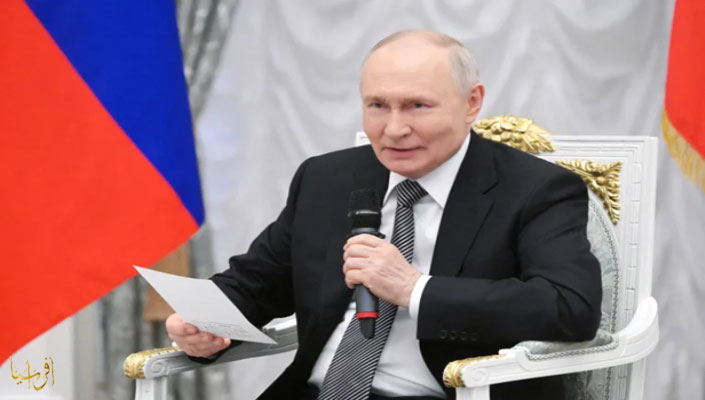
Afrasianet - Russia has decided to forgive new recruits to the war in Ukraine and their families from debt, in a move to encourage those wishing to join the war that has been going on for more than four years.
The Kremlin said late on Monday that Russian President Vladimir Putin had signed a decree forgiving new recruits to the Ukraine war and their families from debt.
The decree states that people who have signed a contract with the Russian Ministry of Defense as of May 1 and their spouses or both will be forgiven their debts of up to 10 million rubles (about $139,700) if the legal claim to collect those debts is valid before that date.
The Kremlin has said the contract to join the "special military operation" — Russia's description of its war in Ukraine that began in February 2022 — must be for at least one year.
The decree adds to a variety of support measures for Russian fighters in the war, from large payments to preferential admission to higher education, as the Kremlin seeks to bolster its forces as U.S.-led peace talks falter.
Russia and Ukraine have been accusing each other of seeking to escalate the conflict, and Kyiv plans to send reinforcements to northern Ukrainian regions to counter what it believes are Russian plans for a new offensive.
Urgent Mediation
On the other hand, US Secretary of State Marco Rubio confirmed on Tuesday that the United States is still ready to mediate the ongoing war between Russia and Ukraine, following Russia's major attack on Kyiv.
"Every time you see these big blows from either side, it's a reminder that this horrific war lasted longer than World War II, and it must end," Rubio said after a phone call with his Russian counterpart Sergey Lavrov.
"The United States stands ready and ready to do everything it can to help facilitate an end to this war, and we hope that the opportunity will come at some point," Rubio told reporters during an official visit to India.
Russia announced on Monday that it planned to launch further strikes against decision-making and command centers in Kyiv, after it fired dozens of drones and missiles into Ukraine over the weekend, killing four people.
The Russian Foreign Ministry announced that Lavrov had urged the United States to evacuate its diplomats from its embassy in Kyiv.
Rubio told reporters that Russia had "sent a notice to all embassies," not just the U.S. embassy.
Warning to evacuate the capital
Russia on Monday urged foreign nationals and diplomats in Kyiv to leave, announcing its intention to launch further strikes on the Ukrainian capital.
The Russian Foreign Ministry said in a statement: "The strikes will target decision-making centers and command centers. We urge foreign nationals, including staff of diplomatic missions and international organizations, to leave the city as soon as possible."
The statement also called on residents of the Ukrainian capital to stay away from "military and administrative infrastructure."
The announcement came after intensive Russian strikes targeted Ukraine, particularly the capital Kyiv, over the weekend, killing at least four people and wounding about 100 others. Russia used an Oryshnik ballistic missile capable of carrying a nuclear warhead in the strikes.
Russia to diplomatic missions: Leave Kyiv before bombing it
Moscow has issued a stern warning to foreign nationals and diplomatic missions to leave the Ukrainian capital Kyiv as soon as possible.
The development came as the Russian Foreign Ministry announced its forces' intention to launch a "series of systematic and coordinated strikes" under the direction of President Vladimir Putin, targeting what it described as "decision-making centers" and headquarters, as well as defense industrial facilities on which Ukrainian forces depend in the capital and its surroundings.
As part of this move, Russian Foreign Minister Sergey Lavrov held a phone call with his US counterpart Marco Rubio, in which he officially informed him of Moscow's decision to carry out these coordinated and systematic strikes.
During the call, Lavrov reiterated his country's recommendation to the United States and other Western countries to ensure the immediate evacuation of their diplomatic staff and citizens from Kyiv.
Russian escalation
The US State Department confirmed that the contact took place between Rubio and Lavrov, noting that the talks touched on the file of the war in Ukraine, the course of bilateral relations, and the situation in Iran, without providing further details on the security arrangements related to the US embassy in Kyiv.
Moscow also called on residents of the Ukrainian capital to immediately stay away from military and administrative facilities in anticipation of imminent strikes.
Russia's warnings follow a wave of intense air strikes launched by Moscow over the weekend, in which it used a modern Uryshnik ballistic missile capable of carrying nuclear warheads, and the strikes targeted several areas in Ukraine, especially the capital Kyiv, killing at least four people and injuring about 100 others.
The Russian Foreign Ministry attributed this sharp escalation to what it described as the "bloody and deliberate attack" that constituted the "point that overflowed the cup", following a drone strike attributed to Ukrainian forces that targeted a student dormitory belonging to a vocational college in the city of Starobilsk in the Russian-controlled Lugansk region of eastern Ukraine, which led to the death of 21 people and the wounding of more than 40 others, according to the Russian version.
Ukraine's position
On the other hand, the General Staff of the Ukrainian army confirmed that its forces had already targeted several Russian military sites that night, including the headquarters of a military unit in the Staropilsk region, without confirming the details of civilian casualties announced by Moscow.
In response, Russian threats were met with a categorical rejection from Kyiv and its Western allies, with Ukrainian Foreign Minister Andriy Sepyha calling the Russian warnings "blackmail" and calling on his country's partners not to surrender and continue providing military support and weapons to Ukrainian forces.
Similarly, European countries ignored Russia's warning, with the French Foreign Ministry asserting that it was out of the question of evacuating their diplomats from Kyiv as they were "used to Putin's threats."
The European Union's ambassador to Kyiv announced that the mission would remain and not leave the Ukrainian capital under the weight of these threats, which reminds us of similar warnings issued by Moscow earlier this month to evacuate Kyiv ahead of the "Victory Day" celebrations on May 9.
Details of Russia's latest attack on Ukraine with an Urshnik missile
The recent statements quickly dissipated with the imminent end of the war between Russia and Ukraine , which has entered its fifth year, as the battlefield between the two sides has recently witnessed a violent escalation during which qualitative weapons have been reused.
In this article, we review the details of Russia's latest attack on Ukraine, one of the most violent attacks since the outbreak of the war, and coincides with international efforts that are still stalled to end the conflict, which has left thousands of victims since it erupted in February 2022.
What happened?
The Ukrainian capital Kyiv had a rough night as a result of a massive attack launched by Moscow , whose Defense Ministry announced the use of Urshnik medium-range missiles capable of carrying nuclear warheads.
It said its forces dealt a major blow with Urshnik ballistic missiles, Iskander aerial ballistic missiles, Kinjal hypersonic and aerial ballistic missiles, Tsirkon cruise missiles, as well as drones in response to Ukraine's attacks on civilian infrastructure on Russian territory .
It stressed that this attack was limited to Ukrainian military targets, including command centers, ground and intelligence force positions, air bases and military industrial facilities.
What are the details of the attack and its losses?
At 1 a.m. local time in Ukraine, violent explosions rang out across Kyiv after warnings from the Ukrainian Air Force that Russia could launch an Urshnyk ballistic missile.
Russian attacks with hundreds of missiles anddrones targeted the Ukrainian capital Kyiv and the surrounding area.
Ukraine's air force announced that Russia had launched a total of 90 missiles and 600 drones.
Natalia Zavarich, 62, said she rushed to the station in her area when the explosions began to shake the city, describing the situation as terrifying and frightening.
As the sun rose, black smoke from several fires blanketed the city's skyline, while fire crews used water cannons to extinguish the flames in the damaged buildings, and rescue teams worked to evacuate the wounded.
Ukrainian President Volodymyr Zelenskyy said Russia had shelled the city of Bela Tserkova in the Kyiv region with an Urshnik medium-range ballistic missile.
Kyiv Mayor Vitali Klitschko said: "It was a horrible night for Kyiv. Rescue teams are currently working to extinguish the fires and remove the rubble, and paramedics are providing assistance to the victims."
Ukrainian officials said the hours-long shelling overnight killed four people and wounded more than 80, and dozens of residential buildings and several schools were damaged.
The windows of the Ukrainian Foreign Ministry building were shattered, and damage was reported in Kyiv's historic Independence Square.
Will Ukraine respond?
Ukrainian President Volodymyr Zelenskyy said it was important that this attack does not go without consequences for Russia, but added that it "requires action from the United States , Europe and others."
He accused Russia of targeting facilities linked to water supplies, in an attempt to damage them ahead of high demand over the summer.
Ukraine's security service said its drones carried out an attack on Sunday on an oil distribution and pumping station in Russia's Vladimir region, adding that the facility is an important focal point in pumping oil products to Moscow and surrounding areas.
He explained that the plant "supplies fuel to main depots in the vicinity of Moscow and the airports of Sheremetyevo, Domodedovo and Vnukovo," noting that a fire spread over an area of about 800 square meters was detected after the strike.
How many times has Moscow used Urshnik missiles in Ukraine?
According to Western media reports, Russia's new attack using the Orshynik missile is the third since the war began more than 4 years ago.
The previous two attacks have targeted major cities, but the most recent strike hit the city of Bela Tsirkova, about 40 miles (40 miles) from Kyiv.
The missile, which can carry nuclear warheads, has a range of thousands of kilometers, and Russian President Vladimir Putin has said the missile cannot be intercepted because of its speed of more than 10 times the speed of sound.
What are the responses to the attack?
French President Emmanuel Macron has denounced the Russian attack and the use of the Urshnik ballistic missile to strike the Ukrainian capital Kyiv, stressing that it primarily indicates a form of escalation and impasse in Russia's war.
On a related note, EU foreign policy chief Kaia Callas said that Russia is seeking to "intimidate Ukraine" with its latest large-scale offensive.
"Russia has reached an impasse on the battlefield, so it is intimidating Ukraine with deliberate strikes on city centers," Kallas wrote on the X platform.
"Moscow's use of Orichenek intermediate-range ballistic missiles is nothing but a tactic of political intimidation and a reckless form of nuclear blackmail," it added.
What preceded the new attack?
Hours before the Russian attacks, Zelensky warned that Russia was preparing to launch an attack on Ukraine using an Urshnyk missile, citing intelligence from Ukraine, the United States and Europe.
On Friday, Russian President Vladimir Putin accused Ukraine of carrying out an attack on a student dormitory in the Moscow-controlled Lugansk region, killing at least 18 people and wounding more than 40, but Kyiv denied the Russian accusations.
The Russian president then directed the Ministry of Defense to submit proposals to respond to the offensive by Ukrainian forces, which have recently intensified their attacks on Russia.
These developments come despite statements by Putin and the Kremlin in recent days that developments in the peace process indicate that the war in Ukraine is coming to an end.
On Friday, Zelensky also said diplomatic efforts to end the war should be given a boost, adding that he expected new U.S. proposals on how to manage those efforts.
Kyiv is under the fire of Oreshnik. Is it a coded Russian message to Europe?
The Ukrainian capital Kyiv has experienced one of the deadliest nights of war since the start of Russia's war in 2022, after it was subjected to an intense barrage of ballistic and winged missiles and drones at dawn on Sunday , in an attack described by Western newspapers as a "qualitative escalation" that reflects a shift in Russian military tactics and Moscow's ability to carry out large-scale air-dumping strikes.
Reports in Le Monde, Le Figaro and Newsweek newspapers agreed that the attack was not just a routine bombardment, but a complex operation involving the various arms of the Russian war machine, from strategic aviation to the Russian fleets in the Black Sea and the Caspian Sea, through ballistic missile units and long-range drones.
According to Western accounts, Russia used about 90 missiles and more than 600 drones, including Iskander missiles and the "Oreshnik" hypersonic missiles, which led to the death of 4 people and the injury of more than 100, as well as extensive damage to residential neighborhoods, government facilities, schools, and metro stations.
The three newspapers agreed on several main points, most notably that the attack represents:
• One of the largest Russian air attacks since the beginning of the war.
• An escalation linked to Moscow's intensification of the production of missiles and drones.
• A Russian attempt to flood Ukraine's air defenses via simultaneous and heavy attacks.
• A message of deterrence after Ukrainian strikes inside Russia.
Reports also unanimously agreed that the "Orishanik" hypersonic missile was the most dangerous element in the attack, especially since it is capable of carrying nuclear warheads and is used for only the third time since the start of the war.
Complex logistical process
The French newspaper Le Monde focused on the military and logistical dimension of the attack, considering that carrying out a strike of this magnitude would require the mobilization of tens of thousands of Russian military personnel.
The newspaper pointed out that Western and Ukrainian intelligence services were aware a few days ago of Russian preparations for a large-scale offensive, explaining that planning such operations could take a whole week, due to the complexities of transporting munitions and equipping bombers, planes and ships.
It quoted Ukrainian air force spokesman Yuriy Ihnat as saying that Russia is now relying on "saturation attacks" to overwhelm air defences, taking advantage of its daily production of drones and missiles.
The newspaper also highlighted that Russia is using mock attacks to lure Ukrainian radars and detect the locations of air defenses before the real strike.
Underground Horror Night
Le Figaro chose a square corner, relaying the scenes of horror experienced by Kievites inside metro stations and shelters.
The newspaper described the night as "one of the most stressful nights since the beginning of the war", noting that residents rushed to tunnels and metro stations dozens of meters deep to escape the bombardment.
A Ukrainian student named Anya was quoted as saying:
"In the sky it was like Star Wars. Sparks and explosions are everywhere."
The newspaper also monitored the extent of the destruction that affected popular markets and residential buildings, and quoted a resident near a burnt market as saying:
"It was just a popular market. They're absolutely crazy."
The newspaper linked the Russian offensive to the escalation of Ukrainian strikes inside Russian territory, especially the targeting of refineries and ammunition depots.
The Encrypted Nuclear Message
Newsweek, on the other hand, focused on the use of the "Oryshnik" missile, which is capable of carrying nuclear warheads, considering its reappearance as "political messages and deterrence."
The magazine single-handedly highlighted the nuclear capabilities of the Urshnik missile, considering its use as a kind of "political blackmail" directed at the West.
It pointed to reports that a house belonging to President Zelensky was damaged and the Ukrainian Foreign Ministry building was damaged for the first time since World War II, reflecting Russia's intention to strike "state symbols."
It quoted European officials as saying the use of the missile was "political intimidation" and "playing on the brink of the nuclear abyss" to dissuade Europe from continuing to support Kyiv with long-range weapons.
While U.S. factories produce 56 interceptors per month, Russia alone produces 60 Iskander and 10 Kinjal missiles in the same period, putting leaders in Europe in front of a bitter technical reality: The Russian "sword" is currently growing faster than the Western Shield.
These Western newspapers conclude that Russia is no longer content with pressuring on the military fronts, but is moving towards a strategy of "total attrition" by striking major cities and flooding Ukraine's air defenses, taking advantage of its high military production and its ability to combine drones, ballistic missiles, and hypersonics in a single attack.
Observers believe that this escalation could open a new phase of the war, dubbed the "air-dumping war," at a time when European fears are growing that Western defense systems will not be able to counter similar large-scale attacks.
