
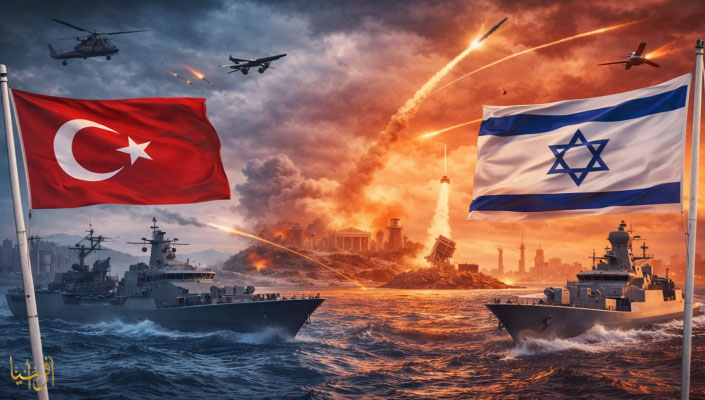
Afrasianet - The phrase "Today is Gaza, tomorrow Turkey", written on billboards on the streets of Istanbul over the past two years has not only expressed a state of sympathy, but also a faint reflection of the concerns of the public and the country's decision-makers, as many in Ankara believe that Israel's war of extermination in Gaza should not be rejected not only from a solidarity or moral standpoint, but also from a pragmatic point of view.
The war on Gaza has damaged Turkey's immediate interests, and has been read by many in Ankara as a "bloody prelude" to a large-scale U.S.-backed Israeli hegemonic project aimed at rearranging the balance of power in the Eastern Mediterranean and encircling Turkey. In the midst of it all, the U.S.-Israeli war on Iran has come as another step in the stampede that is reshaping the region, particularly the Eastern Mediterranean.
But what is happening in the region cannot be separated from the transformations that are striking the entire world order, most notably the intense rivalry between the United States and China. Since Xi Jinping came to power in Beijing in 2013, the CCP's elite has realized that the breach of the U.S. security cordon will not be done through a direct military confrontation in the Pacific, but through an initiative to bring Chinese influence out of the heart of China to Asia and the rest of the world.
This exit was engineered by Beijing through the initiative now known as the Belt and Road Initiative, inspired by the medieval Silk Road in which Chinese empires played a central role. This strategy aims to increase Chinese influence by investing in infrastructure projects, especially in the heart of Asia, to circumvent U.S. naval dominance in the Pacific and Indian Oceans.
In this context, Chinese expansion is no longer an economic issue, but has also become military in nature, and this has left its impact on U.S. strategy. In a 2023 U.S. Department of Defense report, it was clearly noted that "the People's Republic of China is the only competitor to the United States that has the intention and growing ability to reshape the international order," prompting the U.S. National Defense Strategy to explicitly classify Beijing as the "pace challenge" that presents itself to the Pentagon, in the sense that it is the challenge which forces the United States to modernize its military capabilities at a certain pace to keep pace with it, or else it will fall behind.
The report documents that the Chinese Communist Party "tasked the PLA with developing the ability to use force beyond China's borders and immediate surroundings to secure the PRC's growing foreign interests and advance its foreign policy goals." This systematic expansion, according to the report, "has led to an increase in China's willingness to use military force to advance its global development and security interests."
In its quest to contain Beijing without a military clash, Washington has developed what can be called an "integrated strangulation strategy" by controlling raw materials and energy flowing into China, and maintaining the dollar's position as a global currency.
There are four pillars of this strategy: the first is to monopolize technological superiority, through mechanisms such as the "chips legislation" of 2022, which aims to deprive Beijing of advanced chips, and the second is to break the dominance of critical and rare earth metal chains that China has a 90% monopoly The third is to protect the "petrodollar" system to ensure the continued undisputed superiority of the US currency, and finally to dominate strategic corridors, infrastructure, and control of energy transmission routes.
This fourth pillar was embodied in September 2023 at the G20 summit, with the launch of the India-Middle East-Europe Economic Corridor (IMEC). To make it work, India has integrated into the I2U2 alliance, which also includes the United States, the United Arab Emirates, and Israel, an alliance that reflects Washington's broader strategy to encircle China. The corridor starts in India, taking the Arabian Peninsula as a transit point on its way to Israel, before reaching Europe by sea.
The India-Middle East-Europe corridor is billed as a tool to reduce reliance on China-controlled trade routes through the Belt and Road Initiative, and is part of a broader international effort that includes the G7's plan to invest $600 billion in global infrastructure to counter Chinese influence. The corridor adopts a business model that focuses primarily on digital connectivity and finance, presenting itself as a more reliable alternative to the Belt and Road Initiative model, which has faced criticism of the "Chinese debt trap" and its high interest.
While China's Belt and Road Initiative covers more than 170 countries, requires massive investments of more than $8 trillion across the infrastructure, energy, and technology sectors, and connects to 70% of the world's population, the India-Middle East-Europe Corridor is limited to just over 20 countries along its route. This limited scope of the corridor is intended to foster a higher degree of regional cooperation and integration, making it an aspiring more sustainable option In the long term.
However, no corridor that relies primarily on land passage, whatever its scope, can displace the historical sovereignty of sea lanes, so the importance of straits such as Hormuz, Malacca, Bab al-Mandeb and others remains. For this reason, what the Yemeni Houthi group did near Bab al-Mandab during the Gaza war, and what Iran is doing in Hormuz, is more of a threat to global trade routes than the Belt and Road Initiative itself.
During the recent war, the hypothesis of "escaping Hormuz" was put forward by bypassing it through land routes to Red Sea ports, as well as through lines that run through Iraq to Turkey and from there to Europe. The problem is that the volume of oil heading from the region to Europe is small compared to the massive flows to East Asian markets, most notably China. Although China has emerged as one of the most prominent victims of the closure of the Strait of Hormuz, it has a long-term interest in weakening U.S. control of vital choke points.
Isolate Turkey and legalize
it by returning to the issue of corridors, which is the key word in U.S. plans to re-engineer global geography. It was striking that all of Turkey and Egypt were excluded from the "India-Middle East-Europe" corridor, and Ankara in particular viewed with suspicion this deliberate disregard for its position, in favor of turning Israel into the geopolitical fulcrum of American hegemony in the Eastern Mediterranean. More dangerously, politicians in Washington (with the support of the Zionist lobbies) are seeking to entrench this exclusion through congressional legislation, which makes it difficult to The task of changing this situation in the future.
The Security and Energy Partnership Act of 2019 (known as the Menendez-Rubio Act) ushered in this U.S. structural change by abandoning the historic bet on Turkey as the guardian of NATO's southern flank, and building a Israeli-based deterrent wall with two sides, Greece and Cyprus, which was explicitly translated into provisions of the law that lifted the arms embargo on Cyprus and imposed sanctions on Ankara to deny it the acquisition of F-35 aircraft.
This "exclusionary" path is completed today by the Eastern Mediterranean Gateway Bill of 2026, which was passed by the House Foreign Affairs Committee by near-bipartisan consensus, a law aimed at strengthening the energy partnership between Israel, Greece and Cyprus while trying to attract Egypt to this alliance. The US-dominated Eastern Mediterranean thus becomes a gateway to the " India-Middle East-Europe" corridor.
The legislation was a translation of recommendations from think tanks close to Tel Aviv, including the Jewish Institute for National Security's "Sea of Changes" report, which recommended abandoning Turkey in favor of the Israeli-Greek-Cypriot "democratic" alliance. While Senator Bob Menendez was leading efforts to impeach Turkey before resigning over corruption cases, the jurisprudence of Turkey's exclusion has become a mission for the State Department with his partner Marco Rubio taking over the portfolio in the current Trump administration.
Beyond Menendez and Rubio, this anti-Ankara orientation has many supporters in Congress. According to the Greek-American Council, the U.S. House of Representatives includes several members of Greek origin who work for the Athens (anti-Turkey) agenda, most notably Republican Rep. Gus Belirakis and Democratic Rep. Chris Pappas (whose name came to prominence by pressuring the Biden administration to block the supply of F-16 emergency jets to Turkey).
Democratic Rep. Dina Titus and Republican Rep. Nicole Maliotakis also appear on the list. Some of these lawmakers clash with their pro-Israel counterparts in formal congressional alliances, most notably the Greek-Israeli Alliance (CHIA), which was established in 2013 with the aim of supporting the trilateral relationship between Greece, Cyprus, and Israel, and encouraging U.S. support for these relationships.
It can be said that these anti-Ankara legislations aim at the same time to consolidate Israel's influence in its regional environment in the Eastern Mediterranean with American support, break its isolation by engaging in a strong alliance with Cyprus and Greece, and try to attract other actors to this alliance, especially Egypt.
To understand the motives of Turkey's moves, Ankara's transformation from the role of a "marginal buffer" to a "resolute buffer" must be dismantled. A peripheral buffer is a geopolitical entity located on the borders of multiple security intersections, and plays the role of a "negative buffer" that separates the flaming regions and absorbs their shocks, thus remaining outside the equation of organic alliances, content to receive regional influences without the ability to shape them or lead interactions within them (Turkey was a buffer between the Middle East and Europe earlier, Central Asia to the east and the Balkans to the west, and between the Russia to the north and the Mediterranean to the south).
Turkey is beginning to turn into what the literature describes as a "resolute buffer," a country with grand regional ambitions but structurally constrained by a geopolitical reality that excludes them. Here, Ankara views gas discoveries in the Mediterranean not only as an economic commodity, but as a tool in its strategy to establish itself as an energy hub.
To overcome the wall of anti-EU alliances, Ankara adopts the "Blue Homeland" doctrine, which aims to expand its influence in the waters around it, and has not hesitated to resort to the diplomacy of far-flung maritime movements to protect its continental shelf, as manifested in President Erdoğan's description of Western companies involved in gas exploration in the Eastern Mediterranean as "pirates of the sea."
On the other hand, these moves in some Western capitals and Tel Aviv are read with great hostility, as the "blue homeland" is seen as an "offensive expansionist doctrine." To counter Ankara, the alliance of Greece, Cyprus, and Israel is taking hold day by day, and in the midst of sharp polarization, Washington's strategy maintains a chaotic rivalry that drains everyone.
The biggest danger in this exclusionary project is that it does not stop at attempts to marginalize, but puts Turkey directly in the circle of targeting. According to Israeli Prime Minister Netanyahu, after the completion of the Shiite axis, his country is moving towards the "emerging Sunni axis," considering the newly formed understandings between Turkey, Egypt, Pakistan and Saudi Arabia as the next threat.
This strategic encirclement, which has turned the Mediterranean into something like a separation wall for Turkey, is pushing Ankara to have more cards and establish a larger presence on the Mediterranean by maximizing its influence in Syria and Lebanon. In addition to the strategic development road project dedicated to transporting goods and energy between Iraq and Turkey, Ankara signed a pivotal memorandum of understanding with Syria and Jordan last April to revive the Hejaz railway line.
This move aims to link the ports of Turkey and Syria to the Jordanian port of Aqaba and later to Saudi Arabia, to be the fast land-sea artery that connects Europe to the Gulf, and it is Turkey's most important strategic exit to bypass the geopolitical cordon that Israel is trying to impose on it with American support.
Difficulties on the Road to the "Blue Homeland"
In light of this turmoil in the regional order, the efforts to rapproche Ankara and Cairo seem to be a geopolitical necessity, which both sides are clearly aware of. But the shift from diplomatic normalization to open security coordination puts the two capitals in a minefield. While the 2019 U.S. law focused on drawing the rough security border to encircle Turkey, the 2026 draft law came to play a more dangerous game through the use of economics and corridors. The law provides for the designation of Egypt as a Middle Eastern Mediterranean country within the corridor, a move that is essentially aimed at deepening the gap between Egypt and Turkey and trying to entrench its dependence on the Israeli-Greek-Cypriot energy alliance.
With regard to Lebanon, Ankara recognizes that Beirut has become a parallel arena in the geopolitical scramble for the Eastern Mediterranean, becoming a testing ground for the implementation of Turkey's doctrine of a "blue homeland" that equates sovereignty over water and land. Faced with its previous exclusion from the Eastern Mediterranean Gas Forum, Turkey has sought to break its isolation and undermine the Israeli-Cypriot-Greek alliance by offering technical assistance to Beirut in the demarcation of its Exclusive Economic Zones (EEZ).
This frantic rivalry was evident when Ankara offered to use the port of Mersin as an alternative to the port of Beirut after the explosion. To establish a foothold, Ankara moved through the TIKA agency, targeting northern Lebanon, and later expanded into Beirut by providing health, educational, and cultural services. Despite this relative popular success, Turkey suffered from limited influence in Lebanese state decisions compared to Iranian or Western influence.
The most prominent expression of Lebanon's importance to Turkey came when Konor Alp Kocak, a member of parliament from the Turkish Nationalist Movement Party (MHP), warned of "malign operations" aimed at encircling the Turkish state, commenting on the presidential decree on the extension of the mandate of members of the Turkish armed forces operating in the United Nations Interim Force in Lebanon (UNIFIL) in October 2025.
"Given the current risks and threats, it is clear that our national defense and security must start outside our borders, so the security of Beirut, the Golan Heights, Damascus, Kirkuk and Baghdad should not be viewed in isolation from the security of Hatay, Urfa, Konya and Izmir," Kocak said at the time".
It is clear that Turkey's presence in the peacekeeping mission must be taken into account in the context of the geopolitical balance in the Eastern Mediterranean and the Cyprus issue. Lebanon is at the heart of the Eastern Mediterranean energy basin and maritime sovereignty disputes, and Israel, the Greek Cypriot administration, Greece and some Western countries are seeking to create a geopolitical zone that excludes Turkey."
Ankara understands that this escalation is part of a regional restructuring, and if Israel succeeds in forcibly integrating Beirut into the Mediterranean security arrangements (through current efforts to normalize relations or any other framework), the Israeli logistical blockade will be fully applied to the southern coast of Anatolia. The "defense of the Lebanese-Syrian arena" is therefore an existential battle for Turkey to prevent the Eastern Mediterranean from becoming a security lake controlled by Tel Aviv.
To ensure the greatest geopolitical gains, Ankara is pursuing a policy of separating the tactical from the strategic, leaving the flaming south in confrontation with Israel, while focusing on investing in the demographic and institutional incubator of Sunnis in Beirut and Tripoli. In light of this stampede, the Turkish president's February 2026 visits to both Egypt and Saudi Arabia were an attempt to breach the diplomatic wall.
Ankara understands that dismantling the Israeli logistical hegemony project requires attracting the two largest Arab heavyweights, Cairo and Riyadh, and aligning them with their vision. Turkey's maneuver is to convince the Arab allies that escaping the "Iranian threat" in Hormuz does not require a response to American plans, and that there are alternative corridors and plans that guarantee the independence and interests of all.
