
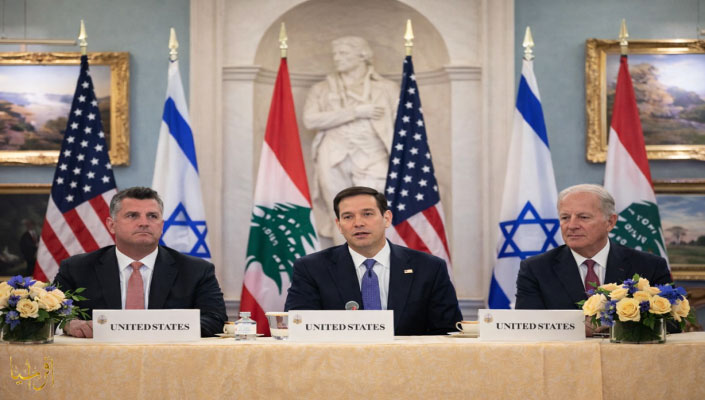
Israel is heavily armed with military power with American support, and Lebanon's delegation has no real papers, in contrast to the intransigent Hezbollah on the ground
Afrasianet - Mohamed Fawaz - On September 19, 1948, Lebanon's first post-independence prime minister, Riad El Solh, arrived in Paris at the head of his country's delegation to the third session of the United Nations General Assembly. Secretly, representatives of the newly established Israel infiltrated him to lure him into secret side negotiations.
At the time, Israel was not a well-established state in the region, and it turned its attention to consolidating the military achievements of the 1948 war (the Palestinian Nakba) politically.
The file of negotiations with the peace was linked to Israel's occupation of Lebanese territory, and to personal offers for reconciliation itself, on top of which was to turn it into an Arab peacemaker, and to support it with the necessary capabilities to enhance its political and media status, and to promote it in the American press, and to try to entice it with generous financial offers under the title of preparing public opinion to accept an Arab-Jewish agreement, as he was the highest-ranking Arab official to participate in the work of the association at the time United Nations General in Paris.
Despite this welcome and cheering for the reconciliation negotiations, David Ben-Gurion, the Israeli Prime Minister at the time, was preparing to assassinate al-Solh in parallel with the negotiation process, and to work to stabilize the occupation of the southern Lebanese villages in preparation for the possibility of annexing them, while exploiting the Lebanese divisions to weaken or pressure the reconciliation government, especially since Jewish groups had opened previous lines of communication with other Lebanese parties.
For its part, al-Solh stuck to the question of the basis and nature of peace, and rejected the policy of imposing reality by force, insisting on Israel's withdrawal from the occupied Lebanese villages. With the peace being prevented, Israel did the Ben-Gurion option, and indeed tried to assassinate the reconciliation, but it failed, as did the secret negotiations in Paris, and then the truce was signed through the UN track, based on Security Council Resolution 62, after Israeli attempts that continued until the last moment to remain in strategic points inside Lebanese territory until a truce is concluded with Syria.
After 77 years, on May 14, 2026, former Lebanese ambassador Simon Karam attended a meeting with an Israeli delegation, led by Yossi Draznin, Israel's deputy national security adviser, and with the participation of the Israeli ambassador to Washington Yehiel Leiter, in the first phase of direct negotiations between Lebanon and Israel in Washington that lasted for two days, after previous preliminary meetings between Lebanon's ambassador to Washington Nada Hamada Moawad and Yehiel Leiter.
The choice of Simon Karam was not in vain, as he is the most capable of representing the president of the republic in the negotiations, both of whom are Christians from the south, and are opposed to any weapon outside the framework of the state, and Karam was active at the beginning of the millennium in the meeting of the famous "Qurnat Shahwan" opposing the Syrian tutelage over Lebanon, in addition to his previous knowledge of the United States, as he served as Lebanon's ambassador there.
Karam represents Lebanon's official view of its person and history, as well as the messages it carried with it after meeting with President Joseph Aoun in Baabda before embarking on the negotiations.
The Lebanese state, represented by the presidency and the government, views the negotiations from two main angles: the first is its attempt to establish its sovereignty over the Lebanese decision, and its refusal to be negotiated by anyone inside or outside Lebanon, and the second is its quest to regain the occupied Lebanese territories, establish a ceasefire, stop Israeli aggressions, return prisoners, return the displaced, and open the door to the return of the displaced Reconstruction through diplomacy.
The state believes that the "option of resistance" is currently no longer able to achieve these demands, and believes that it is Hezbollah that brought the Israeli occupation to what it is today inside Lebanese territory. Prime Minister Nawaf Salam stated after the first round of negotiations, "Any real rescue of Lebanon today is impossible without a clear return to the logic of the state being the master of its own decisions."
Salam added that "the state makes only one national decision, which is the decision of its constitutional institutions, one weapon is the weapon of its national army, and one law." He also pointed out that "futile adventures in the service of foreign projects and interests, the latest of which is a war that we did not choose, but was imposed on us, led to Israel's occupation of 68 towns, villages and sites, after we were seeking to get them out of five points," he said.
Official Lebanon is also afraid of any agreement that comes through Hezbollah or Iran, as it will re-establish their internal position in the country, so Beirut hastened to take its own path, especially with the continuation of Israel's daily expansion in Lebanon by land and air under the cover of a "ceasefire", which makes the pressure on the country increasing from all sides.
The Lebanese state, in the words of its Foreign Minister Youssef Raji, stressed that "there is no shame in negotiating with Israel if the goal is to end the war and regain the land."
In depth, we cannot also overlook the Israeli policy of sticking towards the state itself, if Beirut does not make concessions, Israel is threatening to target Lebanese civilian facilities or expand the targeting of the capital, which has been hanging over the country's neck for more than two years.
Aircraft and tank negotiations
The Israelis were not interested in opening a new negotiating track during the 2026 war. Their strategy, which they adopted after the signing of the previous ceasefire agreement on November 27, 2024, is to complete the war against Hezbollah, and to position itself in Lebanese ruling points near the border strip as a basic security and negotiating card.
This includes the possibility of "lifting the pressure" on Lebanon whenever there is a need to obtain an additional concession, at a time when Hezbollah has refrained from responding, despite being targeted on an almost daily basis for 15 months.
Immediately after Hezbollah fired its six missiles on March 2, 2026 (following the US-Israeli strikes on Iran), Israel escalated militarily on the one hand, and the Lebanese state on the other, considering that Hezbollah had entered the regional war in revenge for the blood of its allies in Iran, as stated in the statement of the first operation, and therefore the government accused the party of involving Lebanon in a war without consulting the country's political leadership.
Accordingly, the government took the initiative to immediately ban Hezbollah's military and security activities, and oblige it to hand over its weapons to the state. In the same context, President Joseph Aoun later announced Lebanon's readiness to start direct negotiations with Israel under international auspices, with the aim of a ceasefire and an end to Israeli aggression, something that has long been (publicly) rejected for the past decades.
Israel rejected offers of direct negotiations, and in the meantime the "mechanism" was in the wind, the committee that monitors the implementation of the previous ceasefire agreement, which includes Lebanon, Israel, France, UNIFIL, and the United States, headed by the latter, after it was unable to play its assigned role after the 2024 agreement. In practice, Israel closed all the doors of negotiation and focused on military operations, which Washington gave political cover.
However, when Pakistani Prime Minister Shehbaz Sharif announced Lebanon's inclusion in the ceasefire agreement resulting from the Islamabad negotiations between Iran and the United States on April 8, 2026, Israel revolted, launching a massive attack on various areas of Lebanon, foremost of which Beirut, resulted in more than 250 martyrs and 1,100 wounded, according to the Lebanese Civil Defense, most of them civilians.
Israel and the United States have met politically to deny Lebanon's inclusion in the ceasefire agreement with Iran, in the words of US President Donald Trump and his vice president, J.D. Vance. At the same time, Israeli Prime Minister Benjamin Netanyahu expressed his readiness to engage in direct negotiations with Lebanon, keeping in mind the separation of Lebanon from Iran and its negotiating track.
This is why we can understand Israel's motivations for entering the negotiations. It enters them as a non-essential track, but it has taken it to achieve the same goal as the previous one: the elimination of Hezbollah. Therefore, there was a near-Israeli consensus to negotiate with Lebanon without giving it much importance, or reducing the level of declared goals during the war as an additional path to achieving the military goal.
Trump's Jumps
As usual, Trump came out with statements that represented a "negotiated escalation," announcing on his platform "Truth Social" that he would invite Netanyahu and Aoun to the White House in order to hold the first meaningful talks between Israel and Lebanon since 1983, as he put it, after announcing that the two sides had agreed to a 10-day ceasefire.
Trump also said he had directed Vice President Vance, his Secretary of State Marco Rubio and Chief of Staff Dan Kaine to work with both sides to achieve a "lasting peace," adding that both sides want peace and that he believes it will happen quickly.
Trump's statement opened the Lebanese internal conflict widely. At the same time, the US ambassador in Beirut, Michel Issa, began to move and visited Bkerki, where he met with Patriarch Bechara al-Rahi, and then moved to Ain el-Tineh, where he met with the Speaker of the House of Representatives, Nabih Berri, stressing that "Netanyahu is not a boogeyman but a negotiator," and that Aoun's visit to Washington is neither a loss nor a concession, but an opportunity for the Lebanese president to put his demands before Trump and Netanyahu, with Trump being a witness to this.
Trump wants to create a historic "peace image" similar to that of Yasser Arafat, Bill Clinton, and Yitzhak Rabin in the White House in 1993, and to compensate for his failure in Tehran with a Lebanese-Israeli image that is recorded in his political legacy.
Not only that, but Lebanese media reported that a personal threat message reached President Aoun from the Israeli side if he did not meet Netanyahu, in a course that has not changed in Israeli behavior since 1948: Negotiation and a gun are not in different hands, but in one hand.
What Hezbollah wants
For its part, Hezbollah has escalated its stance on direct negotiations, especially after the US push for a meeting between Aoun and Netanyahu, and brought a number of its hawks back to the media front, from the head of resources and borders Nawaf al-Moussawi, to the deputy head of the political council, Mahmoud Qamati, to the former head of the Liaison and Coordination Unit, Wafiq Safa.
They stressed the rejection of direct negotiations with Israel, warning against making free concessions under fire, stressing that any negotiation track is not preceded by a complete ceasefire and withdrawal Israelis and the return of prisoners and displaced persons will only serve as a political cover for broader Israeli demands.
The speakers went further, reminding the Lebanese authorities of the fate of both the Vichy government (the French government that aligned with the Nazis) and Egyptian President Anwar Sadat (according to popular accounts that he was assassinated because of the peace agreement with Israel), in an escalation of internal tensions to the extreme.
In this sense, Hezbollah does not reject the principle of negotiation at all, but rather rejects direct negotiation and non-reciprocal concessions, especially if they take place in the wake of continued military operations and U.S.-Israeli pressure.
At the moment, the party's eyes are on the path of Islamabad, while its mind remains confined to the field. It has returned to the logic of the 1980s politically, as it is no longer the post-2006 party, with its extended regional dimension and the balances of deterrence it imposed, but has returned to the framework of a local resistance that moves within regional calculations and places the preservation of its existence as a top priority, including the idea of resistance, its weapons, and the relationship with Iran.
The party is based on its conviction that diplomacy alone does not produce gains, citing the period between the 2024 and 2026 wars, when the political tracks were unable to stop the Lebanese bleeding or regain the land and prisoners.
Therefore, the party has developed its military tools, and in the last stage, the fiber-optic first perspective drones emerged as one of the most prominent new tools of attrition.
These drones have turned into an Israeli concern due to the difficulty of jamming them, their low cost compared to the cost of countering them, and their ability to target soldiers and vehicles with greater accuracy than Conventional weapons previously used by the party.
"Hizbullah believes that at this stage, it has no choice but to fight and hold out, pending a regional arrangement that reformulates the rules of confrontation."
According to Western reports, since the ceasefire in April, Hezbollah has launched more than 100 such drones, supported by videos that raise morale and confirm casualties.
Hence, Hezbollah believes that at this stage, it has only the option of fighting, holding out and attributing, waiting for one of two tracks: either a major regional arrangement that reformulates the rules of confrontation, or a long path of liberation that resembles in its political imagination the path that led to the May 2000 moment (the Israeli withdrawal from the south Lebanese).
The party prefers the first track, because it does not guarantee the future, and because it is suffering from severe attrition due to successive Israeli strikes, the interruption of a key part of Iran's supply lines after the fall of the Assad regime in Syria, and its fear that the Lebanese state will give in to Israeli demands, and the internal and external pressure will accumulate on it.
However, Hezbollah's relationship with the Lebanese state has not yet reached the stage of no return. The government's decisions regarding the restriction of weapons in the hands of the state and the criminalization of illegal weapons have not yet turned into an organized and systematic executive path against the party, nor has the party taken the decision to overthrow the government or the presidency in the streets in a scene similar to the famous events of May 7, because the political and military balance of power is no longer the same as it was in 2008.
Arab Attempt to Make Up
The acceleration of events imposed by Trump, in addition to Hezbollah's threats, prompted Arab countries to intervene. In this context, the movement of the Saudi envoy, Yazid bin Farhan, who proposed an approach based on not rejecting the principle of Lebanese negotiations with Israel, whether direct or indirect, but on the condition that it is carried out quietly and in steady steps, and does not turn into a free political impulse or a solitary peace outside the Arab ceiling. This is without the Kingdom abandoning the foundations of its vision based on arms control In the hands of the Lebanese state and its institutions.
Saudi Arabia, which supports arms controls, does not want Lebanon to separate from its Arab surroundings, or to go, even nominally, to the Israeli guillotine, making uncalculated concessions outside the Arab ceiling that was raised at the Beirut summit in 2002 and confirmed at the Riyadh summits in 2023 and 2024. It also does not want any escape inside Lebanon that could benefit Israel as well as Hezbollah, which would reflect on Lebanon and the region as a whole.
The Kingdom's initiative curbed the Lebanese rush towards negotiations with Israel, or at least readjusted the form and objectives of this negotiation.
It also prompted a number of Lebanese parties to further harden their positions, foremost among them the speaker of the House of Representatives and Hezbollah's ally, Nabih Berri, who reiterated his rejection of normalization and even direct negotiations.
Druze leader Walid Jumblatt, who adhered to the 1949 armistice agreement, went in the same direction, i.e., rejecting normalization and limiting the path to amended security agreements without refusing to negotiate.
The Arab entry into the negotiation line exposed mistakes in the official Lebanese approach, which placed matters between two options: either surrender to Hezbollah or hasty negotiations with Israel. It appeared that the diplomatic track desired by the state was not properly fortified by a series of Arab and regional positions that support the Lebanese position in the negotiations.
The public exchange between Berri and Aoun also weakened the official and popular Lebanese diplomatic position, which is divided officially and popularly, without any real initiatives to remedy it.
The state also entered the negotiations without having the command of the weapons fighting in the south, and its inability to deal with them, which makes it lacking a basic answer in the negotiations, which is Lebanon's vision of how to withdraw Hezbollah's weapons.
In addition, criticism has emerged of the state for not having a file of Israeli crimes in Lebanon to present in international forums and at the negotiating table, in order to put pressure on Israel in the way that the state can and believes in at the very least.
It is this Arab gesture that prompted the Lebanese government to pay a high-level visit to Syria, on the basis that Israel deals with the two countries with a unified plan, and that they must, in return, unite and coordinate positions within the Arab framework, in order to avoid a repeat of what happened with Kissinger, who succeeded in fragmenting Arab positions and then extracting what he could not extract from them when they were combined.
New Round of Negotiations
It is on this ground that the current negotiations are taking place: many military and field cards in the hands of the Israelis with American support, a Lebanese delegation that lacks popular cohesion or control of the battlefield or any of the cards of power, with an Israeli sword on its neck, in contrast to the intransigence of Hezbollah and the raising of the level of its operations in the south, in an affirmation of its own path that relies on weapons only.
The previous round of negotiations lasted two days, and resulted in positive statements, a 45-day extension of the ceasefire, and a confirmation of the two parties' goals. As for Lebanon, it was theoretically able to establish its sovereignty over its territory, which the US State Department acknowledged in its statement.
However, the negotiating dispute is still fundamental, as Lebanon has set its sights on a serious ceasefire, and Israel has its eye on the withdrawal of Hezbollah's weapons, and it has been able to force a redefinition of the idea of a ceasefire, i.e., the cessation of what it calls "offensive actions", and the maintenance of an "advanced defense" pattern, i.e., the freedom to strike any targets it believes are hostile, while refraining from targeting Beirut without US permission or carrying out large-scale ground operations (Israel violated this rule by targeting the vicinity of the Lebanese capital. on May 28).
In practice, the previous round of negotiations announced the launch of a new US-facilitated security track, which will begin at the Pentagon today, May 29, in parallel with a political track at the US State Department in early June. In this sense, it seems that the new track practically replaces the "mechanism" and brings out France and UNIFIL, so that the discussion moves from monitoring the ceasefire to discussing the arrangements in the south, the role of the Lebanese army, and the mechanism for dealing with Hezbollah's weapons.
If Lebanon presents a practical and convincing vision of withdrawing arms and limiting the security decision to the hands of the state, and Israel sees its practical implementations, it may open the door to a gradual Israeli withdrawal from the south.
If the state fails to do so, or makes do with general political pledges (which is most likely), the scene will be protracted and perhaps complicated, as the state refuses to be dragged into a bloody internal conflict to withdraw the party's weapons as Israel wants, but on the other hand, it seems incapable of proposing a third compromise.
Since the pre-Nakba period, Israel's nature has been imposing itself on Lebanon, extending its hand to negotiate at the same time that its mentality and military actions continue, without retreating from its ultimate goals except in one of two cases: that the reality on the ground forces it to retreat, or that the United States reins it. At the moment, neither of these two factors is available.
It is therefore clear that the turmoil in the Lebanese scene will be prolonged, albeit at a pace that varies according to the circumstances. The Lebanese state seems unable to find solutions to its impasse between Israeli pressure and Hezbollah's intransigence, making future developments in Lebanon more dependent on a broader regional settlement than on the unilateral actions of the Lebanese themselves.
