
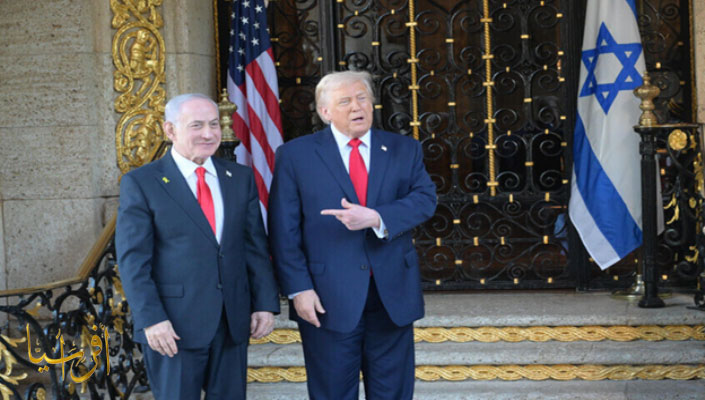
Afrasianet - Since the start of the U.S. attack on Iran, U.S. President Donald Trump has appeared to be walking without a clear plan, and he himself has posted a series of contradictory statements on social media.
At one point, Trump calls for a popular uprising inside Iran, another calls for an unconditional surrender, and then talks about his role in choosing Iran's next leadership, while at the same time hinting that Tehran is being crushed and that the list of military targets could expand.
British journalist David Hurst says in an article published by the Middle East Eye, in which he adds that the most controversial statement came when he described the assassination of Iran's Supreme Leader Ali Khamenei as "the great opportunity for the Iranian people to take back their country."
"But the reality went in the exact opposite direction: Instead of an internal uprising, thousands of Iranians took to the streets to mourn Khamenei as bombs were falling. The assassination of a former head of state was a rare step in modern history, a move that may have achieved the opposite of what Trump and Benjamin Netanyahu, who are seen as the masterminds of the operation, had aspired.
Hurst believes that this move may have revived the Islamic Republic and given the Iranian Revolution a new breath.
• Iran and its red lines
"For decades, the Islamic Republic has shown a great ability to contain internal threats when it feels threatened, but Khamenei, despite his ideological rigidity, has also been a pragmatic politician who accurately calculates his steps," Hurst recalls.
"During his years in power, Iran refrained from responding directly to a series of assassinations of military commanders and nuclear scientists, and even when it did, its response was carefully calculated to contain the crisis, not ignite it."
At that point, Tehran adhered to two clear red lines: not to attack the Gulf states directly, and not to close the Strait of Hormuz.
Even the assassination of Quds Force commander Qassem Soleimani in a U.S. strike in Baghdad did not prompt Iran to attack its Gulf neighbors, nor did it happen after the assassination of Ismail Haniyeh in its hospitality, or after a number of senior military commanders were killed in confrontations with Israel in last year's 12-day war.
Iran has also not responded to the helicopter crash that killed former President Ebrahim Raisi in Azerbaijan, which takes a different turn now that Israel's stated policy has become to kill former and current leaders.
Khamenei represented the pivotal second phase of the Islamic Republic, whose response was studied, and Khamenei was unwavering and his often quoted to U.S. officials: "A person like me does not pledge allegiance to the likes of you."
"This is Iran-Khamenei, a country that calculates risks before pulling the trigger," he said, adding that in response to Soleimani's assassination, Iran targeted two US bases in Iraq with missiles, but informed the Iraqi government of the bases it intended to attack.
Iran has twice tried to negotiate with Trump over its uranium enrichment program.
Under Khomeini, Iran was more revolutionary and volatile, with a 444-day U.S. hostage crisis and an eight-year long war with Iraq.
But that same war transformed the IRGC from an emerging revolutionary force into a massive military institution, which later became the backbone of Iran's regional power.
With Khamenei's death, that old revolutionary spirit seems to have returned to the forefront.
• Rapid and dangerous transformations
In just a few days, the regional landscape changed drastically and Iran closed the Strait of Hormuz, halting much of the global oil flow.
With oil and gas production disrupted in the Gulf, a global energy crisis emerged that may have had a greater impact than the oil crisis of 1973.
The interruption of nearly 20 million barrels per day of oil has also shocked global energy markets.
In addition, the U.S. defense infrastructure in the region has been hit hard, including extensive damage to an early warning system in Qatar worth more than $1 billion.
The United States has been forced to replace damaged defense systems by moving parts of Patriot batteries deployed elsewhere in the world.
The skies of the Gulf, a symbol of global economic movement, were filled with drones, with cities such as Dubai, Riyadh, Doha, Manama and Kuwait subjected to a series of attacks that led to an almost complete paralysis of air traffic.
What began as a limited confrontation quickly turned into a multilateral conflict, dragging at least 14 countries in the region into war.
• The Rise of Mojtaba Khamenei
At home, a new name quickly emerged as Mojtaba Khamenei, the late Supreme Leader's son, as his choice is a direct message to Washington and Tel Aviv that external pressures will not break the regime.
Unlike many of the world's leaders' sons, Mojtaba spent many years within the security institutions and the Revolutionary Guards, and built a deep network of relationships within the state's security apparatus.
Until now, his influence has been exerted behind the scenes, but the war has pushed him to the forefront.
• War unites opponents
The author also mentions that "the irony is that the US-Israeli attack has had an effect that was not in the calculations of its owners, which is to unite large segments of Iranians behind the regime, and even some of the most prominent opponents of the Islamic Republic have adopted a nationalist discourse in the face of the war.
Among them is the well-known Iranian intellectual Abdolkarim Soroush, who lived in exile for many years and was highly critical of the regime."
"Today, Soroush says that Iran's military forces are fighting with faith and courage," Hurst continues, calling on the people to support them in the face of external aggression.
In times of major wars, internal divisions often recede in the face of a national sense of existential danger, according to the same source.
• The bubble burst
A few days after the outbreak of the confrontation, the war has turned from a regional conflict into a potential global crisis, with Iran threatening to cut off shipping routes in the Bab al-Mandab Strait through its Houthi allies, potentially putting global trade at unprecedented risk.
Western powers are trying to catch up, with France sending frigates to the region and Britain preparing to deploy an aircraft carrier, but these moves appear to be more of a backlash than a deliberate strategy.
This has burst the bubble of security and wealth that has surrounded the Gulf states and exposed their vulnerability to all-out war, which often in the past has not affected them or changed their lifestyle.
• Trump and Netanyahu. Frustration and depression
Little by little, the pressure of the turmoil in oil and financial markets will increase, prompting Trump to halt the worst intervention the United States has made in a long history of failed wars.
Pressure is already mounting to set a deadline, with Israeli journalist Ronen Bergen quoting one of his security sources as saying, "We are in a state of chaos."
"There are usually goals in wars, and a deadline is set either based on their achievement or on the basis of the conditions set in negotiations with the enemy for a ceasefire. Here, no clear targets have been set and we don't know for sure."
The defense source asserts that his American colleagues who only carry out orders do not know either.
The market turmoil does not bode well for Trump, as he is not a president who ignores what Wall Street tells him, especially since only 20% of American adults support him, and he faces a midterm election in November.
To continue this war to the end, the United States will have to occupy one or perhaps two major straits to protect international shipping channels, and this will only be possible with the presence of ground forces and none of this can be accomplished quickly.
If Trump backs down, he will destroy his legacy, halt Netanyahu's messianic vision of an Israeli-dominated region, and no future U.S. president will be dragged down the same misguided path by the same coalition.
To win, Trump needs Iran to collapse quickly, but it shows no sign and its survival strategy seems to be paying off.
But in the meantime, this war could escalate to include the destruction of states, oil fields, the plundering of the Gulf's wealth, and the killing of thousands of innocent civilians.
This is the price the region is paying for one man's arrogance, another's Christian vision, and the impotence of a Europe that stands idly by.
"Trump and Netanyahu, who are frustrated and depressed, are now the two most dangerous men on the planet."
Source: Middle East Eye
