
Afrasianet - War seems to be proceeding according to the "escalation trap" put forward by historian Robert Pipe; the stronger power wins the first confrontation, but the real conflict moves elsewhere. What is it?
The British newspaper The Guardian talks about the course of the US-Israeli war on Iran, and points out that it follows the "escalation trap" put forward by the historian Robert Pipe.
The answer is in the following article.
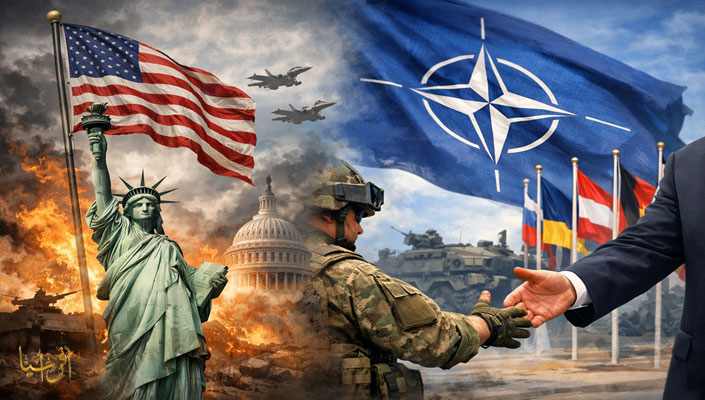
Donald Trump wants everyone to know that he is winning landslide victories in the war with Iran, so much so that he needs NATO's help, and he warns that the future of the Western alliance will be "very bad" if its members refuse to do so. The German defense minister's response was succinct: This is not our war.
Meanwhile, oil tankers are piling up outside the Strait of Hormuz, while Britain promises, indirectly, to continue to "study" its options. Trump has realized that starting a war without a coalition of willing nations is easier said than done.
Along with Benjamin Netanyahu, the US president launched an illegal attack on Iran that resulted in the assassination of the country's Supreme Leader. By targeting military sites while avoiding key oil facilities on Kharg Island, Trump is sending a clear message: The United States can destroy Iran's economy, but it has not yet made a decision.
He hints that things will only get worse unless Tehran negotiates. Bad things have already happened. Among them are the sinking of an Iranian frigate in international waters and the bombing of a school that reportedly killed 168 people, most of them young girls. No wonder, then, that allies are reluctant to fight what Defense Secretary Pete Hegseth proudly calls a "politically unacceptable war."
Iran knows that it cannot defeat the United States in a conventional war. So its strategy is to make the war unsustainable, and it expands its scope, by attacking U.S. military bases in the Gulf, blocking oil tanker traffic in the Strait of Hormuz, and causing turmoil in energy markets. These repercussions turn the military conflict into a political conflict. The strategy is to prolong the war until U.S. alliances collapse.
Trump argues that countries that rely on Gulf oil should help secure the strait, but many are cautious, and they have every right to do so. Escort warships will come under fire from Iranian drones, missiles, and speedboats, as well as have to cross minefields, and the navies involved will find themselves in an illegal war.
The United States could try to secure navigation through the strait on its own, but doing so without its traditional allies would expose Washington's isolation. Europeans will also have to balance domestic reactions, a dilemma shared by Gulf states that find themselves caught between their alliances with the United States and public opinion.
The situation is further complicated by Israel's "invasion" of Lebanon in its attempt to eliminate Iran's ally Hezbollah. Once wars spread across multiple fronts, either side loses control of the escalation. If Tehran's Yemeni allies join the fight, the conflict will stretch from Lebanon to the Gulf and all the way to the Red Sea. Each new front intensifies tensions and risks.
This situation is not strange. The war seems to be proceeding according to the "escalation trap" put forward by the historian Robert Pipe: the stronger power wins in the first confrontation, but the real conflict moves elsewhere, to oil markets, shipping lanes, alliances, and domestic politics.
The United States could inflict far more casualties on Iran, but that threatens to exacerbate the political and economic fallout that Tehran is seeking to cause.
Trump's call for allies to reopen the Strait of Hormuz does not indicate military weakness, but rather shows that the war has moved to a battlefield where military power is less important.
