
Afrasianet - Sayed Ahmed Al Khidr - When he announced that he was stopping teaching international law courses because they were no longer important, Lebanese academic Kamal Habib saw the world order as the appropriate response to governments watching Israel wreak havoc and destroy crops in Gaza and throughout the Middle East.
This happened in 2023, when the United States was under the leadership of Democrat Joe Biden, a veteran politician who initially favors the tools of soft power and continues to affirm his faith in the world order and international institutions to which humanity has relied after it has been devoted to two world wars: 1914-1918 and 1939-1945.
But the obituary of the world order became more relevant after Donald Trump returned to the White House, where the Pentagon gave the name "War Department" instead of "Defense," and then unabashedly declared his desire to change the regimes of certain countries and take over others.
On June 22, the U.S. president sent B-2 bombers into Iran's skies , raining down bombs that had not been used in recent decades, and asserting that he had set back its nuclear program for more than 70 years.
Trump then told the world that the force no longer cared about long-established norms and morals, so he sent soldiers to the head of an independent country and took him at night from his palace to a ship at sea and then to a plane that took him to New York, and he was shown to the cameras, like a petty criminal caught by police while stealing a gas cylinder from a house in a poor neighborhood.
In practice, the 1969 Vienna Convention was dropped , and the 1973 International Convention to Prevent and Punish Internationally Protected Persons was torn apart.
Before the world woke up from the shock of watching the Venezuelan president handcuffed in New York, Trump reiterated that he would not back down from his intention to control the island of Greenland, and then took to the podium of Davos and the wider Europe of us, hurting, mocking and threatening.
At this point, fears of the collapse of the world order were no longer an academic luxury, and the leaders of important countries engaged in lamentations for the international system and declared that it was inevitable to face arrogance to enter an era in which power had the final say in the seizure of wealth and the change of borders.
The following are some of the statements of prominent leaders about the collapse of the world order:
Crying over the era of rules
Canada is one of the world's seven most powerful economies, a member of the North Atlantic Treaty Organization (NATO), and has been at the forefront of Western civilization for decades.
But it has long been the station of Trump's ambitions and he is not ashamed to threaten its annexation of the United States, and is occasionally "blackmailed" in the files of oil, trade and borders, which led its Prime Minister Mark Carney to say, firstly, that the world "has entered a new era fraught with dangers in which great powers compete and in which the middle countries need to join forces in order to survive."
With undisguised heartbreak, the liberal man said, "The middle countries have to move together, because if they're not sitting at the table, they're on the menu."
From Davos, Carney asserted that "the past year has shown that the world is moving towards a system based on economic coercion, where the great powers pursue their own interests above all considerations."
Carney was no exception: the Davos Forum in Switzerland became an occasion for the funeral of the international order and the cry of an era when people had a limited recourse to the charters of the United Nations.
As such, Belgian Prime Minister Bart de Weaver warned that the United States was no longer acting like an ally.
Prominent leaders and figures have used the Davos forum to raise their voices against American hegemony and to call for a new political dictionary whose vocabulary: subjugation, coercion, and seizure.
The era of risks. Germany reminds itself of itself
These transformations naturally reverberate in Germany, which was the center of military arrogance in two eras: tsarism in World War I, and Hitler in World War II.
German Chancellor Friedrich Merz warns of the impact of major shifts in U.S. policies on the global order that has prevailed over the past decades.
Speaking at the Davos forum, the 70-year-old judge was fed up with Washington's contempt for international law, saying that "the world order, which may not have been perfect, is being shaken by a new order based on force."
But he added, in a confident tone, that Europe "is not at the mercy of this new world order, and it has the choice to shape the future."
He did not stop there, but called on the countries of the continent to be realistic in light of the new conditions, and to quickly inject new investments in the military industries to defend themselves.
The German chancellor said the world would be a very dangerous place if it was based on strength alone, because it would only benefit the stronger.
When Germany talks about power, the world should take it seriously, as it has the strongest economy in Europe at $4.66 trillion and has a history of blockading and subjugating states and armies.
A dangerous precedent. Guterres warns them
As for the old Portuguese man who leads the United Nations, his wrinkles do not hide his sadness at the imminent collapse of international institutions, conventions and laws, which means the outbreak of new conflicts and the collapse of the existing borders in the face of the power of ambitions.
António Guterres , who was prevented by a cold from taking the Davos podium, telegraphed to the forum a message in which he said that leaders' disregard for international law is undermining the world order.
In a post published on the X platform, he said that the UN Charter is the foundation of international relations and the cornerstone of peace, sustainable development and human rights.
"When leaders ignore international law and choose for themselves the rules they will abide by, they undermine the world order and set a dangerous precedent," Guterres wrote, warning of "a reality characterized by inequality and corruption of institutions and shared values that unite us."Trump.
French "no".. a refusal to madness
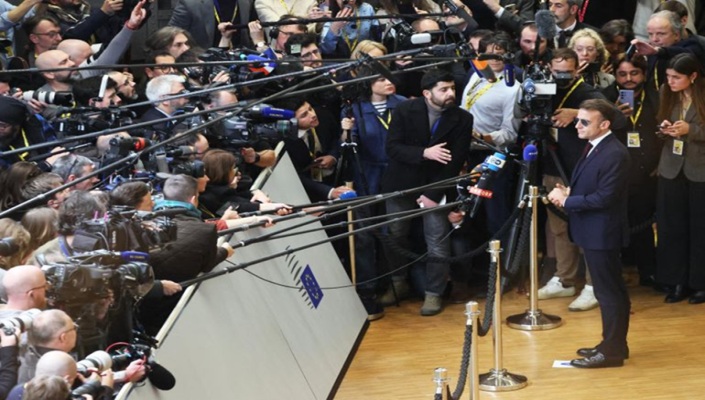
For some time, French President Emmanuel Macron has been keen to appease his American counterpart, but he is one of the few who raise the voice of disapproval in his face in some sensitive files globally.
Macron has refused to join the Trump Peace Council in Gaza, calling his quest to annex Greenland unacceptable crazy.
From Davos, Macron joined leaders who warned against entering the world into an era of great tyranny, stressing that France and Europe would not "accept the law of the strongest."
Macron, who recently signed a decree to build an aircraft carrier "the size of France's glories," said Europe "will not give in to the bullies or give in to intimidation."
France's voice should also be taken seriously, as it is one of the nuclear states and among the most powerful economies in the world, with a history of greatness and military deployment in the east and west of the world.
