
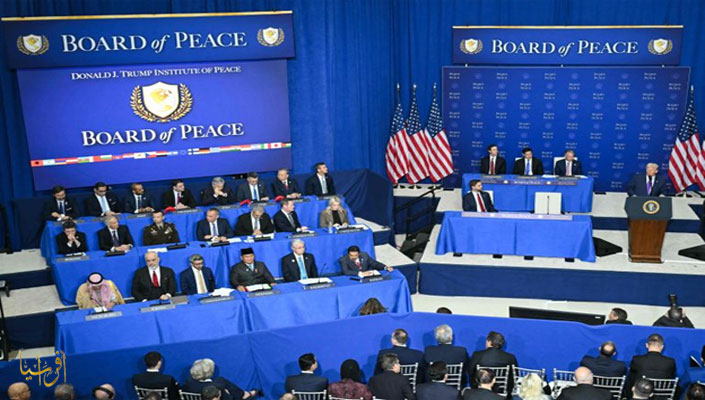
Afrasianet - Prof. Dr. Mohsen Mohamed Saleh - Will the Trump Peace Council succeed in achieving its goals of reconstructing the Gaza Strip, disarming the resistance, and ensuring Israel's withdrawal from the remaining Gaza Strip, according to the perceptions of the Trump plan, during the two years given to it to complete its work in Gaza, or will it lose its impulse, erode its content, and become preoccupied with managing the conflict rather than resolving it, and providing the justifications for the survival of the occupation rather than effective arrangements for its withdrawal?
Thus, it will eventually turn into a "lame duck" that lacks the justifications for its existence. Waiting for the situation to explode again?!
Political Momentum and the Logic of Power:
The "Peace Council" announced by Trump gained its political and practical momentum, not because it offers a just solution, nor because it sets a path that is agreed upon by the Palestinian, Israeli, Arab and international countries, but because many saw it as a minimum to stop the Israeli war of extermination, stop the systematic destruction, stop the projects of displacement of the people of the Gaza Strip, and a door to provide aid to the people of Gaza and reconstruction.
It was not an integrated political project or a road map for a settlement, but it gained its momentum from the United States' support behind it, from Trump and his personal nature, and his ability to put pressure on the Israeli side and the Arab, Islamic and international parties.
No one wanted to confront Trump, his anger and revenge, and Arab and international powers bet on taking advantage of his impulse and then absorbing their momentum, and trying to redirect some paths over time and getting into the details, where there may be an opportunity to deal more realistically than Trump, who by nature loves quick achievement, with the files of disarming the resistance, relief, reconstruction, opening the crossings, the role of the Palestinian Authority, and Israeli withdrawal arrangements.
Israel's criterion of "stop evil" and avoiding American anger was key in passing the plan and taking international cover for it by UN Security Council Resolution 2803 on October 17, 2025. However, there are no great chances of success for a plan that carries medium or long-term time dimensions, if the essence of welcoming it is based on addressing urgent issues on the ground, and not sustainable solutions!!
Gaps and Structural Fragility:
The Peace Council does not stand on solid ground, and it is prone to shaking and falling over time, and with practice on the ground. The most prominent gaps can be summarized as follows:
1. The problem of definition, identity, and role: The Peace Council was initially announced as an international transitional administrative body and as part of the U.S. plan to end the war on Gaza, it would set the overall framework for the reconstruction of Gaza, coordinate international funding, and oversee the Committee of Technocrats and the Executive Council.
However, when Trump signed the Council's charter in Davos, he redefined and expanded it as an international organization for the resolution of conflicts, and did not explicitly mention Gaza even once. Its provisions reinforced the convictions of many that Trump wanted to use it As an alternative council to the United Nations and its institutions.
This change has raised a lot of concerns and has weakened the possibility of engaging active international partners such as the Russians, the Chinese, major European powers, and others. Global actors may not seek to confront it... But it will try to empty it of its content, and open the channels that push for its gradual failure.
2. The Council not only gives a single leadership to the United States, but also gives Trump himself exceptional powers, and ties decisions to his temperament, so that he looks closer to a "dictatorial administration" than a respectable international administration, as Trump is the one who calls for membership, he is the one who withdraws and cancels it, and he is the "ruler by his order."
3. The Council lacks international legitimacy, and it does not emanate from the United Nations and international institutions, nor from a binding international resolution.
4. The Council lacks legal and constitutional reference, as it is not based on international resolutions, nor international law, and is not disciplined by the norms and norms of the international community, which makes it a hotbed of temperament and the logic of power. It abolishes humanitarian, moral and legal standards, and moves from the logic of conflict resolution to conflict management.
5. It lacks Palestinian legitimacy, it is a supra-colonial guardian council that has imposed an imposition on the Palestinians, does not represent them or express their will, and its decisions are not binding on them.
It ignores hundreds of international resolutions against the Palestinian people to lead themselves and self-determination, and it ignores Palestinian representative institutions such as the Palestine Liberation Organization (PLO). The Technocrats Committee is nothing more than a group of administrative employees in a colonial service system.
It also separates the Gaza Strip from the West Bank, the Palestinian political and popular system, and from the unity of Palestinian representation, and it is exclusive to the Gaza Strip and its future arrangements, away from the will of the Palestinian people and from the international resolutions that support it.
6. The Palestinian side is absent from the Council, as there is no representation or real role in decision-making, for the main party that has the issue, on which the essence of the process of the Gaza administration and reconstruction is based.
The Council (within the framework of the Trump plan) is distorting the Palestinian issue from an issue of right, justice and freedom, into an economic and security problem, and it preserves all the elements of the bombing in the future.
7. While the victim is punished, the occupation is rewarded, because the withdrawal from the Gaza Strip is subject to the Israeli mood and standards, and there is nothing to prevent the occupation from pursuing its aggression, assassinations, destruction and siege.
At the same time, the Israeli entity is a member of the Peace Council, so that the war criminals have become partners in the "peacemaking" and engineering the future of Gaza, and those who destroyed Gaza and shed the blood of its people become essential partners in determining its fate.
Thus, the perpetrator of the crime is placed in the structure of the solution, the accused sits in the place of the judge, and the concept is emptied Justice is one of its contents.
Netanyahu is being remarketed and his image is being tried to whitewash his image, while he is being prosecuted as a war criminal at the International Criminal Court.
This is where the danger of "legitimizing" the occupation, which continues to occupy it within the "agreed" arrangements that do not force it to leave, thus providing it with the possibility of turning the "temporary" into the "permanent" one, while the process of punishing, resisting, and disarming the Palestinian people is taking place.
8. Trump's internal problems and external fires that do not provide a successful environment for the Peace Council under his leadership. In an article published in the New York Times on January 23, 2026, David Brooks pointed to at least four unravelings that Americans and the world are experiencing, and the main actor is Trump himself:
• The collapse of the international system.
• The collapse of U.S. domestic stability.
• The disintegration of the American democratic system.
• The collapse of President Trump's mind, as he put it.
Since Trump began his presidency, he has not stopped destabilizing the American domestic system and "fanning fires" in the global environment, in implementation of his "populist nationalism" visions.
This does not provide the minimum for a stable and continuous systematic work of the Peace Council, in a way that makes it achievable.
Moreover, in about nine months, Trump will face the merit of the midterm elections, as polls indicate a high probability that his Republican Party will lose the House of Representatives, making it more difficult for him to enforce his visions.
Future Reading:
Apparently, no one will confront Trump in forming the "Peace Council", and the participation of many Arab, Islamic and global countries will be for various reasons, but in essence they do not believe in Trump's dictatorship or his right to global leadership and the establishment of a new world order.
However, its work will continue in the short term, as the interests of a number of parties intersect, as it provides the Israeli entity with an occupation without commitments, the American influence without costs, and many Arab and Islamic regimes have an opportunity to marginalize the line of resistance and weaken "political Islam", and many regimes in the world are embarrassed in front of their people.
Arab and Muslim countries may have preferred to participate to try to influence and redirect the tracks from within the council, and to use some of the available margins to serve the Palestinian people.
On the other hand, the state of "stampede" will continue on the part of the Israeli side, which insists on pursuing hegemony, and on the Palestinian side, which insists on its political rights and refuses to disarm the resistance.
The situation will therefore range from waves of tension, to relative breakthroughs in the entry of relief and reconstruction materials, and to the tactical repositioning of the occupation.
From the Palestinian side, there will be an avoidance of confrontation with the "Peace Council" and its tools, practical acceptance of services, allowing the technocratic committee to work, trying to activate the tools of popular action and trade union frameworks, imposing a realistic local rhythm on the labor structures, and trying to overcome the factional conflict.
Future scenarios for the Peace Council:
The first scenario: limited formal success: Based on the American momentum and Arab and Islamic cooperation to try to succeed in a number of its aspects, especially with regard to relief and reconstruction, and the formation of administrative and security institutions, with the continued slowness and stumbling in matters of reconstruction, Israeli withdrawal, and the disarmament of the resistance.
This is accompanied by the efforts of world powers such as China, Russia, and other European countries to limit the work of the Council to the Gaza Strip.
The second scenario: gradual erosion: due to the obstacles and gaps that we mentioned in the previous points, the increase in Trump's crises and internal and external problems, and his inability to move forward with his perceptions of Gaza and the region, coupled with attempts to weaken the Council and empty it of its content by major international powers.
This is accompanied by a conflict of roles between the actors, an increase in Israeli blackmail and obstruction, weak funding, an escalation of Palestinian anger and frustration, a failure to disarm the resistance, a decline in Arab enthusiasm, and a decline in media attention. Consequently, The council's gradual loss of its luster and importance has melted over time, and thus the chances of confrontation between the Israeli occupation and the resistance are escalating.
Scenario Three: Sharing Roles and Interests: China's and Russia's interests intersect with Trump in transcending the world order and the United Nations system; creating a global environment based on "power and interest"; and using this to make deals, such as China acquiring Taiwan, Russia achieving its goals in Ukraine, while Trump pursues his paths in the Americas, Greenland, and the Middle East.
This may be accompanied by China and Russia's bet that Trump's gains will often take a temporary form, due to his inability to continue and the multitude of bombing elements in the while the gains of China and Russia are of the "solid" type, which is more able to hold and last.
In this case, pressure on Gaza and the region may increase towards the tracks of settlement and the Abraham Accords. But at the same time, it will cause the elements of frustration and popular anger in the region to explode, in the medium and long term.
This scenario, though unlikely, is reminiscent of the conditions that prevailed in the late nineteenth and early twentieth centuries, just before World War I, when the so-called "colonial balance of power" system that divides weak countries among the major colonial powers was widespread.
***
In any case, the Peace Council holds many of the seeds of its own failure, and may open the way for a new conflict of wills, and move the battle to a new phase with various tools.
Thus, it will become more like a "crisis management council."
It will be liable to collapse in the medium term, not through a thunderous fall, but through gradual disintegration and erosion, and the loss of its role and justification for existence.
Prof. Dr. Mohsen Mohamed Saleh, Director General of Al-Zaytouna Center for Studies and Consultations.

