
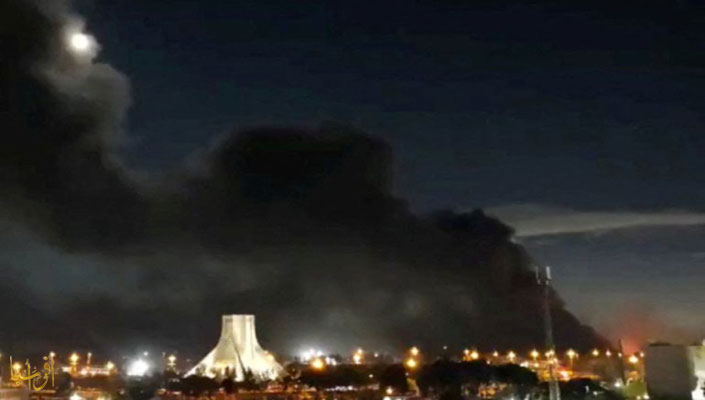
Afrasianet - Mazen Al Najjar - Days after the war in Ukraine enters its fifth year, the United States and Israel have launched massive air strikes on Iran to kick off the war that is now underway. While experts were busy diagnosing the nature of the conflict, the goals and outcomes of the parties, some looked at the strategies of the conflicting parties, the patterns of war, and the definition of victory and loss by the parties.
It has been noted that Iran has established a decentralized and symmetrical defense system for decades to prevent a rapid collapse and impose a costly and protracted war on its enemies, maintain a continuous ability to respond beyond a retaliatory strike, and determine when and how the war will end.
This "mosaic" defense system is synergized with the strategy of disrupting the regional and international order, which represents a structural basis that supports its opponents and thwarts their goals.
Two different wars
But what distinguishes the current confrontation between the two sides is not just the scope of violence or geopolitical risks; it is more central and confusing: the two sides are fighting two different types of wars.
The United States is engaged in a military "war of destruction of materiel," where targets are identified, struck, strike assessed, launch pads destroyed, weapons factories are targeted, and commanders are killed. Its metrics are familiar: intensive sorties, defensive capabilities are disrupted, capabilities are reduced. It's a war of visual objects, which can be counted, tracked, and displayed in briefings.
But the opposing side of the conflict is performing differently, not winning a conventional military competition, matching U.S. firepower, or dominating the battlefield analogically. Rather, it seeks something else: to disrupt the regional and international order behind the adversary's hypotheses, premises, and equations.
The U.S. values success by meaningful measures in a different kind of war, in which victory depends on a clear depletion of the enemy's conventional capabilities.
This is what the University of Chicago political scientist Robert Bibb means by the Vietnam War "death count fallacy." U.S. leaders reported increasing numbers of enemy deaths, as if the accumulation of dead bodies would eventually translate into a strategic victory that did not occur.. Vietnam was fighting another war, where resilience, renewal, and will were more important than battle losses.
There is a possibility that something similar is happening now. When U.S. commanders point to the destruction of 90 percent of missile platforms, and the destruction of large parts of the Iranian navy, they are not always wrong; they are measurable targets.
But the Irish scholar Dylan Evans asks: Are these metrics and targets accurate in evaluating? If the actual conflict revolves around imposing costs on the global system — disrupting the flow of energy, fertilizers, and helium, raising prices, and choking markets to generate political pressure — these standards are meaningless.
Strength Feasibility
The importance of this distinction lies in the fact that it defines the essence of the strategy itself; it is not just a question of the effective application of force, but that military action be aligned with an ultimate political goal that force can achieve: the so-called "force effect," as General Robert Smith brilliantly described it in his book The Feasibility of Force. It is about understanding the nature of the ongoing conflict, what counts as a win, and what counts as a loss.
According to Bibb's explanation, America now risks having tactics without a strategy, including "shock and intimidation." It is adept at hitting targets, but it is not certain that goals are linked to a political achievement.
Political scientists John Mearsheimer and Paul Grenier argue that the dispersion of the adversary's center of gravity in society and geography loses its decisiveness.
In Vietnam and Afghanistan, decentralization has made vivability a driving force to prevent collapse. It is who survives the first shock that sets the political course of the war. In Vietnam, survival has become a driving political force. In Afghanistan, resilience has finally led to the restoration of power.
For the weaker side, the conflict should be transformed from a decisive conflict into a protracted one, from a military conflict to a political one, and from an eradication struggle to a conflict of attrition, while the strategic culture of America and Israel favors rapid and intense campaigns, which constitutes a structural dilemma. The longer the war drags, the more influential variables are: world markets, regional escalation, domestic politics, alliance cohesion, and they begin to affect the ongoing conflict.
But can technologically advanced militaries achieve decisive results against an adversary that rejects centralization?
The success of this bet depends on variables that are not fully controlled by the parties to the conflict: the dynamics of escalation, regional alliances, economic flexibility, and political will. Structurally, the main lesson of America's wars in the present and past centuries has been this: the most dangerous enemy is not the one who wins the first battle, but who survives it.
Employing power
Against this backdrop, Norwegian scholar and former diplomat Jo-Inge Beckefold revisits long-standing debates about how to use military force to achieve strategic goals; accurately measure and judge military power; and factors other than military power that influence the outcome of a war.
Therefore, Phillips Payson O'Brien's book, out of October 2025, is a valuable contribution to this debate. In his book "War and Power: Who Wins Wars – and Why?" O'Brien, a professor of strategic studies at the University of St Andrews in Scotland, says the outcome of the war could already be influenced by factors beyond arms, air power and troop numbers. A more comprehensive approach to measuring military power better understands who wins wars and why, and even deters States from going to war.
The book was published before the recent war on Iran, but given O'Brien's stance on America's attempts at regime change in Iraq and Afghanistan, it is likely that he would have advised Washington not to do so in Iran. The book concludes with a stern warning to Beijing and Washington against igniting a catastrophic war based on misconceptions about their military capabilities.
The theme of war and power has several main aspects:
O'Brien criticizes the inability of governments, intelligence and academia to assess military power and predict the outcome of war. Given the complexity of the factors at play, wars rarely go according to plan, often derail, and last much longer than the aggressor expects.
One of the fundamental problems of war analysis is the tendency to focus on battles, while wars reveal a much broader and more complex context than individual battles or aerial bombing campaigns.
This is not new. The Prussian military commander, Helmut von Moltke, stated in the 1880s: "There is no plan that can withstand the first encounter with the enemy."
It is a firm acknowledgement that European military strategy shifted from a focus on battles to a more comprehensive vision during the Napoleonic Wars. In China, a broad strategic understanding of war is evident in classic texts written 2,500 years ago. The wars of Putin and Trump clearly demonstrate the need for military planners and decision-makers to be constantly reminded of the complexity of war.
Overall Power
O'Brien believes that the danger of analyzing the failure to predict the outcome of a war is exacerbated by the neglect of social and political factors, such as the country's political system, leadership, social fabric, and willingness to fight.
Armies are the product of the total power of the state. Military power is only beyond the strength of available economic and technological resources, the political and military leadership that guides it, and the broader society that serves it. But he worries that analysts continue to neglect these variables when assessing military strength.
O'Brien blames the realist school of international relations—and its obsession with hard power and military factors—for the flawed methodology used by analysts and academics to measure military power. He is highly critical of realism's tendency to use the theory of the balance of power in a deterministic way.
Although it is incapable of assessing only material capabilities to measure military power, it is more dangerous to base assumptions about power and war on non-material factors, or the whims of political leaders.
Of all the factors that determine a state's ability to fight war, hard power is the absolute most important. It may not be enough to win a war, but it is impossible to fight without it.
O'Brien emphasizes the failure of realism to define a superpower, and proposes the concept of "all-encompassing power" as an alternative. Western analysts also criticize contemporary Russia as a great power and that Ukraine was doomed to failure.
The term "all-out power" is a useful measure of the full range of a state's military and other capabilities, from hybrid warfare tools to conventional and unconventional platforms. However, rather than developing new concepts, research requires careful use of established concepts such as great power, great power, and second-tier power.
Regarding the current war, O'Brien is highly critical of America's failed and repeated attempts at regime change. He sees the invasion of Iraq in 2003 as a strategic disaster, as chaos has pervaded the region and anti-American hostility has engulfed the Muslim world.
O'Brien considers the two-decade war and regime-change efforts in Afghanistan to be a dismal failure, and the U.S.-established government did not hold up hours after the withdrawal of U.S. troops. History shows how difficult it is to win the hearts and minds of a people by invading them militarily.
O'Brien distinguishes between battles and wars. In contrast to Russia's war of attrition in the trenches and towns of Ukraine, the U.S.-China conflict is likely to be a limited naval war, closer to what is considered a battle.
He concludes from the complexities of war that decision-makers must rely on a variety of sources and experts before making a final decision to go to war, and O'Brien raises troubling questions about the rarity of war. Leaders rarely have complete information. He discusses at length the consequences of providing leaders with only the information they want to hear.
Mazen Al , Najjar - Researcher in History and Sociology
Dr. Mazen Al-Najjar is an academic specializing in industrial management and production systems, and a writer, researcher, and translator in the fields of thought, history, and sociology, with a special interest in settlement studies, the Old Testament, American studies, and biblical (Old Testament).
He has been practicing writing, translation, and academic and journalistic editing, in Arabic and English, since 1980.
He has co-founded and produced a number of intellectual and academic journals, and participated in the scientific review and evaluation of a number of them. He has published hundreds of articles, studies, book presentations, and reports in newspapers, websites, and magazines on a weekly or daily basis.
