
Afrasianet - Trump's speech was neither a declaration of victory nor an exit plan, but a confusing jumble of threats and compromises, exposing the lack of a clear vision and deepening the crisis of internal legitimacy.
At the height of a crisis-ridden administration, more than a month after the ongoing war against Iran, US President Donald Trump's rhetoric was expected to outline a clear strategy that would reassure anxious markets and reassert its domestic legitimacy.
But what appeared on the screen was not a victory speech or even a crisis management rhetoric, but rather a confusing mix of escalating threats and hesitant compromises, from a claim to get the job done to a tacit acknowledgment of the inability to finish it.
The most striking feature of the speech was the ambiguity surrounding the issue of getting out of the war. While the president insisted that "the job is coming to an end," he has completely refused to provide any clear timeline or milestones on which the public can gauge whether the end is really near.
This kind of rhetoric is not new to Trump, but at this particular point it carries double risks. On the one hand, he seems to be trying to buy time, and on the other hand, he is sending conflicting messages to all sides: His repeated threats of "destruction you have never seen before" come in the same sentence in which he calls for "a return to the negotiating table in good faith."
This contradiction has become a consistent pattern in Trump's administration of this war. The result is clear: Financial markets, which deal more with certainty than with threats, have lost faith in any signals coming from the White House. As for Americans' own confidence, according to recent polls, more than 60 percent of voters believe the Trump administration lacks a clear strategy for dealing with Iran.
When the president is unable to answer a simple question like, "When will the war end?" , it gives its domestic adversaries a new tool to dismantle its legitimacy.
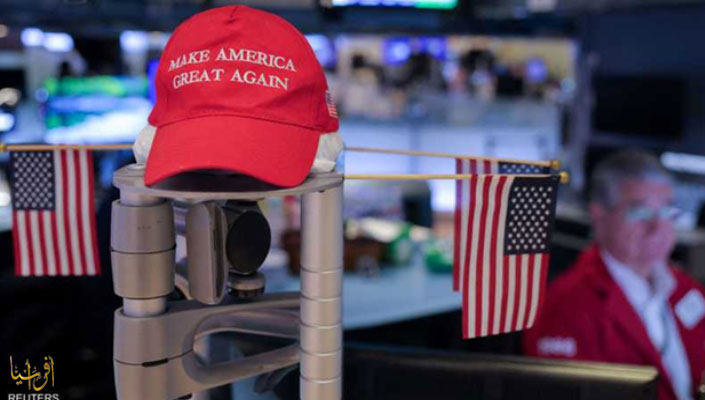
As markets search for certainty, Trump has made do with contradictory messages about the end of the war, adding to the confusion at home and making his allies lose confidence in Washington.
If there is one file that combines the geopolitical challenge with the daily suffering of Americans, it is certainly the Strait of Hormuz crisis. It has become clear to everyone that Iran is using its partial control of this vital waterway as a strategic pressure card, which has been reflected directly on global oil prices, and thus on fuel prices at U.S. gas stations.
But what was truly surprising about Trump's speech was the way he handled the issue: Instead of explicitly declaring that Washington would take direct action to open the strait, he blamed oil-importing countries, calling on them to "shoulder the burden of protecting their energy corridors."
This stance has left Washington's allies stunned. Western countries, especially European ones, have been betting that Washington will remain the security guarantor of freedom of navigation in the region, as it has been for decades. Gulf allies, on the other hand, felt as if a hidden message was being sent to them: "You are now alone in confronting Tehran."
This reading was not exaggerated, but was reinforced by Trump's earlier statements about his desire to "reduce the U.S. military presence in the Middle East." The immediate result: Fears mount that the current war is just the beginning of a new phase of regional instability, without a reliable U.S. partner.
Perhaps the most controversial claim in Trump's speech is that he declared, implicitly though not explicitly, that the strategic goals of the war had been achieved.
The second goal, which is to weaken and deter Iran's military capabilities, is that Iran did not emerge defeated from this war. It is true that it has received painful blows, but its ability to respond, whether through its proxies in the region or through its long-range missiles, is still there and may even become more radicalized. History teaches us that targeting the leaders of a regime, as has happened recently, rarely changes the nature of that regime.
The result is often the opposite: Increasing internal cohesion, stripping the new leadership of any incentives for compromise, and strengthening the rhetoric of resistance.
This decline in media performance is a dangerous indicator of the president's own condition. Everyone knows that Trump has always relied on his strong media presence as a secret weapon to compensate for his political weaknesses.
If we add to this that Trump has not provided any concrete evidence that Iran has halted its activities in the region, we are faced with one inescapable conclusion: the war has not achieved its stated goals, and the US president is either misleading the public or misleading himself.
Beyond the battlefields of the Middle East, there is another battle Trump is fighting on the home front, one that he appears to be clearly losing.
His latest speech, though it came at a time when Americans were looking for reassurance and national unity, failed to achieve any of these goals. Rather than declare victory or even announce a clear exit plan, he delivered a confused speech that made the average American feel that there was no end in sight to this war, and that its economic costs Humanity will continue to accumulate.
Perhaps what surprised observers most was Trump's own lackluster media performance. The man, who was known for his impassioned speeches that filled the squares and his powerful sentences that dig into memory, this time seemed to be reading a text he didn't believe.
The usual enthusiasm was gone, and the confrontational style that made him a TV star before he became president was gone. Trump seemed tired, repeating his points without adding anything new to them, as if he wanted to end the speech as quickly as possible.
This decline in media performance is a dangerous indicator of the president's own condition. Everyone knows that Trump has always relied on his strong media presence as a secret weapon to compensate for his political weaknesses. When that presence fades, the president remains naked in front of his critics, unable to redirect the narrative in his favor.
The result: a speech that did not excite the masses, did not convince the hesitant, and did not deter opponents. All he did was assure those who were still skeptical, that this administration was in a double crisis: A strategic crisis abroad, and a crisis of legitimacy at home.
Open-ended policy
Trump's recent rhetoric has reproduced the policy of open ends, a combination of threats and hesitant statements that leaves wars with no clear end and deepens regional and international chaos.
In the world of U.S. foreign policy, there is a recurring pattern that transcends administrations and generations, which can be called "open-ended politics." This pattern means not only failing to achieve temporary goals, but also not being able to end conflicts once and for all—but also unwillingly doing so—leaving behind decades of protracted political, economic, and security vacuums.
President Donald Trump's recent speech on the war on Iran provides a vivid and disturbing example of this pattern. Military or drawing up a coherent exit plan, the rhetoric left the door wide open for chaos, with a mix of escalating threats and hesitant diplomatic hints, reflecting the continuation of a long-standing U.S. policy that has become a hallmark of U.S. interventions around the world.
Trump's speech is no exception to the career of a president known for his controversial statements, but a new episode in a long line of presidential speeches that have tried, and failed, to craft a convincing end to America's endless wars.
To understand what is happening today, we have to step back a bit, to those bloody imprints left by the U.S. military in distant lands, and to those phrases repeated by American presidents before Trump, promising victory, withdrawal, or "end of the mission," while the fire was still burning.
From Vietnam to Afghanistan, Iraq, Libya, and Syria, America's open ends are repeated; inconclusive withdrawals, political vacuums, and protracted crises that are left to worsen over generations
Vietnam was the first and most painful lesson. America fought a war that lasted nearly two decades, ending it not with a military victory, but with a shameful withdrawal from the roof of the embassy in Saigon, and helicopter images of the last diplomats being left to their fate.
The end was open in the harshest sense: no one declared victory, no one conceded defeat, only the Americans left, leaving behind a political vacuum filled with civil wars and mass camps.
Cuba provided another example, where the Bay of Pigs invasion failed, and then the island became an open wound in the American body for decades, with blockades and sanctions that never achieved their goals.
Afghanistan was the longest play: Twenty years of war, $2,300 billion spent, and thousands of soldiers killed, all ended with the Taliban returning to power as if nothing had happened, and former President Joe Biden later announced that "mission accomplished" as U.S. planes left Kabul, leaving billions of dollars of weapons behind. Iraq, a country that was devastated by two American wars, did not witness a decisive end, but rather a hasty withdrawal in 2011 followed by the return of American forces years later under the pretense of confronting ISIS, and then remaining open without a clear strategy.
Libya and Syria completed the picture: quick interventions, ambiguous targets, and endings in which the Americans left the theater of operations before things settled down, leaving behind creative chaos in the literal sense, and political vacuums filled with extremists and proxy wars.
Trump's recent rhetoric has reproduced this pattern with unfortunate subtlety. On the one hand, he has made escalating threats of "destruction you've never seen before," trying to restore the prestige of American deterrence that has been damaged after decades of shameful ends.
On the other hand, he has made hesitant compromises, calling for a return to the negotiating table as if nothing had happened. He declared that the mission was "nearing its end," but he refused to provide any timetable or any clear roadmap for an exit.
He said that Iran had been deterred, but he did not provide a single proof that its nuclear or missile capabilities had been destroyed.
This sharp contrast between the declaration of imminent victory and the tacit acknowledgment of the inability to end the war has confused financial markets looking for certainty, confused allies seeking leadership, and confused the American public seeking reassurance.
The result was Familiar: A speech that is not fundamentally different from Nixon's speeches in Vietnam, George W. Bush in Iraq, or Obama in Afghanistan. They all promised ends, and they all left the ends open.
On the geopolitical level, the impact of this ambiguity has been catastrophic. In the Strait of Hormuz, the vital corridor through which a large proportion of the world's oil supply passes, Trump surprised everyone by shifting responsibility. Instead of explicitly declaring that the United States would use its military power to open the strait, he blamed oil-importing countries for this, calling on them to shoulder the burden of protecting their energy corridors.
This position, which could be described as an "American resignation" from the United States' traditional role as the world's policeman, left the allies Westerners and Gulf people are stunned. Europe, which relies heavily on Gulf oil, suddenly realized that the shadow of the U.S. security umbrella was no longer the same.
The Gulf states, Washington's traditional ally, felt the implicit message that "you are alone now." The direct result is a decline in confidence in Washington as a guarantor of regional security, and mounting fears that the region is entering a new phase of instability, with no party capable or willing to control its pace.
Domestically, the failure was even more painful for Trump himself. His speech did not succeed in reassuring Americans, nor in restoring his popularity, which has fallen to its lowest levels, with his approval rating not exceeding 38 percent in the latest polls. But more telling than the numbers is the lackluster media performance of the president himself. After his enthusiastic speeches in front of the crowds and his words tickle the emotions of the audience, this time he seemed to be reading a text that was strange to him, and his tone disappeared The confrontation that characterized his speeches, and the president, who used his media presence as a secret weapon to compensate for his political weaknesses, turned into an ordinary man repeating empty words.
This performance decline is not a minor detail, but rather the essence of the crisis. Because when Trump loses his ability to dazzle, he loses his last weapon in the battle for domestic legitimacy. The end result is a twofold crisis: a strategic crisis abroad, where there is no clear end to the war, and a crisis of legitimacy at home, where no president is able to convince his people that he knows what he is doing.
Trump's rhetoric is no exception in the history of the U.S. presidency, but rather a tragic continuation of a policy of leaving endings open. From Vietnam to Iran, through Afghanistan, Iraq, Libya and Syria, Washington seems to suffer from a chronic inability to forge clear ends to the wars it initiates.
The question that arises urgently: Is this a conscious strategy, a kind of "creative chaos" through which America wants to keep its adversaries in a perpetual state of confusion? War, inability to admit defeat, inability to emerge with dignity from endless quagmires?
Perhaps the truth is as it often is: a combination of the two, some intent and some impotence, with a heavy dose of arrogance that prevents serious policy review.
But the most important question for the reader, for the American citizen, and for the world at large: How long will these open ends last? How much will humanity pay for a policy that considers war as a game without end, and chaos as a means without a goal? The movies end, and the wars should have ended, but it seems that in Washington, not a single reader has read the script to the end.
These open endings are like Hollywood movies that leave the viewer hanging, not knowing if the hero will win or be defeated, just a white screen and the words "follow."
But the difference is that Hollywood movies end after two hours, while America's wars span generations. It is also similar to the concept of "creative chaos" promoted by some theorists, where the goal is not to build a stable new order, but to tear down the old and leave everyone floundering in a vacuum. The problem is that creative chaos creates, above all, chaos, and it is rarely creative for anyone except arms dealers.
