
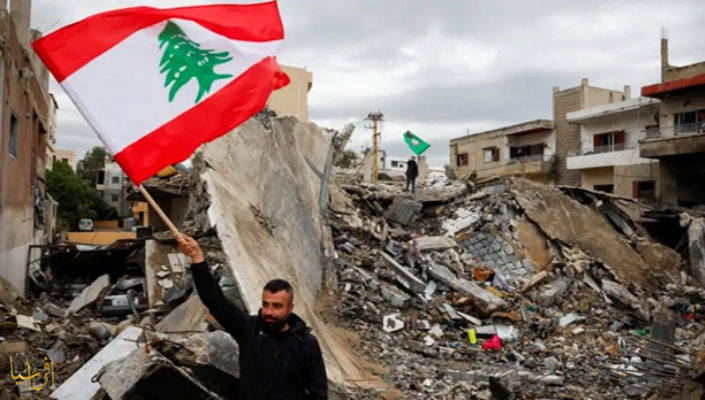
Afrasianet - Khader Raslan - Is it really necessary to stop the Israeli aggression, or to reformulate the balance of power in Lebanon in a way that serves Israeli interests and redraws the equations inside Lebanon?
The disagreement today is not about a technical item in ongoing negotiations, nor about the mechanism of deploying forces here or there, but about the definition of Lebanon itself, its role and the limits of its sovereignty.
The more proposals under the banner of the truce advance, the deeper and more dangerous a question comes to the fore: Is it really necessary to stop the Israeli aggression, or to reformulate the balance of power in Lebanon in a way that serves Israeli interests and redraws the equations inside Lebanon?
Anyone who reads the course of the negotiations will notice that the priority is not given to stopping Israeli aggressions, ending the occupation, or freeing the prisoners and returning the people to their villages, as much as it is given to the file of the weapons of resistance as the obligatory entrance to any future settlement. This is the essence of the dilemma.
When the party that is targeted on a daily basis is asked to give up its elements of power in advance, while the aggressor retains freedom of movement, pressure and threats, it is no longer a matter of a balanced settlement, but of trying to impose new political realities under the weight of the war and its consequences.
What is striking is that what is happening is being marketed to the Lebanese as an opportunity for stability, while large segments fear that it will become a gateway to deepen the internal division and produce new crises.
Issues related to national security and sovereignty cannot be addressed under external pressure or within deadlines imposed by the outside, but through an inclusive national dialogue that is based on Lebanon's interest first, and its natural right to protect its land, people, and sovereignty.
On the other hand, the resistance looks at the scene from a different angle. It considers that the root of the problem lies not in its existence, but in the continuation of the Israeli occupation, aggressions and threats.
In this sense, it rejects the separation between the ceasefire and the cessation of comprehensive aggression, and stresses that any real settlement must begin with a cessation of Israeli aggressions, a complete withdrawal from the occupied Lebanese territories, the return of the people to their villages, the launch of the reconstruction process and the treatment of the prisoners' file.
It believes that any agreement that exceeds these priorities or attempts to replace them with internal political and security conditions will remain fragile and subject to shake at the first field or political test.
The current landscape reveals that Lebanon is at a very sensitive crossroads. There are those who seek to turn the results of the war into lasting political gains, and there are those who insist that the priority must remain to stop the aggression and restore full national rights.
Between these two tracks, a legitimate question arises among a large segment of the Lebanese about the feasibility of official performance at this stage, and about the reasons that push for making commitments or concessions in advance while the aggressions are still continuing, the territory is occupied, and the prisoners are behind bars.
Negotiations are inherently based on the exchange of obligations and rights, not on giving free cards of power to a party that continues to exploit military and political pressure to reap further gains. Therefore, any approach that does not start from establishing national rights first may therefore be interpreted by many as a transition from conflict management to concession management.
The question that imposes itself on all Lebanese remains: If the declared goal is to achieve security and stability, why is the Lebanese force being discussed before ensuring the cessation of aggression and withdrawal from the occupied territory?
What surprises many Lebanese is not only what the enemy wants, but also the ease with which some of its demands can be turned into negotiable items before restoring full national rights.
This is the essence of the real debate: Are we facing a path aimed at protecting Lebanon and restoring its sovereignty, or are we facing an attempt to reshape it according to the scales that the occupation wants to impose in exchange for stopping the war?.
________________

